
Amphetamines
14 PRODUCTS · CLASS OVERVIEW
Reviewed by Tariq Halim, MD · Last medical review: November 12, 2026 · Editorial policy
Overview
- Active ingredients: amphetamine; amphetamine sulfate; dextroamphetamine; dextroamphetamine saccharate, amphetamine aspartate monohydrate, dextroamphetamine sulfate, and amphetamine sulfate; dextroamphetamine saccharate, amphetamine aspartate, dextroamphetamine sulfate, and amphetamine sulfate; dextroamphetamine sulfate; dextroamphetamine sulfate, dextroamphetamine saccharate, amphetamine sulfate, and amphetamine aspartate; lisdexamfetamine dimesylate; methamphetamine hydrochloride.
- DEA schedule: Schedule II controlled substance (CII) (all 14 products).
- Generic available: 10 of 14 (see the table; status from each product’s Orange Book data).
- Forms: Capsule; chewable tablet; Extended-release capsule; Extended-release oral suspension; extended-release tablet; Extended-release orally disintegrating tablet; Oral solution; Orally disintegrating tablet; Sustained-release capsule; Tablet; Transdermal system.
- Status notes: Adderall: shortage listed · sources differ on brand status; Evekeo ODT: discontinued.
How it works
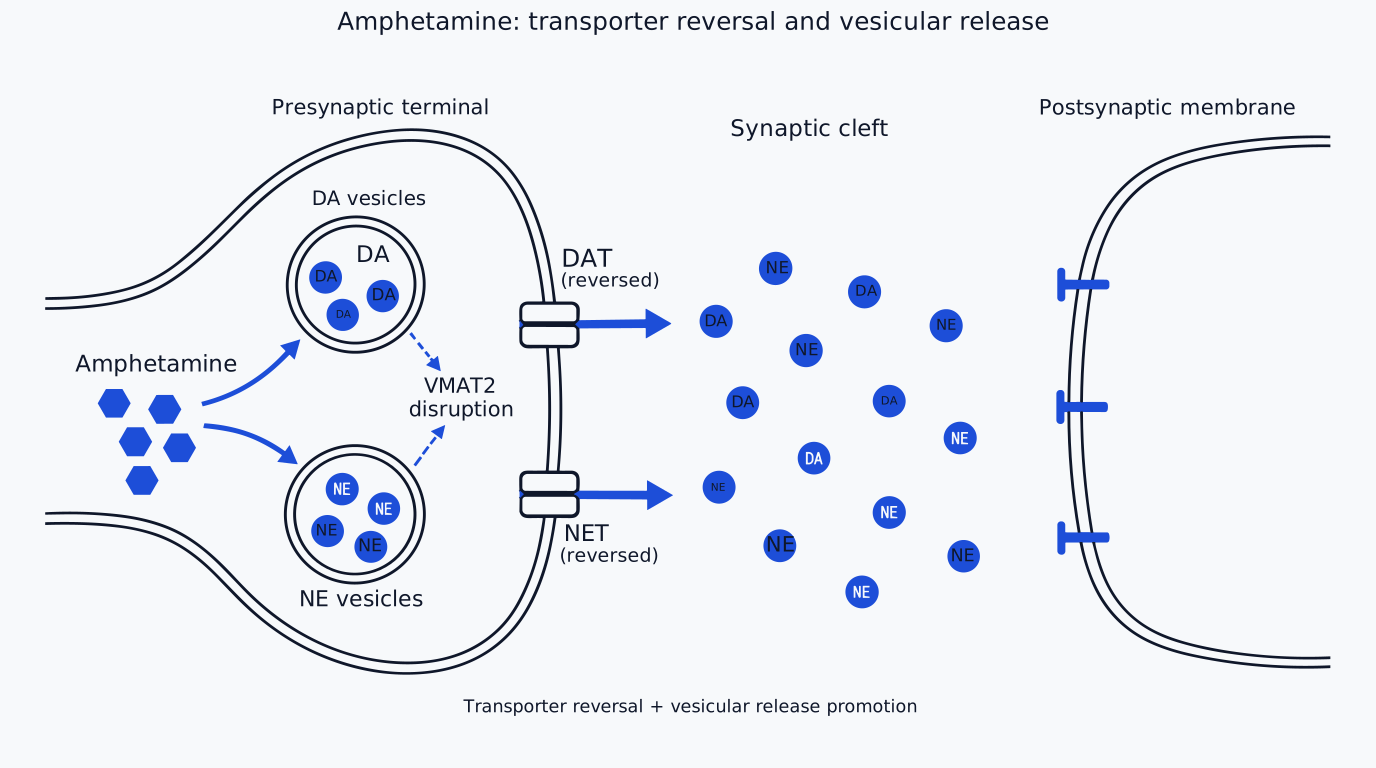
Amphetamine increases the amount of dopamine and norepinephrine available between nerve cells, both by blocking their reuptake and by promoting their release. This supports attention and impulse control.
Mechanism summary reused from the Adderall page (mechanism per its Prescribing Information, revised 05/2024).
Products
Formulation, duration and approved ages as stated on each product page (from its label). Generic: “Yes” means an FDA-approved generic or authorized generic is available.
| Product | Formulation | Duration | Approved ages | Generic |
|---|---|---|---|---|
| Vyvanse | Capsule; chewable tablet | Benefit through 12–13 hours in children and up to 14 hours in adults in label studies. | ADHD: 6 years and older; BED: adults | Yes |
| Adderall XR | Extended-release capsule | Once daily on awakening; the label gives no duration in hours (morning and afternoon benefit in studies; peak about 7 hours). | 6 years and older (children, adolescents, adults) | Yes |
| Xelstrym | Transdermal system | Patch worn up to 9 hours; scores averaged across 1 to 12 hours after application beat placebo in the pediatric study. | 6 years and older (children, adolescents, adults) | No |
| Adderall shortage listed · sources differ on brand status | Tablet | No fixed duration in the label; doses are given 4–6 hours apart (peak about 3 hours). | ADHD: 3 years and older (not recommended under 3); also narcolepsy | Yes |
| Mydayis | Extended-release capsule | Up to 16 hours (label); significant from 2 or 4 hours through 16 hours in adult studies. | 13 years and older (adolescents and adults) | Yes |
| Adzenys XR-ODT | Extended-release orally disintegrating tablet | No fixed duration in the label; peak about 5 hours; matched doses are bioequivalent to Adderall XR. | 6 years and older | Yes |
| Dyanavel XR | Extended-release oral suspension; extended-release tablet | Benefit at every time point from 1 to 13 hours in the label classroom study. | 6 years and older | No |
| Evekeo | Tablet | No single-dose duration in the label; in a classroom study one morning dose helped from about 45 minutes through 10 hours. | ADHD (3 years and older); narcolepsy; exogenous obesity (short-term adjunct, not under 12) | Yes |
| Arynta | Oral solution | Expected to match Vyvanse: benefit through about 12–13 hours in children and up to 14 hours in adults in Vyvanse studies. | ADHD: 6 years and older; BED: adults | No |
| Zenzedi | Tablet | No fixed duration in the label; doses are given 4–6 hours apart (peak about 3 hours). | ADHD ages 3–16; narcolepsy | Yes |
| ProCentra | Oral solution | No fixed duration in the label; doses are given on waking and 4–6 hours apart. | ADHD ages 3–16; narcolepsy | Yes |
| Dexedrine Spansule | Sustained-release capsule | The label states no fixed duration (peak about 8 hours after a 15 mg dose). | ADHD ages 6–16 (not recommended under 6); narcolepsy | Yes |
| Evekeo ODT discontinued | Orally disintegrating tablet | Short-acting; the label gives no duration (an extra dose 4 to 6 hours later if needed). | 6–17 years | No |
| Desoxyn | Tablet | The label gives no duration of effect (half-life 4–5 hours). | ADHD: pediatric patients 6 years and older | Yes |
What published studies show
These findings come from published research, not from the FDA labels. They describe groups of people; they cannot predict how one person will respond. Talk to your prescriber.
- How well they work: reviews of short-term trials found that amphetamines reduce ADHD symptoms more than placebo in children, teens and adults. In the largest comparison of ADHD medicines, amphetamines had the largest short-term effect on clinician ratings, but more people stopped them because of side effects than stopped placebo. Reviewers rated much of the evidence low quality, and no amphetamine product was shown to be better than another.
- Higher doses: extra benefit gets smaller at higher doses while side effects keep rising. Doses above the label maximum (not FDA-approved) gave no clear added benefit for amphetamines.
- Trying the other stimulant family: some people respond better to amphetamine and others to methylphenidate. In small studies, trying both raised the share of children with a good response, and many adults switched families early because of side effects.
- Tics: in placebo-controlled trials, new or worse tics were about as common on stimulants as on placebo, and in children who already had a tic disorder, stimulants did not make tics worse on average.
- Long-term outcomes: large Swedish and US health-record studies linked periods on ADHD medicine to fewer psychiatric hospital stays, suicide attempts, car-crash and substance-related emergency visits, and criminal convictions. These are associations, not proof that the medicine caused them.
- Heart: large health-record studies did not find more heart attacks, strokes or sudden cardiac deaths during ADHD medicine use. The labels’ heart warnings and checks still apply.
- Pregnancy: large studies did not link amphetamine use in pregnancy to autism or ADHD in children once other factors were accounted for. Continuing a stimulant past the first 3 months was linked to a small rise in preeclampsia and preterm birth.
For clinicians: figures and sources
- Efficacy: Cortese 2018 NMA (133 RCTs), clinician-rated SMD vs placebo, amphetamines −1.02 (95% CI −1.19 to −0.85) in children and −0.79 (−0.99 to −0.58) in adults; AE discontinuation OR 2.30 (children) and 3.26 (adults) (PubMed 30097390). Cochrane, children: 23 RCTs, n=2,675, CGI-I responder RR 3.36 (2.48–4.55), low to very low quality (PubMed 26844979). Cochrane, adults: 19 RCTs, n=2,521, clinician-rated SMD −0.90 (−1.04 to −0.75); AE withdrawal RR 2.69 (1.63–4.45); 16 of 19 studies industry funded (PubMed 30091808).
- Dose: incremental benefit fell beyond 20 mg/day amphetamine in fixed-dose pediatric trials (Farhat 2022, 65 RCTs, n=7,877; PubMed 35027679); pediatric efficacy plateaued near 25 mg/day and adult near 50 mg/day (Nourredine 2026, 113 RCTs; PubMed 42134365); adults, unlicensed vs licensed amphetamine doses SMD −0.08 (−0.24 to 0.08), not FDA-approved (Farhat 2024; PubMed 37878348).
- Switching: crossover RCT in 36 medication-naive children 9–14, favourable response 26 (72%) on each stimulant, 33 (92%) when both were tried (Ramtvedt 2013; PubMed 23659360); 41% of 49 adults switched stimulant family within 90 days for tolerability (Biederman 2021; PubMed 33657069).
- Tics: 22 RCTs, n=2,385, new/worse tics 5.7% vs 6.5%, RR 0.99 (0.78–1.27) (Cohen 2015; PubMed 26299294); ADHD + tic disorder NMA, 8 RCTs, stimulants tics SMD −0.22 (−0.49 to 0.05), low to very low certainty (Farhat 2024; PubMed 39320340).
- Outcomes (within-individual, observational): psychiatric hospitalization aHR 0.80 (0.78–0.82) lisdexamphetamine, 0.74 (0.61–0.90) amphetamine; suicidal behaviour 0.76 (0.68–0.84) lisdexamphetamine (Taipale 2024, n=221,714; PubMed 38506810); MVC ED visits OR 0.62 men, 0.58 women (PubMed 28492937); substance-related ED visits OR 0.65 men, 0.69 women (PubMed 28659039); convictions 32% lower in men, 41% in women (PubMed 23171097).
- Heart (class-level): aHR 0.75 (0.31–1.85) in 1,200,438 aged 2–24 (PubMed 22043968); current vs remote use RR 1.03 (0.86–1.24) in adults (PubMed 22161946); heart failure/cardiomyopathy <50 per 10,000 person-years under 45 in 2,012,948 initiators (FDA Sentinel; PubMed 30102629).
- Pregnancy: amphetamine/dextroamphetamine in the second half of pregnancy, autism aHR 0.80 (0.56–1.14), ADHD 1.07 (0.89–1.28) (PubMed 38265792); pooled HR any neurodevelopmental disorder 1.00 (0.83–1.20) (PubMed 40148550); preeclampsia aRR 1.29 (1.11–1.49) with early-pregnancy use and preterm birth 1.30 (1.10–1.55) with continuation (PubMed 29112657); continuation into 2nd/3rd trimester pre-eclampsia RR 1.42, preterm 1.34 (PubMed 41400021).
Each study is summarized, with its limits and funding, in the Clinical evidence section of every amphetamine and lisdexamfetamine product page.
Comparisons and guides
- Vyvanse vs Adderall XR
- Adderall vs Adderall XR
- Concerta vs Vyvanse
- Ritalin vs Adderall
- Stimulants vs Nonstimulants
- All comparisons · Switching guide · Availability tracker · Label update log
Sources
Each product’s current prescribing information, as cited on its page (other sources are listed on each product page):
- Takeda Pharmaceuticals America, Inc. Vyvanse (lisdexamfetamine dimesylate) capsules and chewable tablets, CII. Prescribing Information, revised 04/2026. DailyMed (accessed Oct 2026).
- Takeda Pharmaceuticals America, Inc. Adderall XR (mixed salts of a single-entity amphetamine product) extended-release capsules, CII. Prescribing Information, revised 04/2026. DailyMed (accessed Oct 2026).
- Noven Pharmaceuticals, Inc. Xelstrym (dextroamphetamine) transdermal system, CII. Prescribing Information, revised 09/2025. DailyMed (accessed Oct 2026).
- Teva Pharmaceuticals USA, Inc. Adderall (dextroamphetamine saccharate, amphetamine aspartate, dextroamphetamine sulfate and amphetamine sulfate tablets), CII. Prescribing Information, revised 05/2024 (Rev. O). DailyMed (accessed Oct 2026).
- Takeda Pharmaceuticals America, Inc. Mydayis (mixed salts of a single-entity amphetamine product) extended-release capsules, CII. Prescribing Information, revised 04/2026. DailyMed (accessed Oct 2026).
- Neos Therapeutics Brands, LLC. Adzenys XR-ODT (amphetamine extended-release orally disintegrating tablets), CII. Prescribing Information, revised 09/2025. DailyMed (accessed Oct 2026).
- Tris Pharma, Inc. Dyanavel XR (amphetamine) extended-release oral suspension and extended-release tablets, CII. Prescribing Information, revised 09/2025. DailyMed (accessed Oct 2026).
- Azurity Pharmaceuticals, Inc. Evekeo (amphetamine sulfate tablets, USP), CII. Prescribing Information, revised 06/2025. DailyMed (accessed Oct 2026).
- Azurity Pharmaceuticals, Inc. Arynta (lisdexamfetamine dimesylate) oral solution, CII. Prescribing Information, revised 12/2025. DailyMed (accessed Oct 2026).
- Azurity Pharmaceuticals, Inc. Zenzedi (dextroamphetamine sulfate tablets, USP), CII. Prescribing Information, revised 05/2025. DailyMed (accessed Oct 2026).
- Independence Pharmaceuticals, LLC. ProCentra (dextroamphetamine sulfate) oral solution, CII. Prescribing Information, revised 05/2025. DailyMed (accessed Oct 2026).
- Amneal Pharmaceuticals LLC. Dexedrine Spansule (dextroamphetamine sulfate) sustained-release capsules, CII. Prescribing Information, revised 09/2025. DailyMed (accessed Oct 2026).
- Arbor Pharmaceuticals, LLC. Evekeo ODT (amphetamine sulfate) orally disintegrating tablets, CII. Prescribing Information, revised 10/2023. Drugs@FDA (accessed Oct 2026).
- Ajenat Pharmaceuticals, LLC. Desoxyn (methamphetamine hydrochloride tablets), CII. Prescribing Information, revised 09/2024. Drugs@FDA (accessed Oct 2026).