
Nonstimulants
6 PRODUCTS · CLASS OVERVIEW
Reviewed by Tariq Halim, MD · Last medical review: November 12, 2026 · Editorial policy
Overview
- Active ingredients: atomoxetine; clonidine; guanfacine; viloxazine.
- DEA schedule: Not a controlled substance (all 6 products).
- Generic available: 4 of 6 (see the table; status from each product’s Orange Book data).
- Forms: Capsule; Extended-release capsule; Extended-release oral suspension; Extended-release tablet; Oral solution.
- Status notes: Atomoxetine: brand discontinued; Kapvay: brand discontinued.
How it works
Atomoxetine
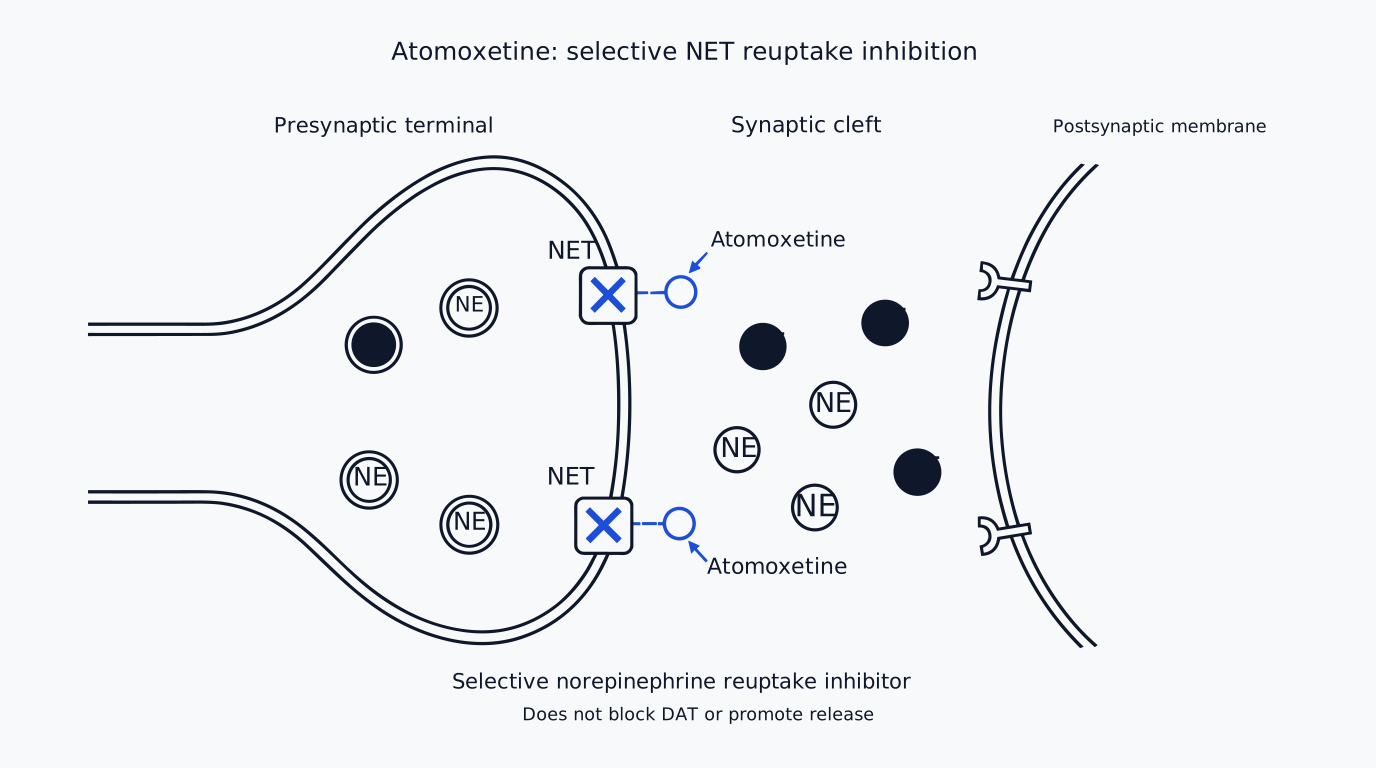
Atomoxetine blocks the norepinephrine transporter, so more norepinephrine stays available between nerve cells in brain networks involved in attention and impulse control. It does not release dopamine or norepinephrine the way stimulants do.
Viloxazine
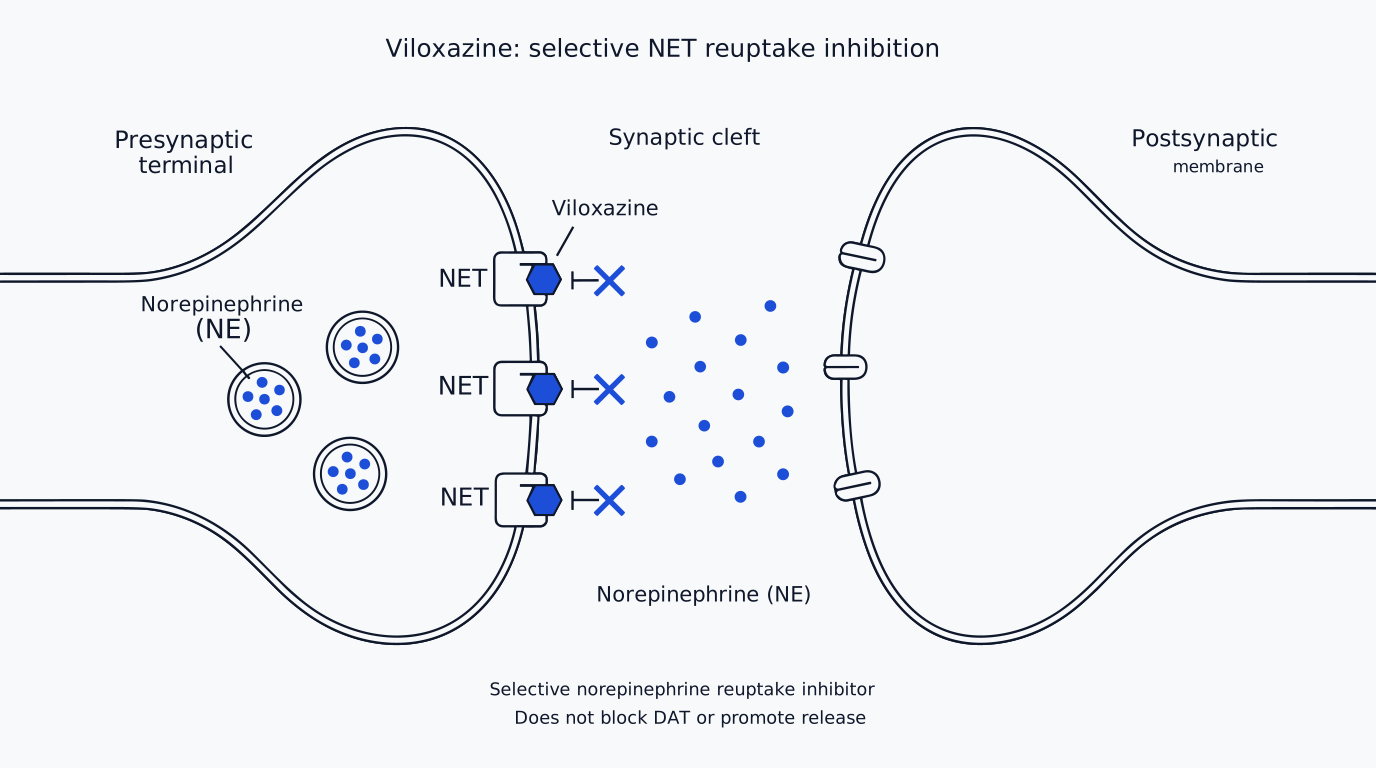
Viloxazine blocks the norepinephrine transporter, so more norepinephrine stays available between nerve cells. It also acts on one type of serotonin receptor (5-HT2C). It does not release dopamine or norepinephrine like stimulants do.
Guanfacine
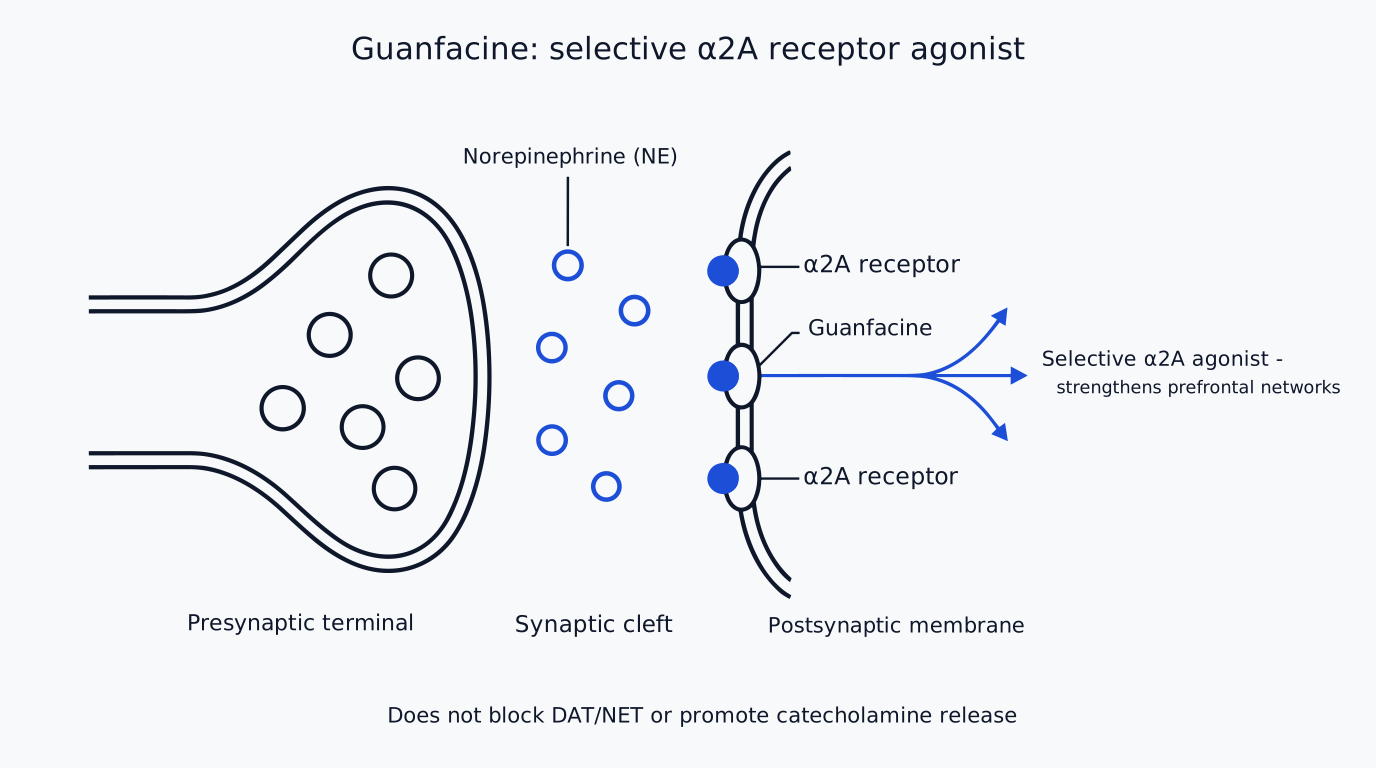
Guanfacine stimulates alpha-2A receptors in the brain. It is not a stimulant and does not block dopamine or norepinephrine transporters. The same action lowers blood pressure and heart rate, which is why those are monitored.
Clonidine
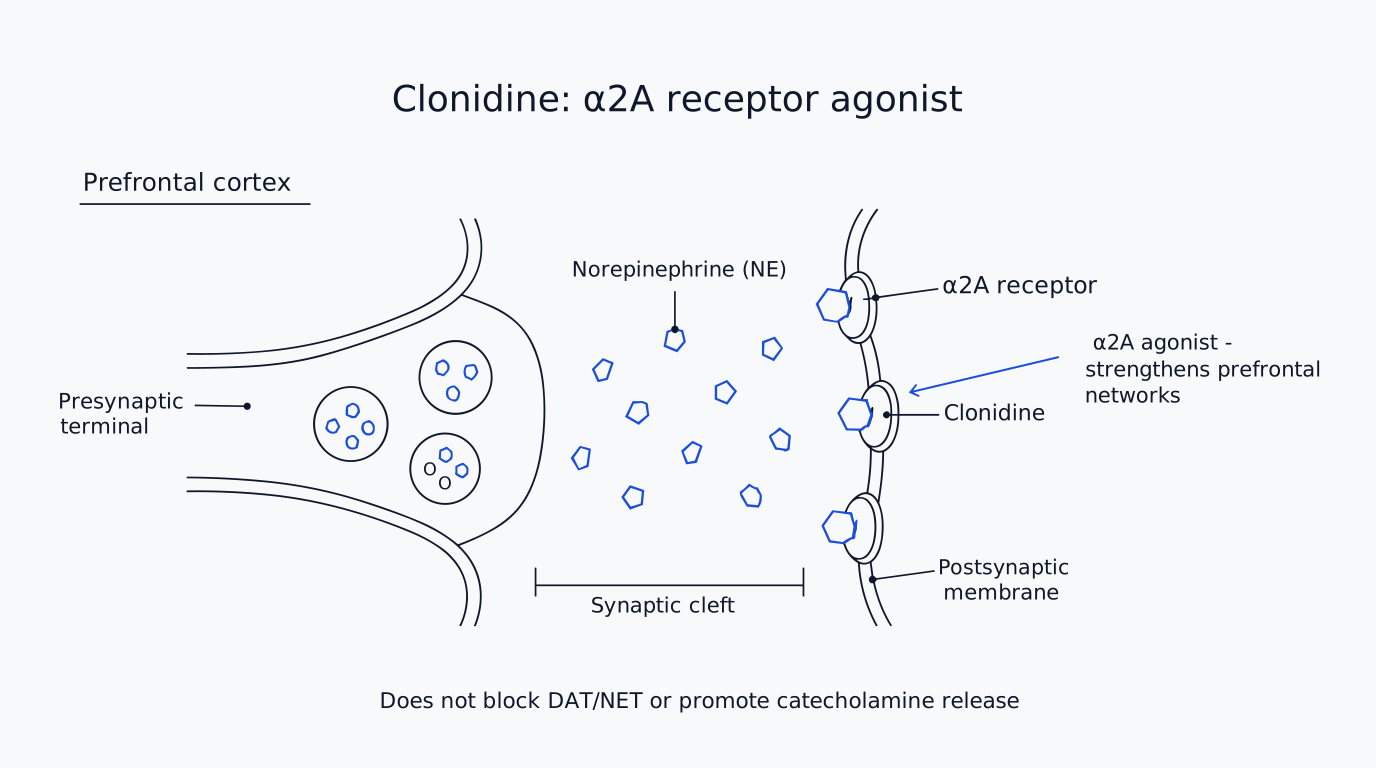
Clonidine stimulates alpha-2 receptors in the brain. It is not a stimulant and does not block dopamine or norepinephrine transporters. The same action lowers blood pressure and heart rate, which is why those are monitored.
Mechanism summary reused from the Atomoxetine page (mechanism per its Prescribing Information, revised 06/2026), Qelbree page (mechanism per its Prescribing Information, revised 01/2025), Intuniv page (mechanism per its Prescribing Information, revised 06/2025), Kapvay page (mechanism per its Prescribing Information, revised 10/2025).
Products
Formulation, duration and approved ages as stated on each product page (from its label). Generic: “Yes” means an FDA-approved generic or authorized generic is available.
| Product | Formulation | Duration | Approved ages | Generic |
|---|---|---|---|---|
| Qelbree | Extended-release capsule | Taken once daily, every day; the label does not describe hour-by-hour effects (benefit measured after 6–8 weeks). | 6 years and older, and adults | No |
| Atomoxetine brand discontinued | Capsule | Taken every day; the labels do not describe an hour-by-hour effect (benefit measured after weeks of treatment). | 6 years and older, and adults | Yes |
| Intuniv | Extended-release tablet | Taken once daily, every day; the label does not describe hour-by-hour effects (half-life about 18 hours). | 6–17 years (monotherapy or adjunct to a stimulant) | Yes |
| Kapvay brand discontinued | Extended-release tablet | Taken twice daily, every day; the label does not describe hour-by-hour effects (half-life about 12–13 hours). | 6–17 years (monotherapy or adjunct to a stimulant) | Yes |
| Onyda XR | Extended-release oral suspension | Taken once daily at bedtime; the label does not describe hour-by-hour effects. | 6 years and older (monotherapy or adjunct to a CNS stimulant) | No |
| Atoncy | Oral solution | Taken every day; the label does not describe an hour-by-hour effect (benefit was measured after weeks of daily treatment). | 6 years and older, and adults | Yes |
What published studies show
These findings come from published research, not from the FDA labels. They describe groups of people; they cannot predict how one person will respond. Talk to your prescriber.
- How well they work in adults: a review of adult trials found that atomoxetine and guanfacine reduced ADHD symptoms more than placebo. Guanfacine is not FDA-approved for ADHD in adults in the United States.
- Guanfacine response: a review of guanfacine trials found that people on guanfacine were more likely than those on placebo to be rated much or very much improved (about 1.8 times the response rate). The review pooled guanfacine trials and did not report Intuniv separately.
- Time of day (atomoxetine): taking atomoxetine in the morning or in the evening both helped ADHD symptoms more than placebo. Morning dosing was better on some measures of how well it worked; evening dosing was easier to tolerate.
- Preschool children (not FDA-approved under age 6): in an 8-week trial of 5- and 6-year-olds, atomoxetine helped more children than placebo, but the difference was not statistically significant, and most children on atomoxetine were still at least moderately ill at the end. In a clinic records study, preschoolers started on an alpha-2 agonist (guanfacine or clonidine) or a stimulant often improved; sleepiness was more common on the alpha-2 agonists and appetite loss was more common on stimulants. None of these medicines is FDA-approved for ADHD under age 6.
- Atomoxetine levels: people whose CYP2D6 liver enzyme works more slowly can have much higher blood levels of atomoxetine. A clinic study found about twice as much medicine in “intermediate” metabolizers and about ten times as much in “poor” metabolizers, compared with “normal” metabolizers. The labels already tell prescribers to go more slowly in those cases.
- Suicidality (observational): two large health-record studies did not find a clearly higher risk of suicidal events on atomoxetine than on stimulants, but the estimates were imprecise. The labels’ boxed warning still applies.
- Qelbree 400 and 600 mg: in a trial of 297 adolescents, the 400 mg dose improved ADHD symptoms more than placebo, but the 600 mg dose did not reach statistical significance, and because of the way the doses were tested in sequence, neither dose could be officially called superior to placebo. The authors pointed to a high placebo response.
- Qelbree and other medicines or liver disease: taken with caffeine, Qelbree greatly increased caffeine exposure (about four- to six-fold). In people with mild, moderate or severe liver impairment, average Qelbree exposure stayed within about 25% of matched controls, though the medicine stayed in the body longer when liver disease was moderate or severe. The label already warns about CYP1A2 interactions; it does not give a special liver-dose table.
- Add-on Qelbree (not FDA-approved): an open-label study of Qelbree added to a stimulant reported further symptom improvement, with few people stopping because of side effects. Combining Qelbree with a stimulant is not an FDA-approved use.
- Keeping guanfacine going: in children and teens who were already doing well on guanfacine, those who stayed on it were less likely to relapse over 26 weeks than those switched to placebo.
- Pregnancy and breastfeeding (atomoxetine): a large multinational study did not find more major birth defects overall after atomoxetine in early pregnancy. A combined analysis did not find a higher rate of developmental disorders in children exposed before birth. A small milk study found only a very small amount of atomoxetine in breast milk.
For clinicians: figures and sources
- Adult nonstimulant efficacy (Radonjić 2023, 18 studies, 4,308 participants; PubMed 37166701): atomoxetine (15 RCTs) Hedges’ g = −0.48 (95% CI −0.64 to −0.33); guanfacine (two RCTs) g = −0.66 (−0.94 to −0.38); viloxazine ER (one RCT) also favored the drug vs placebo. Guanfacine is not FDA-approved for ADHD in adults in the US. Figures are for the class as analyzed; they were not reported separately by US brand.
- Guanfacine CGI-I response: Yu S 2023, 12 RCTs, 2,653 participants, RR 1.78 (95% CI 1.59–2.01) for CGI-I ≤2 (PubMed 36944092). This review pooled guanfacine trials; it did not report Intuniv separately. Do not cite the 59.8% vs 34.0% or 9.3% vs 1.9% figures from secondary sources; they are not in this abstract.
- Atomoxetine morning vs evening (Block 2009; PubMed 19420182): 3-arm RCT, morning atomoxetine n=102, evening n=93, placebo n=93, about 6 weeks; both active arms beat placebo; morning dosing was superior on some efficacy measures; evening dosing showed greater tolerability (more patients on morning dosing reported at least one adverse event). The total N=288 is not stated in the abstract; arm sizes are.
- Preschool atomoxetine (Kratochvil 2011; PubMed 21422081), not FDA-approved under 6: 8-week RCT in 101 children aged 5 and 6 years; CGI-I response 40% vs 22% placebo (not significant); 62% of children on atomoxetine were still moderately, markedly, or severely ill at endpoint.
- Preschool alpha-2 agonists vs stimulants (Harstad 2021; PubMed 33946100), not FDA-approved under 6, observational: 497 preschool-age children (median age 62 months at initiation); improvement reported in 66% (57.5–73.9%) on an α2-adrenergic agonist vs 78% (72.4–83.4%) on a stimulant; daytime sleepiness 38% vs 3%; appetite suppression 38% vs 7% (stimulants higher). The study did not report guanfacine or clonidine separately.
- CYP2D6/CYP2C19 (Smith 2023, therapeutic-drug-monitoring cohort n=315; PubMed 36851891): CYP2D6 IM and PM exposure 1.9-fold (1.4–2.7) and 9.6-fold (5.9–16) vs NM; CYP2C19*2 carriers 1.5-fold (1.1–2.2) regardless of CYP2D6 genotype.
- Suicidality, observational: Davies 2017, n=4,509, RR 0.71 (95% CI 0.48–1.07) for atomoxetine vs stimulants (PubMed 27810613); Linden 2016, first-line cohort n=279,315, aHR 0.95 (0.47–1.92) and second-line n=220,215, aHR 0.71 (0.30–1.67) for current atomoxetine vs current stimulant (PubMed 27244795). Wide intervals; the boxed warning is unchanged. The first-line N is 279,315, not 297,315.
- Viloxazine ER 400/600 mg in adolescents (Nasser 2021, N=297; PubMed 34092822, not PMID 34181360): ADHD-RS-5 CFB −18.3, −16.7 and −13.2 (400 mg, 600 mg, placebo); 400 mg p=0.0082, 600 mg p=0.0712; because of sequential testing, neither dose could be considered superior to placebo; the authors attributed the 600 mg result to an unusually high placebo response. Discontinuation for adverse events <5%.
- CYP1A2: Wang 2024, 37 healthy adults, viloxazine ER 900 mg/day with a Cooperstown cocktail (PubMed 38598106): caffeine AUCt GMR% 436.15 (398.87–476.92) and AUC∞ 583.35 (262.41–1296.80); strong CYP1A2 inhibitor, weak CYP2D6 and CYP3A4 inhibitor.
- Hepatic impairment: Wang 2026, adults with mild, moderate or severe hepatic impairment (n=8 each) vs matched controls (PubMed 42503060): mean viloxazine exposure within 25% of controls; t½ longer in moderate (9.3 vs 6.0 h) and severe (14.2 vs 7.1 h) impairment. The Qelbree label has no hepatic dose adjustment section.
- Growth, open-label: Nasser 2023, z-scores at 12 months in 338 subjects, weight-for-age −0.2 (0.5) and height-for-age −0.14 (1.1) (PubMed 43010278).
- Viloxazine ER add-on to a psychostimulant (Childress 2025; PubMed 40014428), not FDA-approved: phase 4 open-label trial; ADHD-RS change −18.2 ± 10.0 at week 8; 3.6% withdrew because of adverse events. The abstract does not state the enrolled N.
- Guanfacine randomized withdrawal (Newcorn 2016; PubMed 26871297): 316 of 528 entered a 26-week randomized-withdrawal phase; treatment failure 49.3% GXR vs 64.9% placebo (p=0.006).
- Thorough QT (Martin 2015; PubMed 25109412): 83 healthy adults received immediate-release guanfacine 4 mg and 8 mg; QTcNi largest 1-sided 95% UCB through 12 h was 1.94 ms; QTcF had one UCB of 10.34 ms at 12 h after the 8 mg dose (the only bound >10 ms). Neither dose prolonged QT after individualized correction.
- Pregnancy / milk, atomoxetine: Bröms 2023, 368 Nordic and 622 US first-trimester exposures, adjusted PR any major malformation 0.99 (0.74–1.34), cardiac 1.34 (0.86–2.09) (PubMed 36652686); Bang Madsen 2025, pooled HR any neurodevelopmental disorder 1.00 (0.83–1.20) (PubMed 40148550); Yamada 2025, 10 lactating participants, mean RID 0.19%, worst-case 0.65% (PubMed 41427840). Do not cite a pooled N=990; the abstract reports 368 and 622 separately.
Each study is summarized, with its limits and funding, in the Clinical evidence section of the relevant product page (Strattera, Atoncy, Qelbree, Intuniv). Kapvay and Onyda XR were not changed in this update.
Comparisons and guides
- Strattera (atomoxetine) vs Qelbree
- Intuniv vs Kapvay
- Stimulants vs Nonstimulants
- All comparisons · Switching guide · Availability tracker · Label update log
Sources
Each product’s current prescribing information, as cited on its page (other sources are listed on each product page):
- Supernus Pharmaceuticals, Inc. Qelbree (viloxazine extended-release capsules). Prescribing Information, revised 01/2025. DailyMed; DailyMed version published Oct 08, 2026 (accessed Oct 2026).
- Eli Lilly and Company. Strattera (atomoxetine) capsules. Prescribing Information, revised 06/2026. DailyMed (accessed Oct 2026).
- Takeda Pharmaceuticals America, Inc. Intuniv (guanfacine) extended-release tablets. Prescribing Information, revised 06/2025. DailyMed (accessed Oct 2026).
- Ajanta Pharma USA Inc. Clonidine hydrochloride extended-release tablets. Prescribing Information, revised 10/2025. DailyMed (accessed Oct 2026).
- Tris Pharma, Inc. (labeler NextWave Pharmaceuticals). Onyda XR (clonidine hydrochloride) extended-release oral suspension. Prescribing Information, revised 04/2025. DailyMed (accessed Oct 2026).
- Validus Pharmaceuticals LLC (manufactured by Rubicon Research). Atoncy (atomoxetine) oral solution. SPL version 1, effective Apr 2, 2026. Prescribing Information. DailyMed (accessed Oct 2026).