
Atomoxetine (Strattera)
NONSTIMULANTS · SELECTIVE NOREPINEPHRINE REUPTAKE INHIBITOR · CAPSULES AND ORAL SOLUTION
Key facts
- Drug class
- Selective Norepinephrine Reuptake Inhibitor · Nonstimulants
- Active ingredient
- atomoxetine
- FDA-approved ages
- 6 years and older, and adults
- Form and strengths
- Capsule; Capsule strengths: 10, 18, 25, 40, 60, 80, 100 mg (generic atomoxetine; Strattera brand discontinued); Oral solution: Atoncy 4 mg/mL, 100 mL bottle with 10 mL oral syringe (approved March 2026)
- Usual dose and maximum (label)
- Under 70 kg: start 0.5 mg/kg/day, target 1.2 mg/kg/day; 70 kg or more and adults: start 40 mg/day, target 80 mg/day, maximum 100 mg/day.
- Duration
- Taken every day; the labels do not describe an hour-by-hour effect (benefit measured after weeks of treatment).
- DEA schedule
- Not a controlled substance
- Generic
- AB-rated generics (see Generic manufacturers)
- Label date
- Prescribing Information revised 06/2026 (DailyMed)
Label last checked: Oct 2026 — Prescribing Information revised 06/2026 (DailyMed) · Last medical review: November 12, 2026
Educational information only, not medical advice. Do not start, stop or change a medication without your prescriber. Medical disclaimer
What it is
Atomoxetine is a nonstimulant capsule (or liquid) for ADHD. It is taken every day, not just on school or work days, and it is not a controlled substance. The brand name Strattera is discontinued, but generic atomoxetine is widely available.
Boxed warning — suicidal thoughts and behaviors in pediatric patients 6 years and older: atomoxetine increased the risk of suicidal ideation in short-term pediatric studies. Monitor closely for suicidal thoughts and behavior, clinical worsening, or unusual changes in behavior, especially during the first months and after dose changes; consider stopping if these emerge.
Selective norepinephrine reuptake inhibitor (initial U.S. approval 2002). Indicated for ADHD in adults and pediatric patients 6 years and older. Not a controlled substance. Metabolized mainly by CYP2D6: in the label PK table, poor metabolizers have t½ 21.6 h vs 5.2 h and accumulation 3.3- vs 1.1-fold; paroxetine raised steady-state atomoxetine AUC 6.5-fold and fluoxetine 6- to 8-fold in non-poor metabolizers. Orange Book (October 2026): Strattera NDA 021411 all strengths DISCN (Federal Register determination: not withdrawn for safety or effectiveness); AB-rated generic capsules from nine ANDA holders; Atoncy oral solution NDA 220320 approved Mar 20, 2026.
When considering this for a patient
Atomoxetine is a common choice when stimulants are not tolerated, not effective, contraindicated, or not wanted, or when a non-controlled medicine is preferred. Clinicians also consider it when there is concern about stimulant misuse in the household; these are clinical-practice reasons rather than labeled indications.
Before starting, the label calls for screening for personal or family history of bipolar disorder, mania or hypomania, and a cardiovascular history and exam. Measure heart rate and blood pressure at baseline, after dose increases, and periodically. Stop and do not restart if there is jaundice or laboratory evidence of liver injury.
Patient profile and niche
Atomoxetine may be particularly useful in the following situations:
- Patients or families who prefer, or need, a non-controlled ADHD medicine.
- People who could not tolerate stimulants or did not respond to them.
- People who want continuous, every-day coverage rather than coverage tied to each day’s dose time.
- Children who cannot swallow capsules (the Atoncy oral solution, 4 mg/mL).
Less suited when a fast, same-day effect is needed. Benefit builds over weeks, and the label notes no additional benefit above 1.2 mg/kg/day in children. These are clinical considerations; atomoxetine has not been studied specifically for these subgroups.
When it is active
Atomoxetine does not work like a stimulant that switches on and off each day. It is taken every day, and blood levels settle into a repeating daily pattern (steady state) within a few days. The labels do not describe an hour-by-hour effect; in clinical trials, benefit was measured after weeks of daily treatment and titration.
The chart below shows the schematic steady-state blood level across 24 hours for the time you take it. In most people (normal CYP2D6 metabolizers) levels peak about 1 hour after a dose and fall with a half-life of about 5 hours; in CYP2D6 poor metabolizers (a genetic difference) the half-life is about 22 hours and levels stay much flatter and higher.
Enter your usual dose time and day. The curve shows the schematic blood level after several days of daily dosing (steady state), across a full 24 hours. It does not show when the medicine ‘works’: for this medicine, benefit is judged over weeks, not hour by hour.
The curve shows relative blood level, not clinical effect. Benefit builds over weeks of daily dosing.
Dashed line: CYP2D6 poor metabolizers (t½ ~21.6 h), scaled to its own peak to show the flatter shape; their actual levels are much higher. Everyone is different; this is a schematic, not a prediction.
How it works
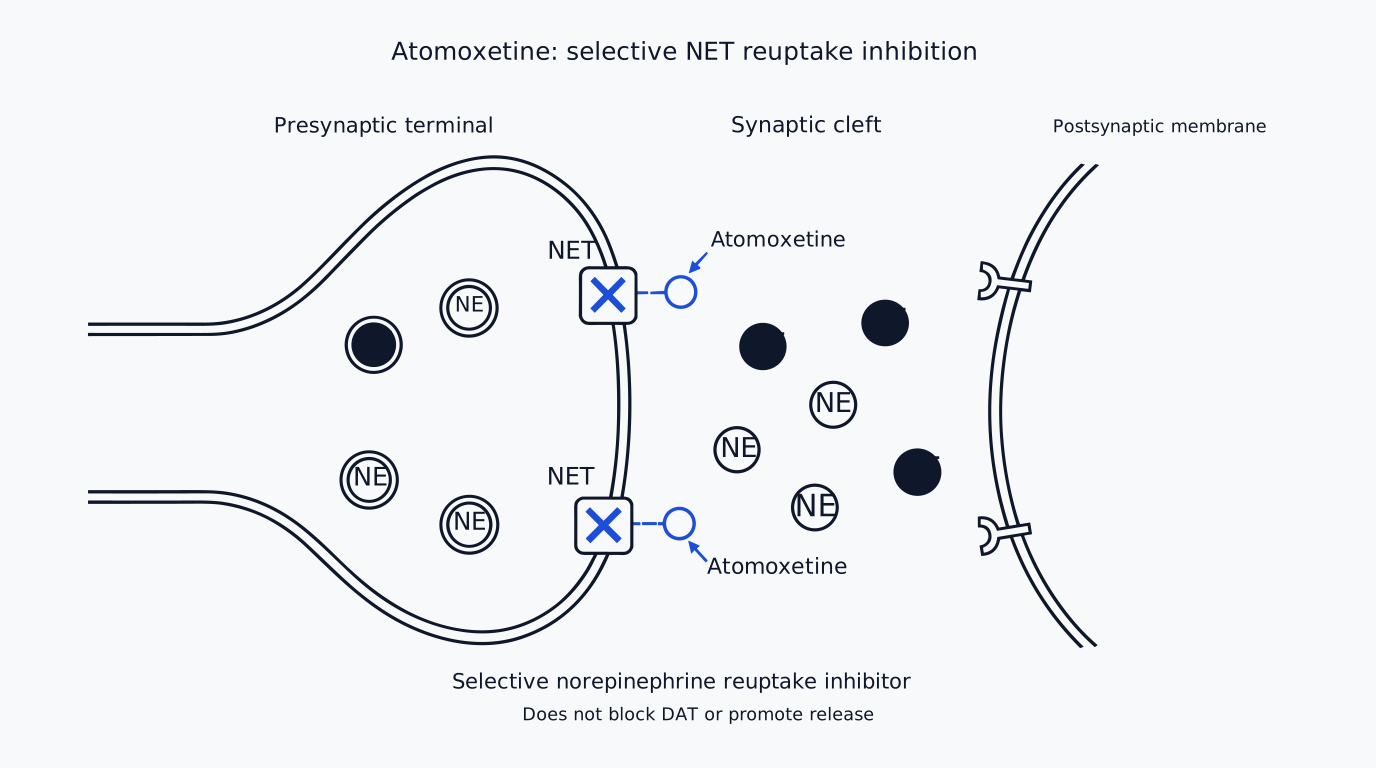
Atomoxetine blocks the norepinephrine transporter, so more norepinephrine stays available between nerve cells in brain networks involved in attention and impulse control. It does not release dopamine or norepinephrine the way stimulants do.
More synaptic norepinephrine
Per labeling, the precise mechanism by which atomoxetine produces its therapeutic effects in ADHD is unknown, but is thought to be related to selective inhibition of the pre-synaptic norepinephrine transporter. The 4-hydroxyatomoxetine metabolite is equipotent at the norepinephrine transporter but circulates at about 1% of atomoxetine concentrations in normal metabolizers.
Formulations and duration
Capsules in seven strengths, plus an oral solution. Capsules are swallowed whole and should not be opened (the label notes atomoxetine is an ocular irritant).
| CAPSULE STRENGTHS | 10, 18, 25, 40, 60, 80, 100 mg (generic atomoxetine; Strattera brand discontinued) |
|---|---|
| ORAL SOLUTION | Atoncy 4 mg/mL, 100 mL bottle with 10 mL oral syringe (approved March 2026) |
| APPROVED AGES | 6 years and older, and adults |
| DOSING | Once daily in the morning, or evenly divided morning and late afternoon/early evening |
| CONTROLLED STATUS | Not a controlled substance |
Discontinuation: the label states no taper is needed. MAOIs: contraindicated with, or within 14 days of, an MAOI (both directions).
Appearance
Strattera brand capsules (FDA label; the brand is listed as discontinued, so pharmacies usually dispense generics):
- 10 mg — opaque white / opaque white, “LILLY 3227” (NDC 0002-3227-30)
- 18 mg — gold / opaque white, “LILLY 3238” (NDC 0002-3238-30)
- 25 mg — opaque blue / opaque white, “LILLY 3228” (NDC 0002-3228-30)
- 40 mg — opaque blue / opaque blue, “LILLY 3229” (NDC 0002-3229-30)
- 60 mg — opaque blue / gold, “LILLY 3239” (NDC 0002-3239-30)
- 80 mg — opaque brown / opaque white, “LILLY 3250” (NDC 0002-3250-30)
- 100 mg — opaque brown / opaque brown, “LILLY 3251” (NDC 0002-3251-30)
Generic atomoxetine capsules look different by manufacturer. Atoncy oral solution is clear and colorless (100 mL amber bottle, NDC 30698-456-02). Check the bottle label for the strength.
Official package photos and pill identifiers:
Generic manufacturers
Atomoxetine capsules are made by many companies and rated AB (therapeutically equivalent). The oral solution (Atoncy) has no ANDA generic; an NDA authorized generic distributed by Advagen is listed on DailyMed.
| Product | Notes |
|---|---|
| Strattera (Eli Lilly) | NDA 021411 — discontinued (not for safety or effectiveness reasons) |
| AB-rated atomoxetine capsules (Orange Book) | Apotex, Aurobindo, Dr. Reddy’s, Glenmark, Hetero (reference standard), Pharmazone, Strides, Teva, Zydus |
| Atoncy oral solution 4 mg/mL | NDA 220320 (MAP77 LLC; DailyMed labeler Validus Pharmaceuticals), approved Mar 20, 2026; no TE-rated (ANDA) generic; NDA authorized generic labeled by Advagen Pharma (DailyMed marketing start Mar 20, 2026) |
Orange Book (October 2026): nine active AB-rated ANDA holders for atomoxetine capsules; the Hetero 60 mg product is the reference standard. Strattera 5–100 mg are DISCN.
Common side effects
Boxed warning — suicidal thoughts and behaviors in pediatric patients 6 years and older: atomoxetine increased the risk of suicidal ideation in short-term pediatric studies. Monitor closely for suicidal thoughts and behavior, clinical worsening, or unusual changes in behavior, especially during the first months and after dose changes; consider stopping if these emerge.
Common side effects in children include nausea, vomiting, tiredness, decreased appetite, stomach pain and sleepiness. In adults, constipation, dry mouth, nausea, decreased appetite, dizziness, erectile dysfunction and trouble urinating are most common. Use caution driving until you know how it affects you.
| EFFECT | FREQUENCY | NOTES |
|---|---|---|
| Nausea / vomiting / stomach pain | Common (children) | Can be taken with or without food |
| Decreased appetite / weight | Common | Growth is monitored in children |
| Sleepiness or tiredness | Common | Use caution driving until you know how it affects you |
| Dry mouth, constipation, dizziness | Common (adults) | Usually mild |
| Urinary hesitation, erectile dysfunction | Common (adults) | Report if bothersome |
| Higher heart rate or blood pressure | Monitored | Checked at baseline and after dose increases |
| Suicidal thoughts (boxed warning) | Uncommon but serious | Watch closely in the first months and after dose changes |
| Liver injury (jaundice, dark urine, itching) | Rare but serious | Stop and seek care; do not restart |
Label 5.1: in pediatric pooled trials, suicidal ideation occurred in 0.4% (5/1,357) of atomoxetine-treated vs 0% (0/851) placebo patients, all ages 6–12 and in the first month; no suicides. Most common adverse reactions (≥5% and ≥2× placebo): pediatric — nausea, vomiting, fatigue, decreased appetite, abdominal pain, somnolence; adult — constipation, dry mouth, nausea, decreased appetite, dizziness, erectile dysfunction, urinary hesitation. Other warnings: severe liver injury; serious cardiovascular reactions; blood pressure and heart rate increases; psychosis/mania (screen for bipolar disorder); aggression or hostility; hypersensitivity; urinary retention; priapism; growth effects. Contraindications: MAOIs (within 14 days), narrow-angle glaucoma, pheochromocytoma, severe cardiac or vascular disorders.
Interactions (label 7): use cautiously with antihypertensive drugs, other drugs that increase blood pressure, and pressor agents (e.g., dopamine, dobutamine), because of possible blood pressure increases; monitor blood pressure more often. Systemically administered (e.g., oral) albuterol or other beta2 agonists: atomoxetine can potentiate their heart rate and blood pressure increases (12.3: shown with intravenous albuterol 600 mcg over 2 h), so monitor heart rate and blood pressure more often and adjust the dose as needed.
Dosing considerations
The dose depends on weight. It is started low and increased after at least 3 days. Adults and teens 70 kg or more usually start at 40 mg a day and aim for 80 mg a day.
People whose bodies break down this medicine more slowly (a difference in a liver enzyme called CYP2D6) can have much higher levels of the medicine. The label already tells prescribers to go more slowly in those cases. A clinic study of blood levels found about twice as much medicine in “intermediate” metabolizers and about ten times as much in “poor” metabolizers, compared with “normal” metabolizers.
CYP2D6 (label 2.5, rev. 06/2026): in patients taking a strong CYP2D6 inhibitor (the label PK studies used paroxetine and fluoxetine) or who are CYP2D6 poor metabolizers, the label recommends a longer titration interval of 4 weeks, increasing only if ADHD symptoms fail to improve and the initial dosage is well tolerated; it states that the recommended starting, target and maximum dosages are the same as in Table 1 (under 70 kg: 0.5 → 1.2 mg/kg/day, maximum 1.4 mg/kg/day or 100 mg/day, whichever is less; 70 kg or more and adults: 40 → 80 mg/day, maximum 100 mg/day). The label suggests considering genetic testing for CYP2D6 status. Note: the earlier Strattera label (revised 02/2020) said to start at 0.5 mg/kg/day or 40 mg/day and only increase to the usual target of 1.2 mg/kg/day or 80 mg/day if symptoms fail to improve after 4 weeks, and listed no higher dose for this group; the current Atoncy label (Table 2) gives the same start, target and 4-week interval and states that a maximum dosage has not been established for this group. Hepatic impairment: moderate (Child-Pugh B) — 50% of the usual initial and target dose; severe (Child-Pugh C) — 25%. Severe renal impairment (ESRD) raised exposure about 65% in the label PK data. Missed dose: take as soon as possible, but do not exceed the total daily amount in 24 hours.
Outside the label (therapeutic-drug-monitoring cohort; see Clinical evidence from published studies): in 315 patients, CYP2D6 intermediate and poor metabolizers had 1.9-fold (95% CI 1.4–2.7) and 9.6-fold (5.9–16) higher dose-adjusted atomoxetine exposure than normal metabolizers; CYP2C19*2 carriers had 1.5-fold (1.1–2.2) higher exposure regardless of CYP2D6 genotype (Smith 2023, PubMed 36851891). These observational figures do not change the label’s CYP2D6 titration instructions.
| Age and weight | Start | Titration interval | Target | Maximum |
|---|---|---|---|---|
| Children/teens under 70 kg | 0.5 mg/kg/day | At least 3 days | 1.2 mg/kg/day | 1.4 mg/kg/day or 100 mg/day, whichever is less |
| Children/teens 70 kg or more, and adults | 40 mg/day | At least 3 days | 80 mg/day | 100 mg/day (if response not optimal after 2–4 more weeks at 80 mg) |
| CYP2D6 poor metabolizers or taking a strong CYP2D6 inhibitor (label 2.5) | Same as above | 4 weeks (increase only if symptoms fail to improve and the initial dosage is well tolerated) | Same as above | Same as above (label 2.5) |
Doses may be given once in the morning or split evenly between morning and late afternoon/early evening. No additional benefit has been shown above 1.2 mg/kg/day in children. Atoncy uses the same mg schedule (4 mg/mL), except that its label states no maximum dosage has been established for CYP2D6 poor metabolizers or patients taking strong CYP2D6 inhibitors.
Pregnancy and breastfeeding
Tell your clinician if you are pregnant, plan to become pregnant, or are breastfeeding. There is not enough information from studies in pregnant women to know whether atomoxetine raises the risk of birth defects, miscarriage, or other problems. Some animal studies showed harm to the developing baby.
Outside the official label, large health-record studies have not found a higher rate of major birth defects overall after atomoxetine in early pregnancy, and a combined analysis did not find a higher rate of autism, ADHD or other developmental disorders in children exposed before birth, compared with children whose mothers stopped ADHD medicine before pregnancy. A small study of milk from 10 breastfeeding women found only a very small amount of atomoxetine in the milk (well under the usual 5% threshold used for many medicines). These are research findings, not a change to the label. Talk to your prescriber.
It is not known whether atomoxetine passes into human breast milk; it does pass into animal milk. If you breastfeed while taking Strattera, decide together with your clinician.
A national pregnancy registry collects information about ADHD medicines used during pregnancy. You or your clinician can enroll by calling 1-866-961-2388.
Pregnancy (label 8.1): available published studies of atomoxetine in pregnant women are insufficient to establish a drug-associated risk of major birth defects, miscarriage, or adverse maternal or fetal outcomes. Some animal studies showed adverse developmental outcomes: in 1 of 3 rabbit studies, fewer live fetuses, more early resorptions, and slight increases in carotid and subclavian artery variants (at about 3 times the human exposure in most CYP2D6 metabolizer types and 0.4 times in poor metabolizers at the MRHD, with slight maternal toxicity); in rats, lower female fetal weight and incomplete vertebral ossification at about 5 times the MRHD, and lower pup weight and survival in 1 of 2 studies at 5–6 times the MRHD; no adverse fetal effects with dosing during organogenesis alone at up to about 17 times the MRHD. Registry: National Pregnancy Registry for ADHD Medications (as named in the label), 1-866-961-2388.
Lactation (label 8.2): no data on atomoxetine or its metabolite in human milk, effects on the breastfed child, or milk production. Atomoxetine is present in animal milk and is therefore likely to be present in human milk. Weigh the benefits of breastfeeding against the mother’s clinical need for Strattera and any potential effects on the child.
Outside the label (observational cohorts and a milk-PK study; see Clinical evidence from published studies, Pregnancy): in a multinational cohort, first-trimester atomoxetine exposure was identified in 368 pregnancies in four Nordic countries and 622 in US Medicaid; the adjusted prevalence ratio was 0.99 (95% CI 0.74–1.34) for any major congenital malformation and 1.34 (0.86–2.09) for cardiac malformations (Bröms 2023, PubMed 36652686). A Swedish cohort meta-analysed with a Danish study reported a pooled hazard ratio for any neurodevelopmental disorder of 1.00 (0.83–1.20) after methylphenidate, amphetamines or atomoxetine (Bang Madsen 2025, PubMed 40148550). In milk samples from 10 lactating participants (40–100 mg daily), the mean relative infant dose was 0.19% (worst-case 0.65%); no adverse effects were reported in the breastfed infants (Yamada 2025, PubMed 41427840). The label still states that published pregnancy studies are insufficient and that there are no human milk data.
Outside the label: LactMed (NCBI Bookshelf, “Atomoxetine,” revised Jun 2026; NBK501732) says amounts in milk are very low after usual doses, cites manufacturer reports of no serious adverse effects in two breastfed infants, and advises watching the infant for excess sleepiness. (The label states there are no human milk data; LactMed draws on other sources.) This is LactMed’s summary of published data, not FDA label content.
Availability and shortages
GENERICS AVAILABLE Generic atomoxetine capsules are widely available and are not on the FDA or ASHP shortage lists as of October 20, 2026. The Strattera brand is listed as discontinued in the Orange Book.
Atoncy oral solution is a newer option for people who cannot swallow capsules; check coverage. An authorized generic of the solution is also listed on DailyMed.
Checked Oct 20, 2026: FDA Drug Shortages database and ASHP current shortage list — no atomoxetine entries. Orange Book: Strattera DISCN; generics RX.
How Strattera (atomoxetine) compares to other nonstimulant options
Rows summarize each product’s FDA labeling; they are not head-to-head comparisons. Unlike stimulants, atomoxetine, viloxazine, guanfacine and clonidine are not controlled substances and are taken every day for continuous coverage, with benefit judged over weeks of titration rather than hours after a dose.
| Medication | Class / action (label) | Dosing and time course | Controlled status / boxed warning | Key safety and practical notes |
|---|---|---|---|---|
| Atomoxetine (Strattera; generics; Atoncy solution) | Selective norepinephrine reuptake inhibitor | Once daily or split twice daily; titrate after ≥3 days; acute trials up to 18 weeks | Not controlled · Boxed warning: suicidal thoughts (ages 6+) | CYP2D6 poor metabolizers/strong 2D6 inhibitors: 4-week titration interval; label states start, target and maximum unchanged. Liver injury warning. Brand discontinued; AB generics. |
| Atoncy (atomoxetine oral solution 4 mg/mL) | Selective norepinephrine reuptake inhibitor | Same mg dosing as atomoxetine capsules; once daily or split twice daily; measured with supplied 10 mL syringe | Not controlled · Boxed warning: suicidal thoughts (ages 6+) | CYP2D6 poor metabolizers/strong 2D6 inhibitors: 4-week titration interval; maximum not established (label Table 2). Liver injury warning. Discard 45 days after opening. Brand plus an NDA authorized generic. |
| Qelbree (viloxazine ER capsule) | Selective norepinephrine reuptake inhibitor (also 5-HT2C partial agonist) | Once daily; weekly titration; steady state in 2 days; trials 6–8 weeks | Not controlled · Boxed warning: suicidal thoughts (all ages) | Strong CYP1A2 inhibitor: contraindicated with sensitive/narrow-range CYP1A2 substrates. Sprinkle allowed. Brand only. |
| Intuniv (guanfacine ER tablet) | Central α2A-adrenergic agonist | Once daily (AM or PM); +1 mg/week max; trials up to 15 weeks | Not controlled · No boxed warning | Rebound hypertension if stopped abruptly (taper ≤1 mg every 3–7 days). CYP3A4 dose adjustments. Ages 6–17 studied. AB generics. |
| Clonidine ER tablets (Kapvay discontinued) | Centrally acting α2-adrenergic agonist | Twice daily (equal or larger bedtime dose); +0.1 mg/week; max 0.4 mg/day | Not controlled · No boxed warning | Rebound hypertension if stopped abruptly (taper ≤0.1 mg every 3–7 days). Ages 6–17. Kapvay brand discontinued; AB1 generics. |
| Onyda XR (clonidine ER oral suspension) | Centrally acting α2-adrenergic agonist | Once daily at bedtime; +0.1 mg/week; max 0.4 mg | Not controlled · No boxed warning | Rebound hypertension if stopped abruptly (taper ≤0.1 mg every 3–7 days). Liquid 0.1 mg/mL; not mg-for-mg with other clonidine. Ages 6+. |
| Simtriyo (centanafadine ER capsule) | Norepinephrine-dopamine-serotonin reuptake inhibitor; labeled a CNS stimulant | Once daily in the morning; fixed weight-/age-based doses; trials 6 weeks | Schedule III (CIII) · Boxed warnings: pediatric suicidality; abuse/misuse | Approved Jul 24, 2026; DEA Schedule III since Oct 30, 2026; now marketable (check pharmacy availability). Moderate CYP1A2 inhibitor. Ages 6+ and ≥20 kg. |
| Stimulants for contrast (e.g. Concerta, Vyvanse) | Methylphenidate or amphetamine: block (and for amphetamines, release) dopamine and norepinephrine | Effects begin within hours of each dose and wear off the same day (timing depends on formulation; see each label) | Schedule II · Boxed warning: abuse, misuse and addiction | Coverage is tied to dosing time each day, unlike the continuous steady-state coverage of atomoxetine, viloxazine and the alpha-2 agonists. |
Other nonstimulant and newer-mechanism pages: Atoncy (atomoxetine solution), Qelbree, Intuniv, Kapvay (clonidine ER), Onyda XR, Simtriyo. Stimulant overviews: methylphenidate (Ritalin) and amphetamine (Adderall) family pages.
Clinical evidence from published studies
These findings come from published research, not from the FDA label. The FDA label is the official source for approved uses, doses and warnings. Results from studies may not apply to you. Uses marked off-label are not FDA-approved. Talk with your prescriber before making any change.
Items summarize peer-reviewed publications, checked against the PubMed abstract (or full text where stated); figures are reproduced only where the source states them. The FDA label governs approved indications and dosing. Off-label items are not FDA-approved uses. Industry funding or sponsor affiliation is noted where the PubMed record shows it; absence of a note does not mean no industry involvement.
Studies of this medicine (13 studies)
-
Atomoxetine (children and teens)
Pooling 25 placebo-controlled trials (3,928 children and teens), atomoxetine had a moderate effect on ADHD symptoms. About 44% improved by at least 40%, compared with 21% on placebo. Overall dropout was similar to placebo, but stopping because of side effects was more common.
Meta-analysis of 25 DBRCTs (56 arms, N=3,928). Overall ADHD ES −0.64 (CI −0.56 to −0.71); ≥40% improvement 44.4% vs 21.4% (NNT 4). All-cause discontinuation similar (p=1.00); discontinuation for inefficacy RR 0.51 (0.36–0.74); for adverse effects RR 1.89 (1.08–3.31), NNH 50. ≥1 AE 70.4% vs 56.1% (NNH 6).
Schwartz S, Correll CU (2014). Efficacy and safety of atomoxetine in children and adolescents with attention-deficit/hyperactivity disorder: results from a comprehensive meta-analysis and metaregression. J Am Acad Child Adolesc Psychiatry 53(2):174-87. DOI · PubMed 24472252
-
Atomoxetine dose (children)
A dose–response analysis of 12 pediatric trials (2,250 participants) found benefit rose with dose up to about 1.4 mg/kg and then levelled off, supporting the labeled target dose.
Dose-response MA, 12 DBRCTs, 2,250 patients (children); efficacy increased up to 1.4 mg/kg then plateaued.
Terao I, Kodama W, Tsuda H (2024). The Dose-Response Relationship of Atomoxetine for the Treatment of Children With ADHD: A Systematic Review and Dose-Response Meta-Analysis of Double-Blind Randomized Placebo-Controlled Trials. J Atten Disord 28(4):431-438. DOI · PubMed 38069471
-
Atomoxetine: once-daily morning dosing (children)
In an 8-week trial, a single morning dose of atomoxetine reduced ADHD symptoms more than placebo, starting at the first visit after treatment began.
RCT, once-daily ATX (final mean 1.3 mg/kg): ADHD-RS-IV-Parent reductions greater from first post-baseline visit onward; daily parent assessments superior during week 1.
Kelsey DK, Sumner CR, Casat CD, et al. (2004). Once-daily atomoxetine treatment for children with attention-deficit/hyperactivity disorder, including an assessment of evening and morning behavior: a double-blind, placebo-controlled trial. Pediatrics 114(1):e1-8. DOI · PubMed 15231966
-
Atomoxetine in adults: time course of response
Pooled data from Lilly’s adult trials suggest atomoxetine’s benefit builds gradually. The advantage over placebo was present from week 1 but small, reached a small-to-moderate level by 4 weeks, and was moderate by 6 months.
Pooled adult placebo-controlled trials; CAARS change assessed at 1–26 weeks. ES vs placebo: 0.28 from week 1 (P≤0.006); 0.45 at 4 weeks (−13.19 vs −8.84); 0.52 at 26 weeks (−15.42 vs −9.71); 0.82 in the 80 mg group. Response rate (CAARS 50% decrease) kept rising through 26 weeks.
Funding / affiliation: Eli Lilly copyright/authors per PubMed record.
Wietecha LA, Clemow DB, Buchanan AS, et al. (2016). Atomoxetine Increased Effect over Time in Adults with Attention-Deficit/Hyperactivity Disorder Treated for up to 6 Months: Pooled Analysis of Two Double-Blind, Placebo-Controlled, Randomized Trials. CNS Neurosci Ther 22(7):546-57. DOI · PubMed 26922462
-
Atomoxetine (adults)
Pooling 12 trials in 3,375 adults, atomoxetine reduced ADHD symptoms only modestly more than placebo, and stopping because of side effects was more common (odds about 2.6 times higher). The authors judged the balance of benefit and risk as poor.
Meta-analysis, 12 studies (3,375 patients). Efficacy SMD −0.33 (patient-rated) and −0.40 (clinician-rated). All-cause discontinuation OR 1.39; AE-related discontinuation OR 2.57. Authors: "poor benefit-risk balance"; recommendation weak.
Cunill R, Castells X, Tobias A, et al. (2013). Atomoxetine for attention deficit hyperactivity disorder in the adulthood: a meta-analysis and meta-regression. Pharmacoepidemiol Drug Saf 22(9):961-9. DOI · PubMed 23813665
-
Atomoxetine (adults)
Pooling all of Lilly’s adult trials, short-term symptom scores fell by 12.2 points with atomoxetine vs 8.1 with placebo. About 35% vs 22% met a combined response definition.
Integrated patient-level analysis of Lilly-sponsored trials: 6 short-term (10–16 wk; 1,961 patients) and 3 six-month studies (1,413). CAARS-Inv:SV −12.2 vs −8.1 (short-term); −13.2 vs −9.7 (6 months). Response (≥30% CAARS improvement + CGI-ADHD-S ≤3): 34.8% vs 22.3% short-term; 43.4% vs 28.0% at 6 months.
Funding / affiliation: Analysis of Eli Lilly-sponsored studies; Lilly-affiliated authors per PubMed record.
Asherson P, Bushe C, Saylor K, et al. (2014). Efficacy of atomoxetine in adults with attention deficit hyperactivity disorder: an integrated analysis of the complete database of multicenter placebo-controlled trials. J Psychopharmacol 28(9):837-46. DOI · PubMed 25035246
-
Atomoxetine: CYP2D6 poor metabolizers
In children taking atomoxetine, those who break it down slowly (CYP2D6 poor metabolizers) had greater symptom improvement, but also larger rises in heart rate and blood pressure. Reduced appetite and tremor were more common in this group.
Analysis of PM vs EM (doses up to 1.8 mg/kg/day): PMs greater symptom reduction (p<.05); greater HR and DBP increases (p<.001); smaller weight gain; more decreased appetite and tremor.
Funding / affiliation: Eli Lilly-affiliated authors per PubMed record.
Michelson D, Read HA, Ruff DD, et al. (2007). CYP2D6 and clinical response to atomoxetine in children and adolescents with ADHD. J Am Acad Child Adolesc Psychiatry 46(2):242-51. DOI · PubMed 17242628
-
Atomoxetine: CYP2D6 genotype
Genetic-testing guidance (CPIC, 2019) suggests a different plan for people known to break down atomoxetine very slowly (CYP2D6 poor metabolizers). They start at the usual starting dose but are not stepped up on the usual 3-day schedule. If there is no benefit and no side effects after 2 weeks, the dose is raised (adults) or a blood level is checked to guide a careful increase. The dose is lowered if side effects appear. This is guideline advice, not part of the FDA label.
CPIC guideline (Brown 2019; full text read). Poor metabolizer, children: initiate 0.5 mg/kg/day; if no response and no AEs after 2 weeks, consider plasma concentration 4 h post-dose; if response inadequate and <200 ng/mL, proportional increase to approach 400 ng/mL; reduce if unacceptable side effects (strength: strong). Adults: initiate 40 mg/day; if no response and no AEs after 2 weeks, increase to 80 mg/day; if still inadequate after 2 weeks, consider level 2–4 h post-dose with the same targets (moderate). Normal metabolizers: 0.5→1.2 mg/kg/day after 3 days (children). Compare with the FDA label’s poor-metabolizer instruction on the page.
Brown JT, Bishop JR, Sangkuhl K, et al. (2019). Clinical Pharmacogenetics Implementation Consortium Guideline for Cytochrome P450 (CYP)2D6 Genotype and Atomoxetine Therapy. Clin Pharmacol Ther 106(1):94-102. DOI · PubMed 30801677
-
Atomoxetine: randomized withdrawal after a response
In children and teens who were already doing well on atomoxetine, those who stayed on it were less likely to lose their response over the next 9 months than those switched to a placebo (about 22 in 100 vs about 38 in 100).
Randomized, double-blind, placebo-controlled withdrawal after acute atomoxetine treatment. Of 416 patients who completed acute treatment, relapse (return of ADHD symptoms to 90% of baseline and an increase of at least 2 CGI-S points) occurred in 65 of 292 (22.3%) on continued atomoxetine vs 47 of 124 (37.9%) on placebo (p=.002).
Michelson D, Buitelaar JK, Danckaerts M, et al. (2004). Relapse prevention in pediatric patients with ADHD treated with atomoxetine: a randomized, double-blind, placebo-controlled study. J Am Acad Child Adolesc Psychiatry 43(7):896-904. DOI · PubMed 15213591
-
Atomoxetine: morning vs evening dosing
In a 6-week trial, taking atomoxetine once a day in the morning or in the evening both improved ADHD symptoms more than placebo. Morning dosing was better on some measures of how well it worked; evening dosing was easier to tolerate, with fewer people reporting at least one side effect.
3-arm, randomized, double-blind trial of once-daily morning-dosed atomoxetine (n=102), evening-dosed atomoxetine (n=93), or placebo (n=93) for about 6 weeks in children. Both active arms significantly decreased core ADHD symptoms relative to placebo, with improvements measured up to 24 hours later. Morning dosing was superior to evening dosing on some efficacy measures. Evening dosing showed greater tolerability: significantly more patients receiving morning atomoxetine reported at least 1 adverse event than those receiving evening atomoxetine. The combined N=288 is not stated in the abstract; the arm sizes are.
Block SL, Kelsey D, Coury D, et al. (2009). Once-daily atomoxetine for treating pediatric attention-deficit/hyperactivity disorder: comparison of morning and evening dosing. Clin Pediatr (Phila) 48(7):723-33. DOI · PubMed 19420182
-
Switching from a stimulant to atomoxetine: 2-week vs 10-week cross-taper
When children were switched from a stimulant to atomoxetine, crossing over in 2 weeks or in 10 weeks worked about the same. Symptom improvement was similar, and the authors reported no clinically important differences between the faster and slower switch.
Randomized comparison of cross-titration from a stimulant to atomoxetine, fast switch over 2 weeks or slow switch over 10 weeks, N=111 patients. No clinically relevant differences: ADHD-RS change after 2 weeks −8.1 vs −8.0 (p=0.927); after 10 weeks −15.0 vs −14.3 (p=0.692). This is not a milligram-for-milligram dose-conversion study.
Cardo E, Porsdal V, Quail D, et al. (2013). Fast vs. slow switching from stimulants to atomoxetine in children and adolescents with attention-deficit/hyperactivity disorder. J Child Adolesc Psychopharmacol 23(4):252-61. DOI · PubMed 23683140
-
Cross-taper from a stimulant to atomoxetine (pilot)
In a small open-label pilot of children and teens crossing from methylphenidate or amphetamine to atomoxetine, average heart rate rose by about 9 beats per minute. This was a tolerance-and-efficacy pilot, not a comparison with staying on the stimulant.
Open-label pilot in patients aged 6–17 years with incomplete stimulant response; 62 subjects enrolled; 39 (62.9%) completed. Mean (SD) heart rate increased 9.2 (11.6) bpm (P<0.001). This is not a dose-conversion table.
Quintana H, Cherlin EA, Duesenberg DA, et al. (2007). Transition from methylphenidate or amphetamine to atomoxetine in children and adolescents with attention-deficit/hyperactivity disorder--a preliminary tolerability and efficacy study. Clin Ther 29(6):1168-77. DOI · PubMed 17692731
-
CYP2D6 and CYP2C19 genotype and atomoxetine blood levels
In a clinic study of blood levels, people whose CYP2D6 liver enzyme works more slowly had much more atomoxetine in the blood: about twice as much in “intermediate” metabolizers and about ten times as much in “poor” metabolizers, compared with “normal” metabolizers. A second gene (CYP2C19) also raised levels somewhat. The labels already tell prescribers to go more slowly in poor CYP2D6 metabolizers.
Therapeutic-drug-monitoring cohort, n=315. Dose-adjusted serum atomoxetine: CYP2D6 IM 1.9-fold (95% CI 1.4–2.7) and PM 9.6-fold (5.9–16) vs NM. CYP2C19*2 carriers had 1.5-fold (1.1–2.2) higher exposure than noncarriers regardless of CYP2D6 genotype. Observational TDM data, not a randomized dosing trial.
Smith RL, Molden E, Bernard JP (2023). Effect of CYP2D6 and CYP2C19 genotypes on atomoxetine serum levels: A study based on therapeutic drug monitoring data. Br J Clin Pharmacol 89(7):2246-2253. DOI · PubMed 36851891
How ADHD medicines compare (12 studies)
-
ADHD medicines (class)
A large analysis of 133 short-term trials found that every ADHD medicine studied worked better than placebo on clinician ratings in children and teens. Amphetamines had the largest average effect, and methylphenidate was the only medicine also shown to beat placebo on teacher ratings. Amphetamines and guanfacine led to more stopping for side effects than placebo in children. Weighing benefit and side effects, the authors favored methylphenidate first in children and amphetamines first in adults. There was too little data to judge effects beyond about 12 weeks.
Network meta-analysis of 133 double-blind RCTs (efficacy near 12 wk: 10,068 children/adolescents; 8,131 adults). Children, clinician-rated SMD vs placebo: amphetamines −1.02 (95% CI −1.19 to −0.85), methylphenidate −0.78 (−0.93 to −0.62), atomoxetine −0.56 (−0.66 to −0.45). Teacher-rated: only methylphenidate (−0.82, −1.16 to −0.48) and modafinil separated from placebo. Adults, clinician-rated: amphetamines −0.79 (−0.99 to −0.58), methylphenidate −0.49 (−0.64 to −0.35), atomoxetine −0.45 (−0.58 to −0.32). Discontinuation for adverse events vs placebo: amphetamines OR 2.30 (1.36–3.89) in children and 3.26 (1.54–6.92) in adults; guanfacine 2.64 (1.20–5.81) in children; atomoxetine 2.33 (1.28–4.25) and methylphenidate 2.39 (1.40–4.08) in adults only. Head-to-head clinician-rated efficacy favored amphetamines over methylphenidate, atomoxetine and modafinil. Insufficient data at 26 and 52 weeks.
Funding / affiliation: Non-industry (Stichting Eunethydis; UK NIHR Oxford Health BRC).
Cortese S, Adamo N, Del Giovane C, et al. (2018). Comparative efficacy and tolerability of medications for attention-deficit hyperactivity disorder in children, adolescents, and adults: a systematic review and network meta-analysis. Lancet Psychiatry 5(9):727-738. DOI · PubMed 30097390
-
ADHD treatments in children and teens (class)
Across 190 trials in children and teens, methylphenidate, amphetamine, atomoxetine, guanfacine and clonidine all worked better than placebo. Methylphenidate and amphetamine appeared more effective than atomoxetine and guanfacine. Behavioral therapy combined with a stimulant appeared better than either medicine type alone. Most effective medicines also caused harms such as reduced appetite, weight loss and sleep problems.
Bayesian network meta-analyses of 190 RCTs (52 interventions, 26,114 participants; ≥3 weeks follow-up). Medications more efficacious than placebo: methylphenidate, amphetamine, atomoxetine, guanfacine, clonidine. Methylphenidate and amphetamine more efficacious than atomoxetine and guanfacine; methylphenidate and clonidine better accepted (all-cause discontinuation) than placebo and atomoxetine. Behavioural therapy plus stimulants appeared superior to stimulants or nonstimulants alone. Harms included anorexia, weight loss and insomnia. Results expressed as ORs with credible intervals (not reproduced here).
Catalá-López F, Hutton B, Núñez-Beltrán A, et al. (2017). The pharmacological and non-pharmacological treatment of attention deficit hyperactivity disorder in children and adolescents: A systematic review with network meta-analyses of randomised trials. PLoS One 12(7):e0180355. DOI · PubMed 28700715
-
ADHD medicines (class): dose
An analysis of how benefit changes with dose (113 trials) found that, in children and teens, extra benefit stopped rising above about 45 mg/day of methylphenidate, 25 mg/day of amphetamines and 4 mg/day of guanfacine, although data at higher doses were thin. Stopping for side effects rose at higher amphetamine doses, and at methylphenidate doses above 50 mg/day in adults. No dose–benefit pattern was found for atomoxetine in fixed-dose studies.
Dose-effect NMA (Bayesian restricted cubic splines) of 113 double-blind RCTs: 68 pediatric (14,138 participants), 45 adult (11,016). Children/adolescents: median efficacy increased up to ~45 mg/day methylphenidate, ~25 mg/day amphetamines, ~4 mg/day guanfacine, with no evidence of added benefit above (wide credible intervals). Adults: amphetamines plateaued above ~50 mg/day; methylphenidate showed no plateau (sparse data). Dose-dependent AE-related discontinuation: amphetamines above 25 mg/day (children) and 50 mg/day (adults); methylphenidate above 50 mg/day in adults, no clear dose dependence in children. No dose-effect pattern for atomoxetine (fixed-dose studies) or modafinil. Needs full-text check: how amphetamine products were converted to a common dose scale is not stated in the abstract.
Funding / affiliation: Non-industry (UK NIHR).
Nourredine M, Jurek L, Hamza T, et al. (2026). Pharmacological interventions for ADHD: a systematic review and dose-effect network meta-analysis. Lancet Psychiatry 13(6):485-495. DOI · PubMed 42134365
-
Adult ADHD treatments (class)
In adults (113 trials), stimulants and atomoxetine were the only treatments that reduced core symptoms on both self-ratings and clinician ratings at 12 weeks. Several psychological approaches (such as CBT and mindfulness) helped only on clinician ratings. Atomoxetine and guanfacine were stopped more often than placebo.
Component NMA, 113 RCTs (14,887 adults). 12-week core symptoms: atomoxetine SMD −0.38 self-rated (−0.56 to −0.21), −0.51 clinician-rated (−0.64 to −0.37); stimulants about −0.39 self-rated (CI −0.52 to −0.26) and −0.61 clinician-rated (−0.71 to −0.51). CBT (−0.76), cognitive remediation, mindfulness, psychoeducation and tDCS beat placebo on clinician-rated measures only. Acceptability worse than placebo: atomoxetine OR 1.43 (1.14–1.80), guanfacine 3.70 (1.22–11.19).
Ostinelli EG, Schulze M, Zangani C, et al. (2025). Comparative efficacy and acceptability of pharmacological, psychological, and neurostimulatory interventions for ADHD in adults: a systematic review and component network meta-analysis. Lancet Psychiatry 12(1):32-43. DOI · PubMed 39701638
-
ADHD medicines in children (class)
An industry-funded network analysis of 36 trials ranked placebo-adjusted symptom improvement as largest for lisdexamfetamine, then extended-release methylphenidate, then guanfacine ER, then atomoxetine. These are indirect comparisons.
Bayesian NMA of 36 RCTs (6–17 y). ADHD-RS-IV change vs placebo: lisdexamfetamine −14.98 (95% CrI −17.14 to −12.80), MPH ER −9.33 (−11.63 to −7.04), guanfacine ER −8.68 (−10.63 to −6.72), atomoxetine −6.88 (−8.22 to −5.49).
Funding / affiliation: Authors affiliated with Shire (guanfacine ER and lisdexamfetamine manufacturer) per PubMed record.
Joseph A, Ayyagari R, Xie M, et al. (2017). Comparative efficacy and safety of attention-deficit/hyperactivity disorder pharmacotherapies, including guanfacine extended release: a mixed treatment comparison. Eur Child Adolesc Psychiatry 26(8):875-897. DOI · PubMed 28258319
-
Methylphenidate vs atomoxetine (children)
Combining nine head-to-head trials (2,762 participants), methylphenidate and atomoxetine did not differ overall in effect or response rates. In a subgroup, long-acting OROS methylphenidate (the Concerta-type formulation) worked better than atomoxetine, while immediate-release methylphenidate did not.
Meta-analysis of 9 RCTs (n=2,762) comparing methylphenidate and atomoxetine. Overall SMD 0.09 (95% CI −0.08 to 0.26), NS; response RR 0.93 (0.76–1.14). Subgroup: OROS methylphenidate SMD 0.32 (0.12–0.53) favoring OROS; immediate-release methylphenidate −0.04 (−0.19 to 0.12). An update (Rezaei 2016, PMID 27390695; 11 studies, 2,772) reported the same pattern (OROS SMD 0.31, 0.16–0.47).
Hanwella R, Senanayake M, de Silva V (2011). Comparative efficacy and acceptability of methylphenidate and atomoxetine in treatment of attention deficit hyperactivity disorder in children and adolescents: a meta-analysis. BMC Psychiatry 11:176. DOI · PubMed 22074258
See also: Rezaei G, Hosseini SA, Akbari Sari A, et al. (2016). Med J Islam Repub Iran. PubMed 27390695
-
Atomoxetine vs methylphenidate (children)
Pooling seven direct-comparison studies (1,368 children and teens), about half responded after 6 weeks on either medicine (53.6% atomoxetine, 54.4% methylphenidate); atomoxetine met the test for being no worse.
Pooled analysis of 7 head-to-head studies (N=1,368). Response at 6 weeks: atomoxetine 53.6% (95% CI 48.6–58.4; n=811) vs methylphenidate 54.4% (47.6–61.1; n=557); absolute difference −0.9% (−9.2 to 7.5), non-inferior.
Hazell PL, Kohn MR, Dickson R, et al. (2011). Core ADHD symptom improvement with atomoxetine versus methylphenidate: a direct comparison meta-analysis. J Atten Disord 15(8):674-83. DOI · PubMed 20837981
-
Atomoxetine vs OROS methylphenidate (adults)
In adults, a network analysis of trials up to 12 weeks found no significant difference in benefit between atomoxetine and OROS methylphenidate, and no difference in how often people stopped treatment.
NMA in adults: SMD vs placebo atomoxetine 0.46 (95% CrI 0.36–0.56), OROS methylphenidate 0.51 (0.40–0.63); atomoxetine vs OROS −0.05 (−0.18 to 0.08). Discontinuation OR 0.85 (0.53–1.35).
Funding / affiliation: Authors affiliated with Eli Lilly (atomoxetine manufacturer) per PubMed record.
Bushe C, Day K, Reed V, et al. (2016). A network meta-analysis of atomoxetine and osmotic release oral system methylphenidate in the treatment of attention-deficit/hyperactivity disorder in adult patients. J Psychopharmacol 30(5):444-58. DOI · PubMed 27005307
-
Lisdexamfetamine vs atomoxetine
In a 9-week head-to-head trial of 267 children and teens who had not done well on methylphenidate, lisdexamfetamine worked faster and reduced symptoms more than atomoxetine. Response by week 9 was 82% vs 64%.
Head-to-head RCT, n=267 (LDX 133, ATX 134). Median time to response 12.0 vs 21.0 days (p=0.001); week-9 response 81.7% vs 63.6%; ADHD-RS-IV difference −6.5 (−9.3 to −3.6; ES 0.56). TEAEs 71.9% vs 70.9%. Companion analysis (PMID 25038977): ≥30% reduction 88.1% vs 73.7%.
Dittmann RW, Cardo E, Nagy P, et al. (2013). Efficacy and safety of lisdexamfetamine dimesylate and atomoxetine in the treatment of attention-deficit/hyperactivity disorder: a head-to-head, randomized, double-blind, phase IIIb study. CNS Drugs 27(12):1081-92. DOI · PubMed 23959815
See also: Dittmann RW, Cardo E, Nagy P, et al. (2014). CNS Drugs. DOI · PubMed 25038977
-
Guanfacine ER vs atomoxetine (indirect)
With no head-to-head trial available, this industry-funded study statistically matched patients across separate trials and estimated that guanfacine ER reduced symptoms more than atomoxetine. Matched indirect comparisons are weaker evidence than a direct trial.
Matching-adjusted indirect comparison (guanfacine ER individual patient data vs published atomoxetine aggregate data). Base case: additional ADHD-RS-IV reduction with GXR vs ATX −7.0 (SE 2.2; p<0.01); hyperactivity/impulsivity −3.8, inattention −3.2. Consistent in sensitivity analyses.
Funding / affiliation: Industry: lead author affiliated with Shire (guanfacine ER manufacturer) per PubMed record.
Sikirica V, Findling RL, Signorovitch J, et al. (2013). Comparative efficacy of guanfacine extended release versus atomoxetine for the treatment of attention-deficit/hyperactivity disorder in children and adolescents: applying matching-adjusted indirect comparison methodology. CNS Drugs 27(11):943-53. DOI · PubMed 23975660
-
Atomoxetine vs osmotic-release methylphenidate in children and teens
In a 6-week trial in children and teens, both atomoxetine and a long-acting methylphenidate improved ADHD symptoms more than placebo. More children responded to the methylphenidate (about 56 in 100) than to atomoxetine (about 45 in 100); about 24 in 100 responded to placebo.
Randomized, double-blind, placebo-controlled, 6 weeks, ages 6–16: atomoxetine 0.8–1.8 mg/kg/day (N=222), osmotically released methylphenidate 18–54 mg/day (N=220), or placebo (N=74). Response (≥40% decrease in ADHD-RS total): atomoxetine 45%, methylphenidate 56%, placebo 24%. Both active treatments were markedly superior to placebo; methylphenidate was superior to atomoxetine. After 6 weeks, methylphenidate-treated patients were switched to atomoxetine under double-blind conditions.
Newcorn JH, Kratochvil CJ, Allen AJ, et al. (2008). Atomoxetine and osmotically released methylphenidate for the treatment of attention deficit hyperactivity disorder: acute comparison and differential response. Am J Psychiatry 165(6):721-30. DOI · PubMed 18281409
-
Atomoxetine, guanfacine and viloxazine ER in adults vs placebo
A review of adult trials found that atomoxetine and guanfacine reduced ADHD symptoms more than placebo. Guanfacine is not FDA-approved for ADHD in adults in the United States. The review also included one viloxazine ER trial. These are average results across studies, not a comparison of one brand with another.
This review pooled adult trials of atomoxetine, guanfacine and viloxazine ER; it did not report this product separately. Guanfacine is not FDA-approved for ADHD in adults in the United States.
Random-effects meta-analysis updating Cortese 2018; 18 studies (4,308 participants) plus one additional study in a narrative synthesis (374 participants). Atomoxetine (15 RCTs) Hedges’ g = −0.48 (95% CI −0.64 to −0.33); guanfacine (two RCTs) g = −0.66 (−0.94 to −0.38); viloxazine ER (one RCT) was also significantly more efficacious than placebo. Guanfacine is not FDA-approved for ADHD in adults in the US. The abstract does not report 9.3% vs 3.6% adverse-event figures.
Radonjić NV, Bellato A, Khoury NM, et al. (2023). Nonstimulant Medications for Attention-Deficit/Hyperactivity Disorder (ADHD) in Adults: Systematic Review and Meta-analysis. CNS Drugs 37(5):381-397. DOI · PubMed 37166701
Heart and blood pressure (4 studies)
-
Methylphenidate, amphetamines, atomoxetine (children)
Pooling 18 trials in 5,837 children and teens, methylphenidate, amphetamines and atomoxetine all raised systolic blood pressure slightly on average. Amphetamines and atomoxetine also raised heart rate and diastolic pressure; methylphenidate did not. About 2% stopped because of heart-related effects. The authors advise regular heart rate and blood pressure checks.
Systematic review/meta-analysis, 18 trials (10 MPH, 5 AMP, 7 ATX), n=5,837, mean 28.7 weeks. Pre–post SBP SMD: MPH 0.25 (0.08–0.42), AMP 0.09 (0.03–0.15), ATX 0.16 (0.04–0.27). DBP: AMP 0.16 (0.03–0.29), ATX 0.22 (0.10–0.34); HR: AMP 0.37 (0.13–0.60), ATX 0.43 (0.26–0.60); MPH no pre–post effect on DBP or HR. No significant head-to-head differences. 2% discontinued for any cardiovascular effect.
Hennissen L, Bakker MJ, Banaschewski T, et al. (2017). Cardiovascular Effects of Stimulant and Non-Stimulant Medication for Children and Adolescents with ADHD: A Systematic Review and Meta-Analysis of Trials of Methylphenidate, Amphetamines and Atomoxetine. CNS Drugs 31(3):199-215. DOI · PubMed 28236285
-
ADHD medicines (class)
Pooling 102 short-term trials, most ADHD medicines raised blood pressure and pulse modestly, and stimulants did not raise them more than atomoxetine or viloxazine. Guanfacine lowered blood pressure and pulse. The authors advise monitoring blood pressure and pulse with any ADHD medicine, not just stimulants.
NMA of 102 RCTs (13,315 children/adolescents; 9,387 adults; median 7 weeks). Children, mean increase vs placebo: SBP 1.07 (atomoxetine) to 1.81 mm Hg (methylphenidate); DBP 1.93 (amphetamines) to 2.42 (methylphenidate); pulse 2.79 bpm (viloxazine) to 5.58 bpm (atomoxetine). Amphetamines, lisdexamfetamine and methylphenidate not associated with larger increments than atomoxetine or viloxazine. Guanfacine in children: SBP −2.83 (−3.8 to −1.85), DBP −2.08, pulse −4.06. Only four RCTs informed medium-term effects. CINeMA confidence mostly low to moderate in children, very low in adults.
Funding / affiliation: Non-industry (UK NIHR).
Farhat LC, Lannes A, Del Giovane C, et al. (2025). Comparative cardiovascular safety of medications for attention-deficit hyperactivity disorder in children, adolescents, and adults: a systematic review and network meta-analysis. Lancet Psychiatry 12(5):355-365. DOI · PubMed 40203844
-
Methylphenidate and atomoxetine
Pooling 22 studies (46,107 people), methylphenidate raised heart rate and systolic blood pressure compared with placebo in young people and adults; in children, atomoxetine raised them more than methylphenidate. Serious cardiac events did not differ.
Meta-analysis/meta-regression of 22 studies (n=46,107). MPH vs placebo: greater pre–post HR (p<0.001) and SBP (p<0.001) increases in youth and adults. Children/adolescents: ATX > MPH for HR (p=0.025) and SBP (p<0.001). Moderators: age, dose, duration. No difference in adverse cardiac events (MPH vs placebo or ATX). Effects reported as standardized differences, not bpm/mm Hg, in the abstract.
Liang EF, Lim SZ, Tam WW, et al. (2018). The Effect of Methylphenidate and Atomoxetine on Heart Rate and Systolic Blood Pressure in Young People and Adults with Attention-Deficit Hyperactivity Disorder (ADHD): Systematic Review, Meta-Analysis, and Meta-Regression. Int J Environ Res Public Health 15(8). DOI · PubMed 30127314
-
ADHD medicines (class), long-term use
In a Swedish registry study of 278,027 people with ADHD (ages 6–64), longer total use of ADHD medicine was linked to a higher risk of cardiovascular disease, about 4% more per year of use, mainly high blood pressure and arterial disease. This kind of study shows an association, not proof of cause.
Nested case-control (Swedish registers, 2007–2020): 10,388 CVD cases vs 51,672 matched controls. Cumulative use vs non-use: 3–≤5 y AOR 1.27 (1.17–1.39); >5 y 1.23 (1.12–1.36). Per year of use AOR 1.04 (1.03–1.05), steeper in first 3 years (1.08). Hypertension 3–≤5 y AOR 1.72 (1.51–1.97), >5 y 1.80 (1.55–2.08). Similar in under-25s and adults. Not broken down by individual drug in the abstract.
Zhang L, Li L, Andell P, et al. (2024). Attention-Deficit/Hyperactivity Disorder Medications and Long-Term Risk of Cardiovascular Diseases. JAMA Psychiatry 81(2):178-187. DOI · PubMed 37991787
Growth (2 studies)
-
Atomoxetine
Following 714 children and teens treated with atomoxetine for 3 years or more, researchers found no clinically meaningful effect on growth, vital signs or heart tracings, and no new side effects compared with short-term use.
Pooled long-term open-label data: 714 patients ≥3 years (mean 4.8 y), 508 ≥4 years. Mean final dose 1.35 mg/kg. No clinically significant effects on growth rate, vital signs or ECG; <6% aggressive/hostile behaviours; <1.6% suicidal ideation/behaviour; ≤2% potentially clinically significant hepatic changes. Uncontrolled.
Donnelly C, Bangs M, Trzepacz P, et al. (2009). Safety and tolerability of atomoxetine over 3 to 4 years in children and adolescents with ADHD. J Am Acad Child Adolesc Psychiatry 48(2):176-85. DOI · PubMed 20040824
-
Atomoxetine and height after 2 years
In children and teens treated with atomoxetine for 2 years, average height was about half a centimetre below what growth charts would have predicted. The difference was small, and the authors reported that growth effects levelled off over time.
Open-label analysis of patients (N=412) aged 6–16 years at the start of atomoxetine, treated for ≥2 years. After 2-year treatment, the height decrement versus expected was 0.44 cm. For both weight and height, the quartile most below expected at baseline showed catch-up; effects appeared to stabilize.
Spencer TJ, Newcorn JH, Kratochvil CJ, et al. (2005). Effects of atomoxetine on growth after 2-year treatment among pediatric patients with attention-deficit/hyperactivity disorder. Pediatrics 116(1):e74-80. DOI · PubMed 15995021
Other safety findings (5 studies)
-
Atomoxetine: suicidal thoughts (children and teens)
In Lilly’s pooled pediatric trials, suicidal thoughts were reported in 5 of 1,357 children on atomoxetine (0.37%) and none of 851 on placebo. There were no suicides. The label carries a boxed warning on this risk.
Retrospective pooled analysis: suicidal ideation 0.37% (5/1,357) vs 0% (0/851); MH incidence difference 0.46 (0.09–0.83; p=.016); MH RR 2.92 (0.63–13.57). Suicide-related events did not differ between MPH and ATX. NNH 227 for a suicide-related event.
Funding / affiliation: Eli Lilly-affiliated authors per PubMed record.
Bangs ME, Tauscher-Wisniewski S, Polzer J, et al. (2008). Meta-analysis of suicide-related behavior events in patients treated with atomoxetine. J Am Acad Child Adolesc Psychiatry 47(2):209-218. DOI · PubMed 18176331
-
Atomoxetine: suicidality (children and adults)
A later, larger pooled analysis found suicidal thoughts or behavior in 0.37% of children on atomoxetine vs 0.07% on placebo, a difference that was not statistically significant. In adults the rates were about equal (0.11% vs 0.12%). One child attempted suicide, and there were no suicides.
Pooled analysis: pediatric suicidal behaviour/ideation 0.37% vs 0.07% (MHRR 1.57; p=0.42); adults 0.11% vs 0.12% (MHRR 0.96). One pediatric attempted suicide (ATX); no completed suicides.
Funding / affiliation: Eli Lilly-affiliated authors per PubMed record.
Bangs ME, Wietecha LA, Wang S, et al. (2014). Meta-analysis of suicide-related behavior or ideation in child, adolescent, and adult patients treated with atomoxetine. J Child Adolesc Psychopharmacol 24(8):426-34. DOI · PubMed 25019647
-
Atomoxetine vs methylphenidate: liver-injury reports
In a European adverse-event reporting database, liver problems were reported more often for atomoxetine than for methylphenidate. Reporting data like these can flag a signal but cannot measure how often liver injury actually happens.
EudraVigilance disproportionality, head-to-head ATX vs MPH: 421 hepatobiliary ICSRs (ATX 232; MPH 181). Hepatobiliary ROR 2.41 (2.11–3.11); DILI 6.42 (4.45–9.06); hepatitis 6.48 (2.95–14.24); jaundice 2.19 (1.12–4.27). Spontaneous reports; no incidence estimate.
Di Napoli R, Laino LV, Rafaniello C, et al. (2026). Hepatic Safety Profile of Atomoxetine and Methylphenidate in Patients with ADHD: Disproportionality Analysis Using EudraVigilance Database Data. Pharmaceuticals (Basel) 19(7). DOI · PubMed 42515803
-
Atomoxetine vs stimulants: suicidal events (observational)
In a large UK health-record study, children and teens starting atomoxetine did not have a clearly higher rate of suicidal events than those starting a stimulant. The estimate leaned slightly toward atomoxetine, but the difference was not statistically significant and the range of possible results was wide. This does not change the labels’ boxed warning about suicidal thoughts.
Cohort n=4,509 (85.5% male; median age 11 years). Rate ratio for suicidal events, atomoxetine vs stimulant treatment: 0.71 (95% CI 0.48–1.07; P=0.104). Observational comparison; residual confounding is possible. The boxed warning is unchanged.
Davies M, Coughtrie A, Layton D, et al. (2017). Use of atomoxetine and suicidal ideation in children and adolescents: Results of an observational cohort study within general practice in England. Eur Psychiatry 39:11-16. DOI · PubMed 27810613
-
Atomoxetine vs stimulants: suicide-related events (observational)
In two very large US health-record groups, current atomoxetine use was not linked to a clearly higher (or lower) risk of suicide-related events than current stimulant use in the first year. The estimates were imprecise, with wide confidence intervals. This does not change the labels’ boxed warning.
First-line treatment cohort n=279,315: adjusted HR for current atomoxetine vs current stimulant 0.95 (95% CI 0.47–1.92, P=.88). Second-line treatment cohort n=220,215: aHR 0.71 (0.30–1.67). These are the cohort sizes stated in the abstract; a commonly repeated N of 297,315 is incorrect. Observational; the boxed warning is unchanged.
Linden S, Bussing R, Kubilis P, et al. (2016). Risk of Suicidal Events With Atomoxetine Compared to Stimulant Treatment: A Cohort Study. Pediatrics 137(5). DOI · PubMed 27244795
ADHD with other conditions (8 studies)
-
Atomoxetine: ADHD with anxiety (ages 8–17)
In a 12-week trial of children and teens with ADHD plus an anxiety disorder (87 on atomoxetine, 89 on placebo), atomoxetine improved both ADHD and anxiety symptoms more than placebo.
RCT, ages 8–17 with ADHD + GAD/SAD/social phobia: randomized 87 vs 89. ADHDRS-IV-PI −10.5 vs −1.4 (p<.001); PARS −5.5 vs −3.2 (p=.011) (analysed n=55/58).
Funding / affiliation: Results posted at lillytrials.com; Lilly-affiliated authors per PubMed record.
Geller D, Donnelly C, Lopez F, et al. (2007). Atomoxetine treatment for pediatric patients with attention-deficit/hyperactivity disorder with comorbid anxiety disorder. J Am Acad Child Adolesc Psychiatry 46(9):1119-1127. DOI · PubMed 17712235
-
Atomoxetine: adult ADHD with social anxiety disorder
In adults with ADHD and social anxiety disorder, atomoxetine improved both ADHD and social anxiety symptoms more than placebo.
RCT: CAARS-Inv:SV −8.7 vs −5.6 (P<.001); LSAS −22.9 vs −14.4 (P<.001). Insomnia, nausea, dry mouth and dizziness more common with ATX; AE discontinuation similar.
Adler LA, Liebowitz M, Kronenberger W, et al. (2009). Atomoxetine treatment in adults with attention-deficit/hyperactivity disorder and comorbid social anxiety disorder. Depress Anxiety 26(3):212-21. DOI · PubMed 19194995
-
Atomoxetine: ADHD with tic disorders
In children with ADHD and tics, atomoxetine improved ADHD symptoms and did not worsen tics. Tic severity fell slightly more than on placebo, though the main tic scale only approached significance.
RCT, ADHD + Tourette/chronic tics: YGTSS −5.5 vs −3.0 (p=0.063); CGI tic/neurologic −0.7 vs −0.1 (p=0.002); ADHD-RS −10.9 vs −4.9 (p<0.001). Greater HR increase and weight decrease with ATX.
Funding / affiliation: Eli Lilly-affiliated authors per PubMed record.
Allen AJ, Kurlan RM, Gilbert DL, et al. (2005). Atomoxetine treatment in children and adolescents with ADHD and comorbid tic disorders. Neurology 65(12):1941-9. DOI · PubMed 16380617
-
Atomoxetine: ADHD with autism spectrum disorder
In 97 children with autism and ADHD, atomoxetine reduced ADHD symptoms moderately more than placebo, but clinician-rated overall improvement was not significantly different (21% vs 9%).
8-week RCT, n=97: ADHD-RS LSMD −6.7 (−10.0 to −3.4; p<.001); CGI-I much/very much improved 20.9% vs 8.7% (p=0.14). AEs 81.3% vs 65.3%; no serious AEs.
Harfterkamp M, van de Loo-Neus G, Minderaa RB, et al. (2012). A randomized double-blind study of atomoxetine versus placebo for attention-deficit/hyperactivity disorder symptoms in children with autism spectrum disorder. J Am Acad Child Adolesc Psychiatry 51(7):733-41. DOI · PubMed 22721596
-
Atomoxetine: autism with hyperactivity
In a small crossover pilot (16 children with autism and hyperactivity), atomoxetine reduced hyperactivity more than placebo; 9 children responded to atomoxetine and 4 to placebo.
Crossover pilot (12 boys, 4 girls; ages 5–15): ABC Hyperactivity p=.043, d=0.90; responders 9 vs 4. One rehospitalized for violence on ATX.
Arnold LE, Aman MG, Cook AM, et al. (2006). Atomoxetine for hyperactivity in autism spectrum disorders: placebo-controlled crossover pilot trial. J Am Acad Child Adolesc Psychiatry 45(10):1196-1205. DOI · PubMed 17003665
-
Atomoxetine: autism spectrum disorder
Pooling 3 trials (241 children with autism and ADHD symptoms), atomoxetine improved parent-rated hyperactivity and inattention, but the size of the benefit is uncertain. Nausea, vomiting, poorer sleep and reduced appetite were more common.
MA, 3 RCTs, n=241: parent-rated hyperactivity SMD −0.73 (−1.15 to −0.34); inattention −0.53 (−0.93 to −0.12); GRADE: magnitude uncertain.
Patra S, Nebhinani N, Viswanathan A, et al. (2019). Atomoxetine for attention deficit hyperactivity disorder in children and adolescents with autism: A systematic review and meta-analysis. Autism Res 12(4):542-552. DOI · PubMed 30653855
-
Atomoxetine: teens with ADHD and substance use disorder
In adolescents with ADHD and substance use disorder who all received counseling (motivational interviewing and CBT), atomoxetine did not improve ADHD symptoms or substance use more than placebo.
RCT, ATX + MI/CBT vs placebo + MI/CBT: ADHD change p=.2975; substance-use days p=.1103; large placebo-group response.
Thurstone C, Riggs PD, Salomonsen-Sautel S, et al. (2010). Randomized, controlled trial of atomoxetine for attention-deficit/hyperactivity disorder in adolescents with substance use disorder. J Am Acad Child Adolesc Psychiatry 49(6):573-82. DOI · PubMed 20494267
-
ADHD with tic disorders
In children with ADHD and tics (9 trials), methylphenidate, alpha-2 agonists (clonidine, guanfacine) and atomoxetine improved ADHD symptoms. Alpha-2 agonists and atomoxetine also reduced tics, and methylphenidate did not worsen tics in the short term. Very high doses of dextroamphetamine were linked to worse tics.
Meta-analysis, 9 studies, 477 subjects. ADHD efficacy: MPH, α2 agonists, desipramine, ATX. Tic improvement: α2 agonists and ATX. No evidence MPH worsened tics short-term; supratherapeutic dextroamphetamine worsened tics. Authors: MPH gave the greatest and most immediate ADHD improvement.
Bloch MH, Panza KE, Landeros-Weisenberger A, et al. (2009). Meta-analysis: treatment of attention-deficit/hyperactivity disorder in children with comorbid tic disorders. J Am Acad Child Adolesc Psychiatry 48(9):884-893. DOI · PubMed 19625978
Pregnancy (6 studies)
These research findings do not replace the FDA label. For what the label says, see Pregnancy and breastfeeding above.
-
Stimulants and atomoxetine in pregnancy
A 2026 review of 25 studies found that, after accounting for differences between mothers, using stimulants or atomoxetine in pregnancy was not linked to more major birth defects or to most pregnancy and child-development problems. A small link with methylphenidate and heart defects, and with a low newborn Apgar score, could not be ruled out and needs more study.
Systematic review/meta-analysis (25 studies; 23 pooled). Major malformations: unadjusted RR 1.25 (1.14–1.37), adjusted 1.04 (0.97–1.12). Cardiovascular malformations aRR 1.20 (0.88–1.63); methylphenidate-specific aRR 1.33 (1.01–1.74). No adjusted association with miscarriage, preterm birth, low birth weight, SGA, NICU admission or offspring neurodevelopmental disorders. Low 5-min Apgar aRR 1.21 (1.03–1.42). Authors attribute crude associations largely to confounding.
Komargodski R, Tillawe A, Berlin M, et al. (2026). Pregnancy and Offspring Outcomes After Prenatal Stimulant or Atomoxetine Exposure: A Systematic Review and Meta-analysis. Am J Obstet Gynecol MFM 102165. DOI · PubMed 42887725
-
Methylphenidate and atomoxetine in pregnancy
Pooling 10 observational studies, birth defects and miscarriage were not more common in babies of mothers who took methylphenidate or atomoxetine in pregnancy than in unexposed babies.
Meta-analysis of 10 observational studies. vs unexposed offspring of mothers with ADHD: congenital anomalies OR 1.14 (0.83–1.55), miscarriage 1.01 (0.70–1.47); vs general population: anomalies 1.19 (0.93–1.53; I² 74%), miscarriage 1.05 (0.81–1.37). Preterm birth and birth weight not reported as outcomes in the abstract.
di Giacomo E, Confalonieri V, Tofani F, et al. (2024). Methylphenidate and Atomoxetine in Pregnancy and Possible Adverse Fetal Outcomes: A Systematic Review and Meta-Analysis. JAMA Netw Open 7(11):e2443648. DOI · PubMed 39504019
-
ADHD medicines in pregnancy (class)
Pooling 8 cohort studies, ADHD medicine during pregnancy was linked to more newborn intensive-care admissions but not to other maternal or newborn problems; methylphenidate showed a borderline link with heart defects.
Meta-analysis of 8 cohorts. NICU admission RR 1.88 (1.7–2.08) vs never exposed; 1.38 (1.23–1.54) vs exposure before/after pregnancy only. MPH and cardiac malformation RR 1.27 (0.99–1.63; p=0.065). No association with other outcomes; limited confounder adjustment.
Jiang HY, Zhang X, Jiang CM, et al. (2019). Maternal and neonatal outcomes after exposure to ADHD medication during pregnancy: A systematic review and meta-analysis. Pharmacoepidemiol Drug Saf 28(3):288-295. DOI · PubMed 30585374
-
Atomoxetine in early pregnancy: major congenital malformations
A large study in four Nordic countries and the United States did not find more major birth defects overall after atomoxetine use in early pregnancy, compared with unexposed pregnancies. A possible increase in heart defects was not statistically significant, and the estimate was uncertain because relatively few pregnancies were exposed.
Multinational cohort: first-trimester atomoxetine exposure in 368 pregnancies in Denmark, Iceland, Norway and Sweden and 622 in US Medicaid. Pooled crude PR for any major congenital malformation 1.18 (95% CI 0.88–1.60); adjusted PR 0.99 (0.74–1.34). Cardiac malformations, adjusted PR 1.34 (0.86–2.09); limb malformations, adjusted PR 0.90 (0.38–2.16). The abstract reports 368 and 622 separately; it does not give a pooled N of 990.
Bröms G, Hernandez-Diaz S, Huybrechts KF, et al. (2023). Atomoxetine in Early Pregnancy and the Prevalence of Major Congenital Malformations: A Multinational Study. J Clin Psychiatry 84(1). DOI · PubMed 36652686
-
Atomoxetine in breast milk
In milk samples from 10 breastfeeding women taking atomoxetine, the average amount a baby would get through milk was very small (0.19% of the mother’s weight-adjusted dose), well under the usual 5% cutoff used for many medicines. No side effects were reported in the breastfed infants. This is a small study; the official label still says there are no human milk data.
InfantRisk Center milk study: 10 lactating participants treated with atomoxetine 40–100 mg daily. Mean milk concentration 12 ng/mL at an adjusted daily dose of 80 mg, relative infant dose (RID) 0.19%. Worst-case RID using the maximum concentration of 39 ng/mL was 0.65%. No reported adverse effects in the breastfed infants. The abstract does not state how many infants were assessed.
Yamada E, Trehan S, Stark A, et al. (2026). Atomoxetine as a Viable ADHD Treatment in Breastfeeding Mothers: Evidence From Human Milk Pharmacokinetic Analysis. J Clin Psychopharmacol 46(1):16-22. DOI · PubMed 41427840
-
ADHD medicines in pregnancy (incl. amphetamines): child neurodevelopment
A Swedish study of 861,650 children, combined with an earlier Danish study, found no higher risk of autism, ADHD or other developmental disorders in children exposed before birth to methylphenidate, amphetamines or atomoxetine, compared with children whose mothers stopped their medicine before pregnancy. Results were similar when siblings were compared.
Swedish population cohort 2008–2017: 861,650 children of 572,731 mothers; comparator = maternal discontinuation before conception. Adjusted HR: any NDD 0.95 (95% CI 0.82–1.11), ADHD 0.92 (0.78–1.08), ASD 0.86 (0.63–1.18); consistent by medication type, timing, duration and in sibling comparisons. Meta-analysis with a Danish study: pooled HR any NDD 1.00 (0.83–1.20).
Bang Madsen K, Larsson H, Skoglund C, et al. (2025). In utero exposure to methylphenidate, amphetamines and atomoxetine and offspring neurodevelopmental disorders - a population-based cohort study and meta-analysis. Mol Psychiatry 30(9):3885-3894. DOI · PubMed 40148550
Off-label uses (not FDA-approved) (1 study)
-
Atomoxetine in 5- and 6-year-olds (not FDA-approved under 6)
In an 8-week study of 5- and 6-year-old children, more children on atomoxetine were rated much improved than on placebo (40 in 100 vs 22 in 100), but the difference was not statistically significant. Most children on atomoxetine (62 in 100) were still at least moderately ill at the end. Atomoxetine is not FDA-approved for children under 6.
Randomized, double-blind, placebo-controlled 8-week trial in 101 children (5- and 6-year-olds). CGI-I response: 40% of children treated with atomoxetine vs 22% of children on placebo, which was not significant. Sixty-two percent of subjects who received atomoxetine were moderately, markedly, or severely ill at study completion. Not FDA-approved under age 6.
Kratochvil CJ, Vaughan BS, Stoner JA, et al. (2011). A double-blind, placebo-controlled study of atomoxetine in young children with ADHD. Pediatrics 127(4):e862-8. DOI · PubMed 21422081
Frequently asked questions
Is atomoxetine a stimulant?
No. It is a selective norepinephrine reuptake inhibitor and is not a controlled substance.
Is Strattera still available?
The Orange Book lists the Strattera brand as discontinued (not for safety reasons). Generic atomoxetine capsules are AB-rated and widely available.
How long does atomoxetine take to work?
It is not a same-day medicine. Doses are increased over days to weeks, and in clinical trials benefit was measured after several weeks of daily use. Ask your clinician when to judge whether it is working.
Is there a generic version of Strattera (atomoxetine)?
Yes. Atomoxetine capsules are made by many companies and rated AB (therapeutically equivalent). The oral solution (Atoncy) has no ANDA generic; an NDA authorized generic distributed by Advagen is listed on DailyMed.
Does it need to be taken every day?
Yes. It is designed for continuous daily use, not as-needed doses.
What is the boxed warning?
Atomoxetine increased the risk of suicidal thoughts in children and teens in short-term studies. Families should watch for mood changes or suicidal thoughts, especially in the first months and after dose changes.
What does CYP2D6 have to do with it?
CYP2D6 is the main liver enzyme that breaks down atomoxetine. People who are poor metabolizers, or who take strong CYP2D6 inhibitors such as paroxetine or fluoxetine, have much higher levels. For them the label recommends waiting 4 weeks before each dose increase, and increasing only if symptoms have not improved and the starting dose is well tolerated. The label states the starting, target and maximum doses are otherwise the same.
Can the capsule be opened?
No. Capsules should be swallowed whole. For people who cannot swallow capsules, an oral solution (Atoncy, 4 mg/mL) is available.
Do I need to taper atomoxetine when stopping?
The label says no taper is needed. Talk with your clinician before stopping.
How is it different from Qelbree?
Both are nonstimulant norepinephrine reuptake inhibitors with a suicidality boxed warning. Qelbree (viloxazine) is a once-daily capsule that can be sprinkled, is a strong CYP1A2 inhibitor, and is brand-only; atomoxetine is mainly affected by CYP2D6 and is generic.
Does atomoxetine interact with blood pressure or asthma medicines?
It can. Tell your clinician if you take blood pressure medicine or any medicine that raises blood pressure. The label also warns that albuterol (or a similar asthma medicine) taken by mouth or given by injection can raise heart rate and blood pressure more when combined with atomoxetine, so your heart rate and blood pressure may be checked more often. The label does not single out inhalers; ask your clinician about any asthma medicine you use.
Can Strattera (atomoxetine) be taken with food?
Yes. Strattera may be taken with or without food (label sections 2.2 and 17). Food does not change the total amount absorbed; it lowers the peak level by about 37% and delays it by about 3 hours (label section 12.3).
What should I do if I miss a dose of Strattera (atomoxetine)?
Take it as soon as you can, but do not take more than your prescribed total daily amount in any 24-hour period (label section 2.7; Medication Guide).
What are the most common side effects of Strattera (atomoxetine)?
In children, the most common side effects are nausea, vomiting, tiredness, decreased appetite, stomach pain and sleepiness. In adults, they are constipation, dry mouth, nausea, decreased appetite, dizziness, erectile dysfunction and trouble starting urination (Medication Guide; label section 6.1). These are not all the possible side effects; call your prescriber for advice about side effects that bother you.
Can I take Strattera (atomoxetine) while pregnant or breastfeeding?
Tell your clinician if you are pregnant or planning a pregnancy. The label says there is not enough information from pregnant women to know the risk, and some animal studies showed harm. It is not known whether atomoxetine passes into human breast milk, so decide about breastfeeding together with your clinician. A pregnancy registry for ADHD medicines can be reached at 1-866-961-2388.
Prescribing guidelines
Guidelines generally place stimulants first for most school-age children, adolescents and adults when medication is indicated, with atomoxetine, extended-release guanfacine and extended-release clonidine as evidence-based alternatives or (for the alpha-2 agonists) add-on options. Viloxazine and centanafadine were approved after the 2019 AAP guideline, so it does not address them.
Resources
Sources
- Eli Lilly and Company. Strattera (atomoxetine) capsules. Prescribing Information, revised 06/2026. DailyMed (accessed Oct 2026).
- Validus Pharmaceuticals LLC. Atoncy (atomoxetine) oral solution. Prescribing Information. DailyMed (accessed Oct 2026).
- U.S. Food and Drug Administration. Approved Drug Products with Therapeutic Equivalence Evaluations (Orange Book), data files dated October 2026. FDA.
- U.S. Food and Drug Administration. Drug Shortages database, accessed Oct 20, 2026 (no current-shortage entries for atomoxetine, viloxazine, guanfacine, clonidine or centanafadine; guanfacine ER tablets appear only on the discontinuation list). FDA.
- American Society of Health-System Pharmacists. Current Drug Shortage Bulletins list, accessed Oct 20, 2026 (no atomoxetine, viloxazine, guanfacine, clonidine or centanafadine entries). ASHP.
- Wolraich ML, Hagan JF Jr, Allan C, et al.; American Academy of Pediatrics Subcommittee on Children and Adolescents with ADHD. Clinical Practice Guideline for the Diagnosis, Evaluation, and Treatment of Attention-Deficit/Hyperactivity Disorder in Children and Adolescents. Pediatrics. 2019;144(4):e20192528. AAP.
- Centers for Disease Control and Prevention. Clinical Care of ADHD in Children (summary of the AAP guideline; updated Oct 21, 2026). CDC (accessed 2026).
- Drugs and Lactation Database (LactMed). Atomoxetine. National Institute of Child Health and Human Development; revised Jun 2026. NCBI Bookshelf NBK501732.