
Qelbree
NONSTIMULANTS · VILOXAZINE EXTENDED-RELEASE CAPSULES
Key facts
- Drug class
- Selective Norepinephrine Reuptake Inhibitor · Nonstimulants
- Active ingredient
- viloxazine
- FDA-approved ages
- 6 years and older, and adults
- Form and strengths
- Extended-release capsule; 100 mg, 150 mg, 200 mg extended-release capsules
- Usual dose and maximum (label)
- Start 100 mg (ages 6–11) or 200 mg (12–17 and adults) once daily; maximum 400 mg (6–17) or 600 mg (adults).
- Duration
- Taken once daily, every day; the label does not describe hour-by-hour effects (benefit measured after 6–8 weeks).
- DEA schedule
- Not a controlled substance
- Generic
- No generic (see Generic manufacturers)
- Label date
- Prescribing Information revised 01/2025 (DailyMed)
Label last checked: Oct 2026 — Prescribing Information revised 01/2025 (DailyMed) · Last medical review: November 12, 2026
Educational information only, not medical advice. Do not start, stop or change a medication without your prescriber. Medical disclaimer
What it is
Qelbree is a nonstimulant capsule taken once a day, every day. It is not a controlled substance. Capsules can be opened and sprinkled on applesauce or pudding.
Boxed warning — suicidal thoughts and behaviors: in clinical trials, higher rates of suicidal thoughts and behavior were reported with Qelbree than with placebo. Closely monitor all patients (the Qelbree box is not limited to children) for worsening and for new suicidal thoughts and behaviors.
Viloxazine ER (initial U.S. approval 2021), selective norepinephrine reuptake inhibitor indicated for ADHD in adults and pediatric patients 6 years and older. NDA 211964 (Supernus), 100/150/200 mg; no TE-rated generics in the Orange Book (October 2026). Strong CYP1A2 inhibitor; weak CYP2D6 and CYP3A4 inhibitor. Metabolized mainly by CYP2D6, UGT1A9 and UGT2B15; renally excreted (90% of dose in urine within 24 h).
When considering this for a patient
Qelbree is an option when stimulants are not tolerated, not effective, or not wanted, and when a once-daily non-controlled medicine that can be sprinkled is useful. Unlike atomoxetine, it is not mainly affected by CYP2D6 status (exposure was 21–26% higher in CYP2D6 poor metabolizers), but its own CYP1A2 inhibition makes a medication review essential.
Before starting, assess heart rate and blood pressure and screen for personal or family history of suicide, bipolar disorder and depression. Somnolence and fatigue are common; counsel about driving. It may cause maternal harm; the label advises discontinuing when pregnancy is recognized.
Patient profile and niche
Qelbree may be particularly useful in the following situations:
- Patients or families who prefer a non-controlled, once-daily ADHD medicine.
- People who cannot swallow capsules (contents can be sprinkled on applesauce or pudding).
- People who did not tolerate or respond to stimulants, or to atomoxetine.
- Adults as well as children (approved from age 6).
Less suited for people taking sensitive CYP1A2 substrates such as tizanidine, theophylline, duloxetine, ramelteon, tasimelteon or alosetron, and when a same-day effect is needed. The FDA label does not state how soon it starts working or compare its onset with atomoxetine.
When it is active
Qelbree is taken once a day, every day. Blood levels reach a steady daily pattern after about 2 days, with a peak about 5 hours after each dose (range 3–9 hours) and a half-life of about 7 hours. The label does not describe hour-by-hour effects; in clinical trials, benefit was measured after 6–8 weeks of daily treatment with weekly dose increases.
The chart shows the schematic steady-state blood level across 24 hours for your dose time. It is not a picture of when symptoms improve.
Enter your usual dose time and day. The curve shows the schematic blood level after several days of daily dosing (steady state), across a full 24 hours. It does not show when the medicine ‘works’: for this medicine, benefit is judged over weeks, not hour by hour.
The curve shows relative blood level, not clinical effect. Benefit is judged over weeks of daily dosing.
Everyone is different. This is a schematic based on labeling data, not a prediction for any one person.
How it works
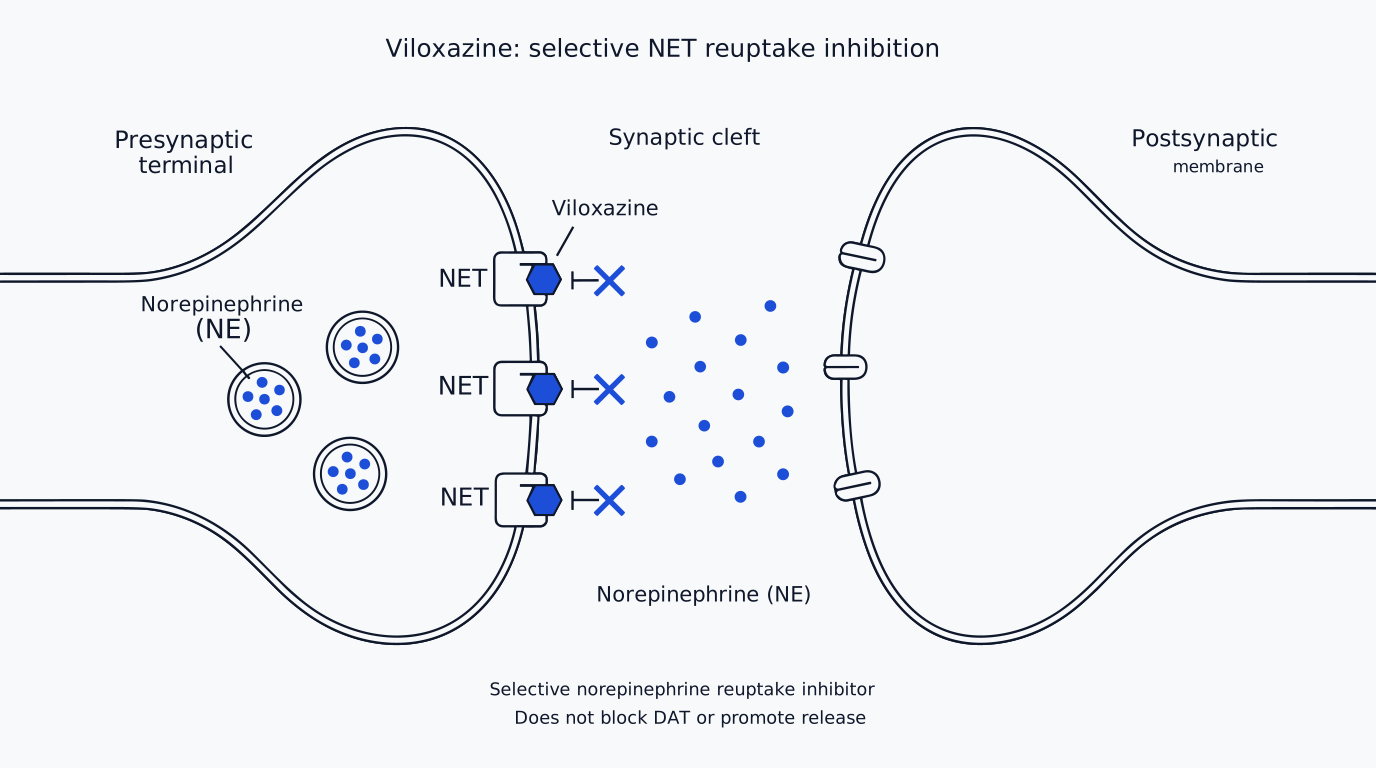
Viloxazine blocks the norepinephrine transporter, so more norepinephrine stays available between nerve cells. It also acts on one type of serotonin receptor (5-HT2C). It does not release dopamine or norepinephrine like stimulants do.
Per labeling, the mechanism of action of viloxazine in ADHD is unclear; it is thought to be through inhibiting the reuptake of norepinephrine. Viloxazine binds to and inhibits the norepinephrine transporter (Ki = 0.13 μM) and binds to and exhibits partial agonist activity at the 5-HT2C receptor (Ki = 0.66 μM). Nonclinical studies suggest potential to inhibit cardiac sodium channels; at 3× the maximum dose there was no clinically relevant QT prolongation.
Formulations and duration
Extended-release capsules taken once daily, with or without food. Swallow whole, or open and sprinkle the entire contents on a teaspoon or tablespoon of applesauce or pudding. Do not cut, crush or chew.
| STRENGTHS | 100 mg, 150 mg, 200 mg extended-release capsules |
|---|---|
| APPROVED AGES | 6 years and older, and adults |
| ADMINISTRATION | Once daily; sprinkled doses: eat within 15 minutes (pudding) or 2 hours (applesauce) |
| CONTROLLED STATUS | Not a controlled substance |
| AVAILABILITY | Brand only (Supernus) |
Contraindications: MAOIs (or within 14 days of stopping one); sensitive CYP1A2 substrates or CYP1A2 substrates with a narrow therapeutic range. Alcohol: 40% alcohol lowered viloxazine Cmax ~32% and AUC ~19% (no effect at 4% or 20%).
Appearance
Qelbree capsules (FDA label; bottles of 30, 60, 90 and 100), printed with edible black ink:
- 100 mg — yellow, “SPN” on cap and “100” on body (NDC 17772-131-30 for 30 count)
- 150 mg — lavender, “SPN” / “150” (NDC 17772-132-30)
- 200 mg — light green, “SPN” / “200” (NDC 17772-133-30)
Check the bottle label for the strength.
Official package photos and pill identifiers:
Generic manufacturers
There is no generic viloxazine extended-release capsule in the U.S. as of October 2026.
| Product | Notes |
|---|---|
| Qelbree (Supernus Pharmaceuticals) | NDA 211964; 100, 150, 200 mg (200 mg is the reference standard) |
| Generic viloxazine ER | None listed in the Orange Book (October 2026) |
Orange Book (October 2026): only the Qelbree NDA is listed for viloxazine.
Common side effects
Boxed warning — suicidal thoughts and behaviors: in clinical trials, higher rates of suicidal thoughts and behavior were reported with Qelbree than with placebo. Closely monitor all patients (the Qelbree box is not limited to children) for worsening and for new suicidal thoughts and behaviors.
Common side effects in children and teens include sleepiness, decreased appetite, tiredness, nausea, vomiting, trouble sleeping and irritability. In adults, trouble sleeping, headache, sleepiness, tiredness, nausea, decreased appetite, dry mouth and constipation are most common.
| EFFECT | FREQUENCY | NOTES |
|---|---|---|
| Sleepiness (somnolence) / tiredness | Common | Caution driving until you know how it affects you |
| Decreased appetite | Common | Weight is monitored |
| Nausea / vomiting | Common | Tell your clinician if it persists |
| Trouble sleeping | Common (especially adults) | Discuss dose timing |
| Higher heart rate or blood pressure | Monitored | Checked before starting and after dose increases |
| Mood changes or suicidal thoughts (boxed warning) | Uncommon but serious | Call your clinician promptly |
Most common adverse reactions (≥5% and ≥2× placebo): pediatric 6–17 — somnolence, decreased appetite, fatigue, nausea, vomiting, insomnia, irritability; adults — insomnia, headache, somnolence, fatigue, nausea, decreased appetite, dry mouth, constipation. Pediatric somnolence (incl. lethargy and sedation) 16% vs 4% placebo. Adult flexible-dose study rates (Qelbree vs placebo): insomnia 23% vs 7%, headache 17% vs 7%, nausea 12% vs 3%, fatigue 12% vs 3%, dry mouth 10% vs 2%, decreased appetite 10% vs 3%. Warnings: suicidal thoughts and behaviors (boxed); blood pressure and heart rate increases; activation of mania or hypomania (screen for bipolar disorder); somnolence and fatigue.
Dosing considerations
Children 6–11 start at 100 mg once a day; teens 12–17 and adults start at 200 mg. Doses go up weekly as needed and tolerated.
This medicine can raise the amount of caffeine and some other medicines in the body. The label already warns about this. A study in healthy adults found that caffeine exposure was about four to six times higher when caffeine was taken with Qelbree.
In a study of people with mild, moderate or severe liver problems, the average amount of Qelbree in the blood stayed within about 25% of people without liver problems. The medicine stayed in the body longer when liver disease was moderate or severe. The label does not give a special liver-dose table. Talk to your prescriber.
CYP1A2: viloxazine is a strong CYP1A2 inhibitor that significantly increases total (not peak) exposure of CYP1A2 substrates. Sensitive CYP1A2 substrates or those with a narrow therapeutic range are contraindicated; moderately sensitive CYP1A2 substrates are not recommended (dose reduction may be warranted). It weakly inhibits CYP2D6 and CYP3A4 — monitor and adjust those substrates as needed. Renal: severe renal impairment (eGFR <30 mL/min/1.73 m²) — start 100 mg once daily, titrate weekly by 50–100 mg to a maximum of 200 mg once daily. No adjustment for mild to moderate renal impairment (eGFR 30–89). The label gives no hepatic-impairment dosing recommendation.
Outside the label (cocktail pharmacokinetic study; see Clinical evidence from published studies): in 37 healthy adults, viloxazine ER 900 mg/day increased caffeine AUCt GMR% to 436.15 (90% CI 398.87–476.92) and AUC∞ GMR% to 583.35 (262.41–1296.80), consistent with strong CYP1A2 inhibition; CYP2D6 and CYP3A4 inhibition was weak (Wang 2024, PubMed 38598106). The label already contraindicates sensitive CYP1A2 substrates.
Outside the label (hepatic-impairment pharmacokinetic study; see Clinical evidence from published studies): in adults with mild, moderate or severe hepatic impairment (n=8 each) versus matched controls, mean viloxazine exposure was within 25% of control values; t½ was longer in moderate (9.3 vs 6.0 h) and severe (14.2 vs 7.1 h) impairment (Wang 2026, PubMed 42503060). This study does not establish a labeled hepatic dose adjustment; the Qelbree label has no hepatic-dosing section.
| Age | Start | Titration | Maximum |
|---|---|---|---|
| 6–11 years | 100 mg once daily | +100 mg at weekly intervals | 400 mg once daily |
| 12–17 years | 200 mg once daily | +200 mg after 1 week | 400 mg once daily |
| Adults | 200 mg once daily | +200 mg at weekly intervals | 600 mg once daily |
Take at about the same time each day, whole or sprinkled. Do not cut, crush or chew.
Pregnancy and breastfeeding
Tell your clinician if you are pregnant, plan to become pregnant, or are breastfeeding. Based on animal studies, Qelbree may harm the mother during pregnancy. The label advises stopping Qelbree when pregnancy is recognized unless the benefits outweigh the possible risk to the mother. There is not enough information from pregnant women to know the risk of birth defects or miscarriage.
A study in breastfeeding women found that small amounts of viloxazine pass into breast milk. Its effects on breastfed babies and on milk supply are not known. If you breastfeed while taking Qelbree, decide together with your clinician.
A national pregnancy registry collects information about medicines used during pregnancy. You or your clinician can enroll by calling 1-866-961-2388.
Pregnancy (label 8.1): based on animal reproduction studies, viloxazine may cause maternal harm; discontinue Qelbree when pregnancy is recognized unless the benefits outweigh the potential risk to the mother. Case-series data are insufficient to determine a drug-associated risk of major birth defects, miscarriage, or adverse maternal outcomes. Animal data: at about the MRHD (600 mg, mg/m² basis), fetal toxicity, delayed fetal development, and possible low incidences of malformations in rats, and maternal toxicity in rabbits; when given to rats and mice during pregnancy and lactation, maternal toxicity and deaths and fetal or offspring toxicity at doses equal to or less than the MRHD. Registry: National Pregnancy Registry for Psychiatric Medications (as named in the label), 1-866-961-2388.
Lactation (label 8.2): a lactation study in 15 women found viloxazine and its metabolite 5-HVLX-gluc in breast milk, with relative infant doses of about 1% and 0.07% of the weight-normalized maternal dose; the label describes this transfer as low. There are no data on effects in the breastfed infant or on milk production. Weigh the benefits of breastfeeding against the mother’s clinical need for Qelbree and any potential effects on the child.
Outside the label: LactMed (NCBI Bookshelf, “Viloxazine,” revised Feb 2025; NBK588747) says amounts in milk appear low and that needing viloxazine is not a reason to stop breastfeeding an older infant, but another drug may be preferred while nursing a newborn or preterm infant until more infant data are available. This is LactMed’s summary of published data, not FDA label content.
Availability and shortages
MARKETED Qelbree is marketed by Supernus and is not on the FDA or ASHP shortage lists as of October 20, 2026. It is brand-only, so check insurance coverage.
This page does not track savings programs; ask the manufacturer (Supernus) or your pharmacy about any current offer.
Checked Oct 20, 2026: FDA Drug Shortages database and ASHP current shortage list — no viloxazine entries. Orange Book: Qelbree RX, no generics.
How Qelbree compares to other nonstimulant options
Rows summarize each product’s FDA labeling; they are not head-to-head comparisons. Unlike stimulants, atomoxetine, viloxazine, guanfacine and clonidine are not controlled substances and are taken every day for continuous coverage, with benefit judged over weeks of titration rather than hours after a dose.
| Medication | Class / action (label) | Dosing and time course | Controlled status / boxed warning | Key safety and practical notes |
|---|---|---|---|---|
| Qelbree (viloxazine ER capsule) | Selective norepinephrine reuptake inhibitor (also 5-HT2C partial agonist) | Once daily; weekly titration; steady state in 2 days; trials 6–8 weeks | Not controlled · Boxed warning: suicidal thoughts (all ages) | Strong CYP1A2 inhibitor: contraindicated with sensitive/narrow-range CYP1A2 substrates. Sprinkle allowed. Brand only. |
| Atomoxetine (Strattera; generics; Atoncy solution) | Selective norepinephrine reuptake inhibitor | Once daily or split twice daily; titrate after ≥3 days; acute trials up to 18 weeks | Not controlled · Boxed warning: suicidal thoughts (ages 6+) | CYP2D6 poor metabolizers/strong 2D6 inhibitors: 4-week titration interval; label states start, target and maximum unchanged. Liver injury warning. Brand discontinued; AB generics. |
| Intuniv (guanfacine ER tablet) | Central α2A-adrenergic agonist | Once daily (AM or PM); +1 mg/week max; trials up to 15 weeks | Not controlled · No boxed warning | Rebound hypertension if stopped abruptly (taper ≤1 mg every 3–7 days). CYP3A4 dose adjustments. Ages 6–17 studied. AB generics. |
| Clonidine ER tablets (Kapvay discontinued) | Centrally acting α2-adrenergic agonist | Twice daily (equal or larger bedtime dose); +0.1 mg/week; max 0.4 mg/day | Not controlled · No boxed warning | Rebound hypertension if stopped abruptly (taper ≤0.1 mg every 3–7 days). Ages 6–17. Kapvay brand discontinued; AB1 generics. |
| Onyda XR (clonidine ER oral suspension) | Centrally acting α2-adrenergic agonist | Once daily at bedtime; +0.1 mg/week; max 0.4 mg | Not controlled · No boxed warning | Rebound hypertension if stopped abruptly (taper ≤0.1 mg every 3–7 days). Liquid 0.1 mg/mL; not mg-for-mg with other clonidine. Ages 6+. |
| Simtriyo (centanafadine ER capsule) | Norepinephrine-dopamine-serotonin reuptake inhibitor; labeled a CNS stimulant | Once daily in the morning; fixed weight-/age-based doses; trials 6 weeks | Schedule III (CIII) · Boxed warnings: pediatric suicidality; abuse/misuse | Approved Jul 24, 2026; DEA Schedule III since Oct 30, 2026; now marketable (check pharmacy availability). Moderate CYP1A2 inhibitor. Ages 6+ and ≥20 kg. |
| Stimulants for contrast (e.g. Concerta, Vyvanse) | Methylphenidate or amphetamine: block (and for amphetamines, release) dopamine and norepinephrine | Effects begin within hours of each dose and wear off the same day (timing depends on formulation; see each label) | Schedule II · Boxed warning: abuse, misuse and addiction | Coverage is tied to dosing time each day, unlike the continuous steady-state coverage of atomoxetine, viloxazine and the alpha-2 agonists. |
Other nonstimulant and newer-mechanism pages: Strattera (atomoxetine), Atoncy (atomoxetine solution), Intuniv, Kapvay (clonidine ER), Onyda XR, Simtriyo. Stimulant overviews: methylphenidate (Ritalin) and amphetamine (Adderall) family pages.
Clinical evidence from published studies
These findings come from published research, not from the FDA label. The FDA label is the official source for approved uses, doses and warnings. Results from studies may not apply to you. Uses marked off-label are not FDA-approved. Talk with your prescriber before making any change.
Items summarize peer-reviewed publications, checked against the PubMed abstract (or full text where stated); figures are reproduced only where the source states them. The FDA label governs approved indications and dosing. Off-label items are not FDA-approved uses. Industry funding or sponsor affiliation is noted where the PubMed record shows it; absence of a note does not mean no industry involvement.
Studies of this medicine (11 studies)
-
Qelbree (viloxazine ER), children 6–11
In a phase 3 trial of 477 children aged 6–11, viloxazine ER 100 mg and 200 mg reduced ADHD symptoms more than placebo, with separation from week 1. Fewer than 5% stopped because of side effects.
Phase 3 RCT (477 randomized; ITT 460): ADHD-RS-5 significant at week 1 (P=0.0004, 0.0244) and at end of study (P=0.0004, <0.0001). Common AEs: somnolence, decreased appetite, headache. AE discontinuation <5%.
Funding / affiliation: Supernus-affiliated authors per PubMed record.
Nasser A, Liranso T, Adewole T, et al. (2020). A Phase III, Randomized, Placebo-controlled Trial to Assess the Efficacy and Safety of Once-daily SPN-812 (Viloxazine Extended-release) in the Treatment of Attention-deficit/Hyperactivity Disorder in School-age Children. Clin Ther 42(8):1452-1466. DOI · PubMed 32723670
-
Qelbree (viloxazine ER), children 6–11
A second pediatric trial (313 children aged 6–11) found viloxazine ER 200 mg and 400 mg reduced ADHD symptoms more than placebo.
Phase 3 RCT, 313 enrolled (ITT 301): ADHD-RS-5 P=0.0038 (200 mg) and 0.0063 (400 mg); Conners 3-PS significant only at 200 mg; WFIRS-P NS. AE discontinuation <5%.
Funding / affiliation: Supernus-affiliated authors per PubMed record.
Nasser A, Liranso T, Adewole T, et al. (2021). Once-Daily SPN-812 200 and 400 mg in the treatment of ADHD in School-aged Children: A Phase III Randomized, Controlled Trial. Clin Ther 43(4):684-700. DOI · PubMed 33750646
-
Qelbree (viloxazine ER), adolescents 12–17
In adolescents aged 12–17, viloxazine ER 200 mg and 400 mg reduced ADHD symptoms more than placebo. Fewer than 5% stopped because of side effects.
Phase 3 RCT (n=310 per abstract methods): ADHD-RS-5 P=0.0232 / 0.0091; CGI-I P=0.0042 / 0.0003; Conners 3 and WFIRS-P not significant. AE discontinuation <5%.
Funding / affiliation: Supernus-affiliated authors per PubMed record.
Nasser A, Liranso T, Adewole T, et al. (2021). A Phase 3, Placebo-Controlled Trial of Once-Daily Viloxazine Extended-Release Capsules in Adolescents With Attention-Deficit/Hyperactivity Disorder. J Clin Psychopharmacol 41(4):370-380. DOI · PubMed 34181360
-
Qelbree (viloxazine ER), adults
In 374 adults, flexibly dosed viloxazine ER (average dose about 500 mg/day by the end) reduced ADHD symptoms more than placebo.
Phase 3 adult RCT, 374 randomized; mean end-of-study dose 504 mg; AISRS −15.5 vs −11.7 (p=0.0040); CGI-S −1.4 vs −1.0 (p=0.0023).
Funding / affiliation: Supernus-affiliated authors per PubMed record.
Nasser A, Hull JT, Chaturvedi SA, et al. (2022). A Phase III, Randomized, Double-Blind, Placebo-Controlled Trial Assessing the Efficacy and Safety of Viloxazine Extended-Release Capsules in Adults with Attention-Deficit/Hyperactivity Disorder. CNS Drugs 36(8):897-915. DOI · PubMed 35896943
-
Qelbree (viloxazine ER)
Pooling 5 trials (1,560 participants, mostly children), viloxazine reduced ADHD symptoms more than placebo. Doses above 400 mg did not appear to add benefit, and improvement levelled off around weeks 4 to 6. About 4% stopped because of side effects, roughly 2.5 times the placebo risk.
Dose-response MA, 5 RCTs, 1,560 participants (mean age 10.6): MD 5.47 points (4.03–6.91). Bell-shaped dose-response; >400 mg or >7 mg/kg may not add efficacy. Curves taper ~weeks 4–6. AE discontinuation 4.15% (45/1,084); RR 2.48 (1.26–4.88).
Yu CL, Kao YC, Thompson T, et al. (2024). Response Trajectories and Temporal Trends of Viloxazine Treatment for Young People With ADHD: A Meta-Analysis. JAMA Netw Open 7(11):e2445885. DOI · PubMed 39560942
-
Qelbree (viloxazine ER), long-term (children and teens)
In a long-term open-label extension of 1,100 children and teens, 8% stopped viloxazine because of side effects. Common side effects were cold symptoms, sleepiness, headache and decreased appetite.
OLE, N=1,100 (646 children, 454 adolescents); median exposure 260 days. AEs ≥5%: nasopharyngitis 9.7%, somnolence 9.5%, headache 8.9%, decreased appetite 6.0%, fatigue 5.7%. AE discontinuation 8.2%. Uncontrolled.
Funding / affiliation: Supernus-affiliated authors/funding per PubMed record.
Findling RL, Katic A, Liebowitz M, et al. (2025). Viloxazine Extended-Release Capsules in Children and Adolescents with Attention-Deficit/Hyperactivity Disorder: Results of a Long-Term, Phase 3, Open-Label Extension Trial. CNS Drugs 39(11):1157-1172. DOI · PubMed 40802027
-
Qelbree (viloxazine ER), adults long-term
In an open-label extension of 159 adults, about 18% stopped viloxazine because of side effects, most often insomnia, nausea or fatigue.
OLE, 159 adults; mean exposure 265 days. TEAEs >10%: insomnia 13.8%, nausea 13.8%, headache 10.7%, fatigue 10.1%. AE discontinuation 17.6%. 73% used ≥400 mg/day. Uncontrolled.
Childress A, Cutler AJ, Adler LA, et al. (2024). An Open-Label Extension Study Assessing the Long-Term Safety and Efficacy of Viloxazine Extended-Release Capsules in Adults with Attention-Deficit/Hyperactivity Disorder. CNS Drugs 38(11):891-907. DOI · PubMed 39373844
-
Qelbree (viloxazine ER), ages 6–17
A meta-analysis of 5 trials (1,605 children and teens) found viloxazine ER led to more responders than placebo, along with more side effects, especially sleepiness. Serious adverse events were numerically more frequent but not statistically different.
SR/MA of 5 RCTs (n=1,605; all low risk of bias). ADHD-RS-5 responders RR 1.62 (95% CI 1.36–1.93); CGI-I improvement RR 1.53 (1.32–1.78); ≥1 AE RR 1.52 (1.24–1.85); somnolence RR 3.93 (2.11–7.31); SAEs RR 2.98 (0.67–13.3; P=.15).
Singh A, Balasundaram MK, Singh A (2022). Viloxazine for Attention-Deficit Hyperactivity Disorder: A Systematic Review and Meta-analysis of Randomized Clinical Trials. J Cent Nerv Syst Dis 14:11795735221092522. DOI · PubMed 35615643
-
Viloxazine ER 400 mg and 600 mg in adolescents (the 400/600 mg trial)
In a trial of 297 teenagers, the 400 mg dose of viloxazine ER improved ADHD symptoms more than placebo. The 600 mg dose did not reach statistical significance. Because the doses were tested in a fixed order, the authors concluded that neither dose could be officially called superior to placebo, and they pointed to a high placebo response at 600 mg.
Phase 3 placebo-controlled trial of once-daily 400 mg and 600 mg viloxazine ER (SPN-812) in adolescents; N=297 randomized. ADHD-RS-5 CFB at end of study (LS mean ± SE): −18.3 ± 1.36 (400 mg), −16.7 ± 1.39 (600 mg), −13.2 ± 1.38 (placebo). Difference vs placebo statistically significant only for 400 mg (p=0.0082); 600 mg p=0.0712. Because of sequential testing, neither dose could be considered superior to placebo. The authors judged the 600 mg result likely due to an unusually high placebo response. Discontinuation for adverse events <5%. This is PMID 34092822, not the 200/400 mg adolescent trial (PMID 34181360).
Funding / affiliation: Authors affiliated with Supernus Pharmaceuticals (manufacturer of Qelbree).
Nasser A, Liranso T, Adewole T, et al. (2021). A Phase 3 Placebo-Controlled Trial of Once-Daily 400-mg and 600-mg SPN-812 (Viloxazine Extended-Release) in Adolescents with ADHD. Psychopharmacol Bull 51(2):43-64. PubMed 34092822
-
Viloxazine ER and CYP1A2, CYP2D6 and CYP3A4 (cocktail study)
When healthy adults took Qelbree with a test dose of caffeine, the total amount of caffeine in the blood rose about four- to six-fold. The medicine also raised levels of two other test drugs a smaller amount. This matches the label’s warning that Qelbree is a strong CYP1A2 inhibitor. Talk to your prescriber about caffeine and other medicines.
37 healthy subjects; viloxazine ER 900 mg/day with a modified Cooperstown cocktail (caffeine, dextromethorphan, midazolam). Caffeine GMR% (90% CI): Cmax 99.11 (95.84–102.49), AUCt 436.15 (398.87–476.92), AUC∞ 583.35 (262.41–1296.80) — about 4.4-fold and 5.8-fold for the two AUC measures. Dextromethorphan AUC∞ GMR% 189.71; midazolam AUC∞ 168.91. Conclusion: strong CYP1A2 inhibitor and a weak CYP2D6 and CYP3A4 inhibitor. CYP2D6 poor vs extensive metabolizer viloxazine Cmax GMR 120.70 and AUC0–24 125.66 (no meaningful change in the viloxazine profile).
Funding / affiliation: Authors affiliated with Supernus Pharmaceuticals (manufacturer of Qelbree).
Wang Z, Liranso T, Maldonado-Cruz Z, et al. (2024). Impact of Viloxazine Extended-Release Capsules (Qelbree(®)) on Select Cytochrome P450 Enzyme Activity and Evaluation of CYP2D6 Genetic Polymorphisms on Viloxazine Pharmacokinetics. Clin Drug Investig 44(5):303-317. DOI · PubMed 38598106
-
Viloxazine ER in hepatic impairment
In adults with mild, moderate or severe liver problems, the average amount of viloxazine in the blood stayed within about 25% of people without liver problems. The medicine stayed in the body longer when liver disease was moderate or severe. The Qelbree label does not give a special liver-dose table; talk to your prescriber.
Adults (18–78 years) with mild, moderate or severe hepatic impairment (n=8 each, Child-Pugh) vs matched controls. Mean exposure for those with HI was within 25% of matched control values. Increased t½ in moderate (9.3 ± 3.1 vs 6.0 ± 1.7 h) and severe (14.2 ± 5.8 vs 7.1 ± 2.7 h) impairment vs controls. Mild-to-severe HI showed minimal impact on viloxazine ER exposure. This pharmacokinetic study does not establish a labeled dose adjustment.
Funding / affiliation: This trial was fully sponsored by Supernus Pharmaceuticals, Inc.
Wang Z, Adewole T, Adeojo LW, et al. (2026). Effect of Hepatic Impairment on the Pharmacokinetics of Single-Dose Viloxazine Extended-Release Capsules (Qelbree(®)) in Adults. Clin Drug Investig 46(10):1121-1135. DOI · PubMed 42503060
How ADHD medicines compare (1 study)
-
Atomoxetine, guanfacine and viloxazine ER in adults vs placebo
A review of adult trials found that atomoxetine and guanfacine reduced ADHD symptoms more than placebo. Guanfacine is not FDA-approved for ADHD in adults in the United States. The review also included one viloxazine ER trial. These are average results across studies, not a comparison of one brand with another.
This review pooled adult trials of atomoxetine, guanfacine and viloxazine ER; it did not report this product separately. Guanfacine is not FDA-approved for ADHD in adults in the United States.
Random-effects meta-analysis updating Cortese 2018; 18 studies (4,308 participants) plus one additional study in a narrative synthesis (374 participants). Atomoxetine (15 RCTs) Hedges’ g = −0.48 (95% CI −0.64 to −0.33); guanfacine (two RCTs) g = −0.66 (−0.94 to −0.38); viloxazine ER (one RCT) was also significantly more efficacious than placebo. Guanfacine is not FDA-approved for ADHD in adults in the US. The abstract does not report 9.3% vs 3.6% adverse-event figures.
Radonjić NV, Bellato A, Khoury NM, et al. (2023). Nonstimulant Medications for Attention-Deficit/Hyperactivity Disorder (ADHD) in Adults: Systematic Review and Meta-analysis. CNS Drugs 37(5):381-397. DOI · PubMed 37166701
Heart and blood pressure (1 study)
-
ADHD medicines (class)
Pooling 102 short-term trials, most ADHD medicines raised blood pressure and pulse modestly, and stimulants did not raise them more than atomoxetine or viloxazine. Guanfacine lowered blood pressure and pulse. The authors advise monitoring blood pressure and pulse with any ADHD medicine, not just stimulants.
NMA of 102 RCTs (13,315 children/adolescents; 9,387 adults; median 7 weeks). Children, mean increase vs placebo: SBP 1.07 (atomoxetine) to 1.81 mm Hg (methylphenidate); DBP 1.93 (amphetamines) to 2.42 (methylphenidate); pulse 2.79 bpm (viloxazine) to 5.58 bpm (atomoxetine). Amphetamines, lisdexamfetamine and methylphenidate not associated with larger increments than atomoxetine or viloxazine. Guanfacine in children: SBP −2.83 (−3.8 to −1.85), DBP −2.08, pulse −4.06. Only four RCTs informed medium-term effects. CINeMA confidence mostly low to moderate in children, very low in adults.
Funding / affiliation: Non-industry (UK NIHR).
Farhat LC, Lannes A, Del Giovane C, et al. (2025). Comparative cardiovascular safety of medications for attention-deficit hyperactivity disorder in children, adolescents, and adults: a systematic review and network meta-analysis. Lancet Psychiatry 12(5):355-365. DOI · PubMed 40203844
Growth (1 study)
-
Viloxazine ER: weight and height over 12 months (interim open-label)
In an ongoing open-label study, children and teens who stayed on viloxazine ER for a year had average weight and height a little below growth-chart expectations (small downward shifts in z-scores). This is an interim look without a placebo comparison, so it cannot prove the medicine caused the change.
Interim results from a long-term open-label study of viloxazine ER. Among 338 subjects at 12 months, mean (SD) weight-for-age z-score was −0.2 (0.5) and height-for-age z-score was −0.14 (1.1). No placebo control at this time point.
Funding / affiliation: Authors affiliated with Supernus Pharmaceuticals (manufacturer of Qelbree).
Nasser A, Hull J, Earnest J, et al. (2023). Effects of Viloxazine ER (Qelbree®) on Weight and Height Trajectories: Interim Results From a Long-term, Open-Label Extension Trial in Pediatric ADHD. CNS Spectr 28(2):218. DOI · PubMed 43010278
Other safety findings (1 study)
-
Qelbree (viloxazine ER), FDA adverse-event reports
An analysis of 546 US adverse-event reports naming viloxazine (2021–2024) found reporting signals for suicidal thoughts, anxiety, irritability and headache, plus unusual ones such as sound sensitivity. Most events were reported within the first 30 days. Spontaneous reports cannot show how often a side effect happens or prove it was caused by the medicine.
FAERS disproportionality analysis, Q2 2021–Q2 2024: 546 reports with viloxazine as primary suspect (of 16,392,056); 64 PT signals across 23 SOCs. Signals included suicidal ideation (EBGM 29.51), anxiety (EBGM 3.47), irritability, headache, hyperacusis (EBGM 54.04), photophobia (EBGM 16.07); most AEs within 30 days of starting. Reporting-rate signals only; no denominator.
Wang S, Jiang Y, Du Z, et al. (2025). Analysis of risk signals for Viloxazine in the treatment of attention deficit hyperactivity disorder based on the FAERS database. J Affect Disord 382:274-281. DOI · PubMed 40274110
ADHD with other conditions (1 study)
-
Qelbree (viloxazine ER), adults with ADHD and depression and/or anxiety symptoms
In a 14-week open-label study in 161 adults with ADHD who also had depression or anxiety symptoms, ADHD, depression and anxiety ratings all improved on viloxazine ER added to existing medicines. There was no placebo group, and the study was run by the maker.
Phase 4, decentralized, open-label (Mar–Dec 2024), viloxazine ER 200–600 mg/day for 14 weeks added to existing medications; n=161 (mean age 39.4, 75.8% female; 99.4% with substantial depression and anxiety symptoms). AISRS total significantly reduced from baseline (37.5 ± 6.53, n=150) to week 14/EOS; depression and anxiety scales improved (all P<.0001). Uncontrolled; Supernus-affiliated authors.
Funding / affiliation: Authors affiliated with Supernus (Qelbree manufacturer) per PubMed record.
Adler LA, Lieberman VR, Brijbasi L, et al. (2026). Viloxazine Extended Release in Adults With Attention-Deficit/Hyperactivity Disorder and Depression and/or Anxiety Symptoms: Results From a Decentralized, Open-Label, Phase 4 Trial. J Clin Psychiatry 87(2). DOI · PubMed 42207988
Pregnancy (1 study)
These research findings do not replace the FDA label. For what the label says, see Pregnancy and breastfeeding above.
-
Qelbree (viloxazine ER), breastfeeding
In 15 healthy breastfeeding women taking the maximum adult dose (600 mg a day), little viloxazine passed into breast milk: the estimated infant dose was about 1.5% of the mother’s weight-adjusted dose. Mild sleepiness was common in the mothers. Infants were not given milk or studied.
Open-label PK study (Supernus), N=15 healthy lactating women ≥12 weeks postpartum, viloxazine ER 600 mg/day × 3 days. Milk Tmax 5.53 h; milk-to-plasma ratio 0.338; estimated daily infant dose 0.134 mg/kg/day; relative infant dose 1.53%. Mild treatment-related AEs in 80% (somnolence 67%). Exposure was estimated, not measured in infants.
Funding / affiliation: All authors employed by Supernus (Qelbree manufacturer) per PubMed record.
Cai Y, Wang Z, Alleyne N, et al. (2026). Pharmacokinetics of Viloxazine ER (Viloxazine Extended-Release Capsules) in Breast Milk of Healthy Lactating Women. J Clin Psychiatry 87(3). DOI · PubMed 42555253
Off-label uses (not FDA-approved) (2 studies)
-
Viloxazine ER added to a stimulant (not FDA-approved as a combination)
In an open-label study, adding Qelbree to a stimulant was followed by a further drop in ADHD symptom scores over 8 weeks, and few people stopped because of side effects. There was no placebo comparison, and combining Qelbree with a stimulant is not an FDA-approved use. The abstract does not state how many people enrolled.
Phase 4, open-label trial of viloxazine ER administered with a psychostimulant in children and adolescents with ADHD. ADHD symptom score change −18.2 ± 10.0 points at week 8 (p<0.0001). Two participants (3.6%) withdrew due to adverse events. Not FDA-approved as combination therapy. The enrolled N is not stated in the abstract (do not infer 56 from the 3.6% figure).
Funding / affiliation: Authors affiliated with Supernus Pharmaceuticals (manufacturer of Qelbree).
Childress A, Asubonteng K, Cox G, et al. (2025). Viloxazine Extended-Release Administered With Psychostimulants in Children and Adolescents With Attention-Deficit/Hyperactivity Disorder: A Phase 4, Open-Label Trial. J Child Adolesc Psychopharmacol 35(3):155-166. DOI · PubMed 40014428
-
Chart review: switching from atomoxetine to viloxazine ER (single practice)
In a small, unblinded chart review from one practice, 50 patients who were switched from atomoxetine to viloxazine ER had lower remaining ADHD symptom scores on viloxazine ER, and fewer stopped for side effects. Because everyone took atomoxetine first, and neither patients nor clinicians were blinded, this cannot prove that one medicine works better than the other.
Retrospective chart review, 50 patients (35 children) at a single practice; fixed sequence (atomoxetine then viloxazine ER), unblinded. ADHD-RS scores were 13.9 ± 10.2 on viloxazine ER vs 33.1 ± 12.1 on atomoxetine. 86% reported a positive response by 2 weeks on viloxazine ER vs 14% on atomoxetine; 36% discontinued atomoxetine for side effects vs 4% who discontinued viloxazine ER. These figures are from an uncontrolled, fixed-sequence, single-practice review.
Price MZ, Price RL (2023). Extended-Release Viloxazine Compared with Atomoxetine for Attention Deficit Hyperactivity Disorder. CNS Drugs 37(7):655-660. DOI · PubMed 37430151
Frequently asked questions
Is Qelbree a stimulant?
No. Viloxazine is a selective norepinephrine reuptake inhibitor and is not a controlled substance.
How long does Qelbree take to work?
The label does not give an onset time. Doses are increased weekly, and in clinical trials benefit was measured after 6–8 weeks of daily treatment. Ask your clinician when to judge whether it is working.
Can Qelbree be sprinkled?
Yes. Open the capsule and sprinkle all of it on a spoonful of applesauce or pudding; eat within 2 hours (applesauce) or 15 minutes (pudding). Do not chew.
What is the boxed warning?
Higher rates of suicidal thoughts and behavior were reported with Qelbree than placebo in clinical trials. All patients should be watched closely for worsening mood or suicidal thoughts.
Which medicines interact with Qelbree?
Qelbree strongly blocks the liver enzyme CYP1A2. Do not take it with sensitive CYP1A2 medicines such as tizanidine, theophylline, duloxetine, ramelteon, tasimelteon or alosetron, or with an MAOI. Review all medicines with your prescriber or pharmacist.
Can adults take Qelbree?
Yes. It is approved for adults and for children 6 and older. The adult maximum is 600 mg once daily.
Is there a generic Qelbree?
No. As of October 2026 it is brand-only in the U.S.
Does it need to be taken every day?
Yes. It is designed for continuous daily use, not as-needed doses.
How is it different from atomoxetine?
Both block norepinephrine reuptake and carry a suicidality boxed warning. Qelbree can be sprinkled, is a strong CYP1A2 inhibitor and is brand-only; atomoxetine capsules should not be opened, are mainly affected by CYP2D6, and are generic.
Can Qelbree be taken with food?
Yes. Qelbree can be taken with or without food (label section 2.3). A high-fat meal lowered the peak level and total exposure by under 10% and delayed the peak by about 2 hours (label section 12.3).
What should I do if I miss a dose of Qelbree?
The Qelbree label does not give specific missed-dose steps; the Medication Guide says to talk to your healthcare provider about what to do if a dose is missed.
What are the most common side effects of Qelbree?
In children 6 to 17, the Medication Guide lists sleepiness, tiredness, vomiting, irritability, decreased appetite, nausea and trouble sleeping. In adults, it lists trouble sleeping, sleepiness, nausea, dry mouth, headache, tiredness, decreased appetite and constipation (label section 6.1). These are not all the possible side effects; call your prescriber for advice about side effects that bother you.
Can I take Qelbree while pregnant or breastfeeding?
Tell your clinician if you are pregnant or planning a pregnancy. Based on animal studies, Qelbree may harm the mother, and the label advises stopping it when pregnancy is recognized unless the benefits outweigh the risk. Small amounts pass into breast milk, and effects on the baby are not known, so decide about breastfeeding together with your clinician. A pregnancy registry can be reached at 1-866-961-2388.
Prescribing guidelines
Guidelines generally place stimulants first for most school-age children, adolescents and adults when medication is indicated, with atomoxetine, extended-release guanfacine and extended-release clonidine as evidence-based alternatives or (for the alpha-2 agonists) add-on options. Viloxazine and centanafadine were approved after the 2019 AAP guideline, so it does not address them.
Resources
Sources
- Supernus Pharmaceuticals, Inc. Qelbree (viloxazine extended-release capsules). Prescribing Information, revised 01/2025. DailyMed; DailyMed version published Oct 08, 2026 (accessed Oct 2026).
- U.S. Food and Drug Administration. Approved Drug Products with Therapeutic Equivalence Evaluations (Orange Book), data files dated October 2026. FDA.
- U.S. Food and Drug Administration. Drug Shortages database, accessed Oct 20, 2026 (no current-shortage entries for atomoxetine, viloxazine, guanfacine, clonidine or centanafadine; guanfacine ER tablets appear only on the discontinuation list). FDA.
- American Society of Health-System Pharmacists. Current Drug Shortage Bulletins list, accessed Oct 20, 2026 (no atomoxetine, viloxazine, guanfacine, clonidine or centanafadine entries). ASHP.
- Wolraich ML, Hagan JF Jr, Allan C, et al.; American Academy of Pediatrics Subcommittee on Children and Adolescents with ADHD. Clinical Practice Guideline for the Diagnosis, Evaluation, and Treatment of Attention-Deficit/Hyperactivity Disorder in Children and Adolescents. Pediatrics. 2019;144(4):e20192528. AAP.
- Centers for Disease Control and Prevention. Clinical Care of ADHD in Children (summary of the AAP guideline; updated Oct 21, 2026). CDC (accessed 2026).
- Drugs and Lactation Database (LactMed). Viloxazine. National Institute of Child Health and Human Development; revised Feb 2025. NCBI Bookshelf NBK588747.