
Kapvay (Clonidine ER)
NONSTIMULANTS · ALPHA-2 ADRENERGIC AGONIST · EXTENDED-RELEASE TABLETS
Key facts
- Drug class
- Alpha-2 Adrenergic Agonist · Nonstimulants
- Active ingredient
- clonidine
- Studied ages (label)
- 6–17 years (monotherapy or adjunct to a stimulant)
- Form and strengths
- Extended-release tablet; 0.1 mg extended-release tablet (generic)
- Usual dose and maximum (label)
- Start 0.1 mg at bedtime; maximum 0.4 mg/day, split into morning and bedtime doses.
- Duration
- Taken twice daily, every day; the label does not describe hour-by-hour effects (half-life about 12–13 hours).
- DEA schedule
- Not a controlled substance
- Generic
- AB1 generics (see Generic manufacturers)
- Label date
- Prescribing Information revised 10/2025 (DailyMed)
Label last checked: Oct 2026 — Prescribing Information revised 10/2025 (DailyMed) · Last medical review: November 4, 2026
Educational information only, not medical advice. Do not start, stop or change a medication without your prescriber. Medical disclaimer
What it is
Clonidine ER is a nonstimulant tablet usually taken twice a day (morning and bedtime). It is not a controlled substance and can be used alone or with a stimulant. The Kapvay brand has been discontinued; generic clonidine ER 0.1 mg tablets are available.
Do not stop suddenly: abrupt discontinuation of an alpha-2 agonist can cause rebound hypertension (labels describe headache, tachycardia, nausea, flushing and rapid rises in blood pressure; hypertensive encephalopathy has been reported with guanfacine). Taper as directed, and watch for missed doses during vomiting illnesses.
Centrally acting alpha-2 adrenergic agonist (clonidine initial U.S. approval 1974); ER tablets are indicated for ADHD as monotherapy or adjunctive therapy to stimulants, with safety and efficacy established in ages 6–17. No boxed warning. Kapvay (NDA 022331, 0.1 and 0.2 mg) and its twin brand Jenloga are DISCN in the Orange Book (Federal Register determination: not withdrawn for safety or effectiveness). Seven AB1-rated 0.1 mg generics are RX; the Ajanta product is the reference standard. Not interchangeable mg-for-mg with immediate-release clonidine, the patch, Onyda XR, or Nexiclon XR.
When considering this for a patient
Clonidine ER is often considered when hyperactivity, impulsivity or sleep-onset problems are prominent, when stimulants are not tolerated or only partly effective (it is labeled as add-on therapy), or when a non-controlled medicine is preferred. These are clinical-practice reasons, not label-studied subgroups.
Measure heart rate and blood pressure before starting, after dose increases, and periodically. Titrate slowly in patients at risk of hypotension, bradycardia, heart block or syncope; avoid dehydration and overheating. Sedation is common. Missed doses (for example during a vomiting illness) raise the risk of rebound hypertension.
Patient profile and niche
Clonidine ER may be particularly useful in the following situations:
- Children and teens 6–17 who need a nonstimulant, or extra control on top of a stimulant.
- Families who prefer a non-controlled medicine.
- Children who have trouble settling at night, where a larger bedtime dose fits the routine (a practice consideration).
- Patients who prefer an inexpensive generic tablet.
Less suited when low blood pressure, slow heart rate or fainting are concerns, when daytime sleepiness would be a problem, or when twice-daily doses are likely to be missed. For a once-nightly liquid clonidine, see Onyda XR.
When it is active
Clonidine ER tablets are taken twice a day, every day. With a half-life of about 12–13 hours, blood levels stay present around the clock once steady state is reached; each ER dose peaks about 6.5 hours after it is taken. The label does not describe hour-by-hour effects; doses are raised weekly and trials measured benefit over several weeks.
The chart shows the schematic steady-state blood level across 24 hours for an equal morning and bedtime dose. Change the times to match your routine.
Enter your usual dose time and day. The curve shows the schematic blood level after several days of daily dosing (steady state), across a full 24 hours. It does not show when the medicine ‘works’: for this medicine, benefit is judged over weeks, not hour by hour.
The curve shows relative blood level, not clinical effect. Benefit is judged over weeks of daily dosing and titration.
At 0.3 mg/day the bedtime dose is larger (0.2 mg) than the morning dose (0.1 mg). Everyone is different; this is a schematic, not a prediction.
How it works
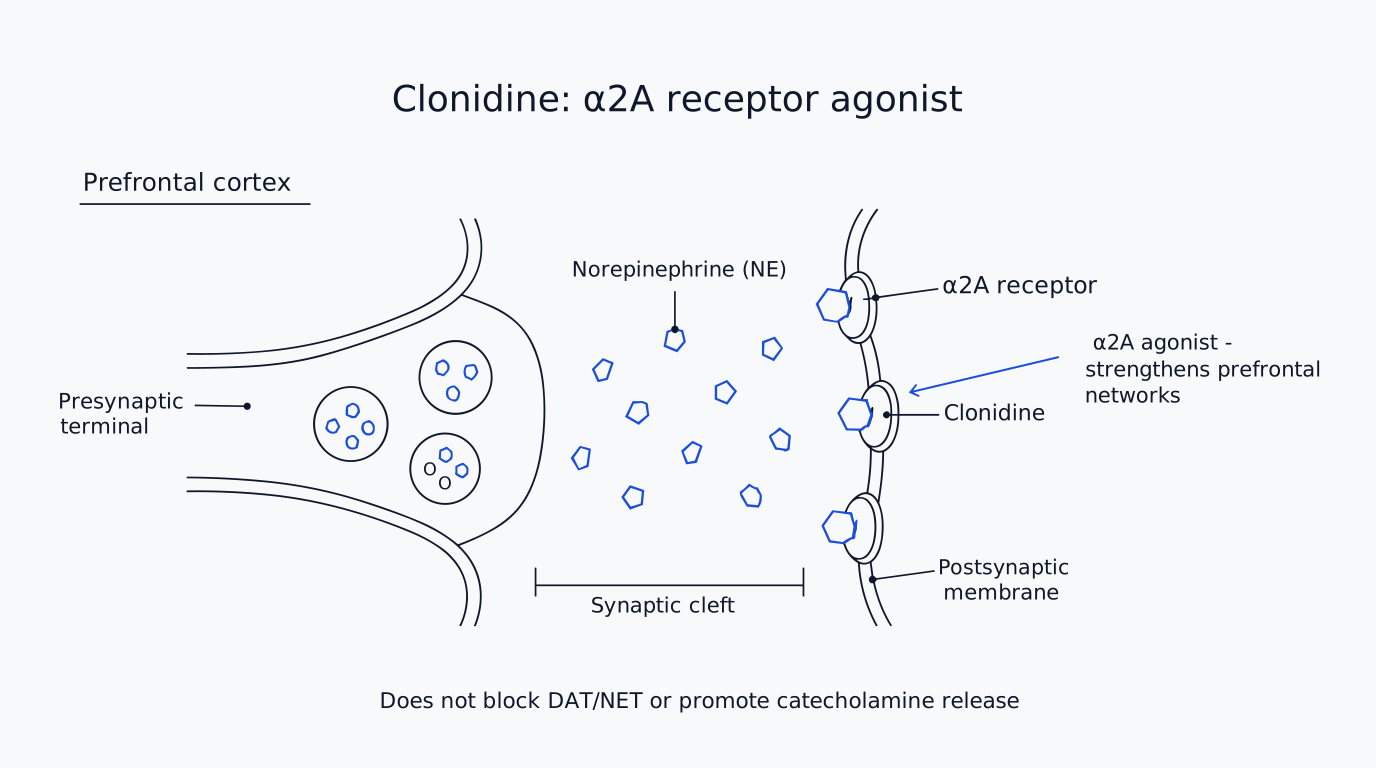
Clonidine stimulates alpha-2 receptors in the brain. It is not a stimulant and does not block dopamine or norepinephrine transporters. The same action lowers blood pressure and heart rate, which is why those are monitored.
Reduces sympathetic outflow
Per labeling, clonidine stimulates alpha-2-adrenergic receptors in the brain, is not a central nervous system stimulant, and its mechanism of action in ADHD is not known. By stimulating alpha-2 receptors in the brain stem it reduces sympathetic outflow, lowering blood pressure and heart rate. About 50% of an absorbed dose is metabolized in the liver and 40–60% is excreted unchanged in urine.
Formulations and duration
Extended-release 0.1 mg tablets, swallowed whole (do not crush, cut or chew), with or without food. The Kapvay brand (0.1 and 0.2 mg) is discontinued.
| STRENGTH | 0.1 mg extended-release tablet (generic) |
|---|---|
| STUDIED AGES | 6–17 years (monotherapy or adjunct to a stimulant) |
| DOSING | Twice daily; equal doses or a larger bedtime dose |
| CONTROLLED STATUS | Not a controlled substance |
| SWITCHING | Not mg-for-mg with other clonidine products (immediate-release, patch, Onyda XR) |
Missed dose: skip it and take the next dose as scheduled; do not exceed the total daily dose in 24 hours.
Appearance
Examples of generic clonidine ER 0.1 mg tablets (FDA labels on DailyMed):
- Ajanta — white to off-white, round, biconvex, debossed “CL” on one side (NDC 27241-108-06, bottles of 60)
- Actavis — pink, round, unscored, company logo on one side and “241” on the other (NDC 0228-4241-06, bottles of 60)
Other generic makers’ tablets look different. Kapvay brand tablets are no longer marketed. Check the bottle label for the strength.
Official package photos and pill identifiers:
Generic manufacturers
Generic clonidine ER 0.1 mg tablets are rated AB1 (therapeutically equivalent to the original Kapvay).
| Product | Notes |
|---|---|
| Kapvay / Jenloga (Concordia) | NDA 022331 — discontinued (not for safety or effectiveness reasons) |
| AB1-rated clonidine ER 0.1 mg (Orange Book, RX) | Actavis (Teva), Ajanta (reference standard), Chartwell, Jubilant, Novast, Somerset, Xiamen LP |
| Discontinued generics | Actavis 0.2 mg, Amneal, PH Health, Rubicon (Orange Book DISCN) |
Orange Book (October 2026). Note: Nexiclon XR (clonidine ER 0.17 mg, NDA 022500) is a different product labeled for hypertension, not ADHD.
Common side effects
Do not stop suddenly: abrupt discontinuation of an alpha-2 agonist can cause rebound hypertension (labels describe headache, tachycardia, nausea, flushing and rapid rises in blood pressure; hypertensive encephalopathy has been reported with guanfacine). Taper as directed, and watch for missed doses during vomiting illnesses.
Common side effects include sleepiness, tiredness, irritability, nightmares, trouble sleeping, constipation and dry mouth. When added to a stimulant, sleepiness, tiredness, decreased appetite and dizziness are most common.
| EFFECT | FREQUENCY | NOTES |
|---|---|---|
| Sleepiness / sedation | Common | Caution with driving; often most noticeable early |
| Tiredness | Common | |
| Irritability, nightmares, trouble sleeping | Common | Tell your clinician |
| Constipation, dry mouth | Common | Usually mild |
| Low blood pressure, slow heart rate, fainting | Uncommon | Monitored; avoid dehydration and overheating |
| Rebound high blood pressure if stopped suddenly | Serious | Always taper |
Most common adverse reactions (≥5% and ≥2× placebo): monotherapy — somnolence, fatigue, irritability, nightmare, insomnia, constipation, dry mouth; adjunct to psychostimulant — somnolence, fatigue, decreased appetite, dizziness. Warnings: hypotension/bradycardia/syncope; somnolence/sedation; rebound hypertension; allergic reactions (including in people sensitized by the clonidine patch); cardiac conduction abnormalities. Interactions: CNS depressants and alcohol; tricyclic antidepressants may reduce the hypotensive effect; caution with drugs affecting sinus node or AV conduction (digitalis, calcium channel blockers, beta-blockers) and with antihypertensives. Contraindication: hypersensitivity to clonidine.
Beta-blockers and stopping clonidine: this label warns of additive bradycardia and AV block with drugs that slow heart rate or AV conduction, including beta-blockers (section 7 table: avoid use), and requires a taper of no more than 0.1 mg every 3–7 days (Kapvay generic label 2.3). It does not address sequencing. Other clonidine labeling (Catapres-TTS and immediate-release clonidine tablets, Warnings: Withdrawal) notes that withdrawal reactions appear more likely with continued beta-blockade and advises, when both drugs are being stopped, withdrawing the beta-blocker several days before the gradual clonidine discontinuation.
Dosing considerations
Start with 0.1 mg at bedtime for one week, then increase by 0.1 mg a day each week as needed, split into a morning and a bedtime dose. The maximum studied dose is 0.4 mg a day.
Doses above 0.4 mg/day (0.2 mg twice daily) were not evaluated for ADHD and are not recommended. When added to a stimulant, the stimulant dose can be adjusted based on response. Renal impairment: base the starting dose on the degree of impairment, monitor for hypotension and bradycardia, and titrate cautiously; supplemental dosing after dialysis is not needed. Discontinuation: taper the total daily dose by no more than 0.1 mg every 3–7 days.
| Total daily dose | Morning | Bedtime |
|---|---|---|
| 0.1 mg/day | — | 0.1 mg |
| 0.2 mg/day | 0.1 mg | 0.1 mg |
| 0.3 mg/day | 0.1 mg | 0.2 mg |
| 0.4 mg/day | 0.2 mg | 0.2 mg |
Do not substitute other clonidine products mg-for-mg; when switching, stop the old product and titrate as above.
Pregnancy and breastfeeding
Tell your clinician if you are pregnant, plan to become pregnant, or are breastfeeding. Decades of clonidine use in pregnancy have not shown a higher risk of major birth defects or miscarriage.
Clonidine passes into breast milk. Most breastfed babies have had no problems, but one baby had sleepiness, floppy muscles, and pauses in breathing. If you breastfeed, watch the baby for sleepiness, unusual tiredness, fast breathing, or poor feeding, and decide together with your clinician.
A national pregnancy registry collects information about medicines used during pregnancy. You or your clinician can enroll by calling 1-866-961-2388.
Pregnancy (label 8.1, current clonidine hydrochloride extended-release tablet label (Ajanta) used for this page): decades of published experience with clonidine in pregnancy (controlled trials, a retrospective cohort study, and case reports) have not identified a drug-associated risk of major birth defects, miscarriage, or adverse maternal or fetal outcomes. Animal data: increased resorptions in rats and mice at 10 and 5 times the adolescent MRHD (0.4 mg/day) and in rats dosed continuously from before mating at 1/3 of the MRHD; no developmental effects in rabbits at up to 3 times the MRHD. Registry: National Pregnancy Registry for ADHD Medications (as named in the label), 1-866-961-2388.
Lactation (label 8.2): clonidine is present in human milk at relative infant doses of 4.1% to 8.4% of the maternal weight-adjusted dose. Most exposed infants had no reported adverse effects, but there is one case report of sedation, hypotonia, and apnea. Monitor exposed infants for hypotension or bradycardia (sedation, lethargy, tachypnea, poor feeding), weigh the benefits of breastfeeding against the mother’s clinical need, and use caution when giving it to a nursing woman.
Outside the label: LactMed (NCBI Bookshelf, “Clonidine,” revised Nov 2024; NBK501628) notes high blood levels in some breastfed infants, possible infant side effects, and possible negative effects on lactation, and (in the context of blood-pressure treatment) prefers other agents, especially while nursing a newborn or preterm infant. This is LactMed’s summary of published data, not FDA label content.
Availability and shortages
GENERICS AVAILABLE Generic clonidine ER 0.1 mg tablets are available from several makers and are not on the FDA or ASHP shortage lists as of October 20, 2026. The Kapvay brand is discontinued.
For a once-nightly clonidine liquid, see Onyda XR.
Checked Oct 20, 2026: FDA Drug Shortages database and ASHP current shortage list — no clonidine ER tablet entries. Orange Book: Kapvay DISCN; seven AB1 generics RX.
How Kapvay (clonidine ER) compares to other nonstimulant options
Rows summarize each product’s FDA labeling; they are not head-to-head comparisons. Unlike stimulants, atomoxetine, viloxazine, guanfacine and clonidine are not controlled substances and are taken every day for continuous coverage, with benefit judged over weeks of titration rather than hours after a dose.
| Medication | Class / action (label) | Dosing and time course | Controlled status / boxed warning | Key safety and practical notes |
|---|---|---|---|---|
| Clonidine ER tablets (Kapvay discontinued) | Centrally acting α2-adrenergic agonist | Twice daily (equal or larger bedtime dose); +0.1 mg/week; max 0.4 mg/day | Not controlled · No boxed warning | Rebound hypertension if stopped abruptly (taper ≤0.1 mg every 3–7 days). Ages 6–17. Kapvay brand discontinued; AB1 generics. |
| Onyda XR (clonidine ER oral suspension) | Centrally acting α2-adrenergic agonist | Once daily at bedtime; +0.1 mg/week; max 0.4 mg | Not controlled · No boxed warning | Rebound hypertension if stopped abruptly (taper ≤0.1 mg every 3–7 days). Liquid 0.1 mg/mL; not mg-for-mg with other clonidine. Ages 6+. |
| Intuniv (guanfacine ER tablet) | Central α2A-adrenergic agonist | Once daily (AM or PM); +1 mg/week max; trials up to 15 weeks | Not controlled · No boxed warning | Rebound hypertension if stopped abruptly (taper ≤1 mg every 3–7 days). CYP3A4 dose adjustments. Ages 6–17 studied. AB generics. |
| Atomoxetine (Strattera; generics; Atoncy solution) | Selective norepinephrine reuptake inhibitor | Once daily or split twice daily; titrate after ≥3 days; acute trials up to 18 weeks | Not controlled · Boxed warning: suicidal thoughts (ages 6+) | CYP2D6 poor metabolizers/strong 2D6 inhibitors: 4-week titration interval; label states start, target and maximum unchanged. Liver injury warning. Brand discontinued; AB generics. |
| Qelbree (viloxazine ER capsule) | Selective norepinephrine reuptake inhibitor (also 5-HT2C partial agonist) | Once daily; weekly titration; steady state in 2 days; trials 6–8 weeks | Not controlled · Boxed warning: suicidal thoughts (all ages) | Strong CYP1A2 inhibitor: contraindicated with sensitive/narrow-range CYP1A2 substrates. Sprinkle allowed. Brand only. |
| Simtriyo (centanafadine ER capsule) | Norepinephrine-dopamine-serotonin reuptake inhibitor; labeled a CNS stimulant | Once daily in the morning; fixed weight-/age-based doses; trials 6 weeks | Schedule III (CIII) · Boxed warnings: pediatric suicidality; abuse/misuse | Approved Jul 24, 2026; DEA Schedule III since Oct 30, 2026; now marketable (check pharmacy availability). Moderate CYP1A2 inhibitor. Ages 6+ and ≥20 kg. |
| Stimulants for contrast (e.g. Concerta, Vyvanse) | Methylphenidate or amphetamine: block (and for amphetamines, release) dopamine and norepinephrine | Effects begin within hours of each dose and wear off the same day (timing depends on formulation; see each label) | Schedule II · Boxed warning: abuse, misuse and addiction | Coverage is tied to dosing time each day, unlike the continuous steady-state coverage of atomoxetine, viloxazine and the alpha-2 agonists. |
Other nonstimulant and newer-mechanism pages: Strattera (atomoxetine), Atoncy (atomoxetine solution), Qelbree, Intuniv, Onyda XR, Simtriyo. Stimulant overviews: methylphenidate (Ritalin) and amphetamine (Adderall) family pages.
Clinical evidence from published studies
These findings come from published research, not from the FDA label. The FDA label is the official source for approved uses, doses and warnings. Results from studies may not apply to you. Uses marked off-label are not FDA-approved. Talk with your prescriber before making any change.
Items summarize peer-reviewed publications, checked against the PubMed abstract (or full text where stated); figures are reproduced only where the source states them. The FDA label governs approved indications and dosing. Off-label items are not FDA-approved uses. Industry funding or sponsor affiliation is noted where the PubMed record shows it; absence of a note does not mean no industry involvement.
Studies of this medicine (6 studies)
-
Clonidine ER (Kapvay) monotherapy, 6–17
In 236 children and teens, clonidine extended-release tablets at 0.2 or 0.4 mg/day reduced ADHD symptoms more than placebo, starting as early as week 2. Sleepiness was the most common side effect. These trials studied Kapvay, a twice-daily extended-release tablet.
RCT, N=236 (placebo 78; 0.2 mg 78; 0.4 mg 80): ADHD-RS-IV improvement significant at week 5 and from week 2. Somnolence most common TEAE; minor ECG changes.
Jain R, Segal S, Kollins SH, et al. (2011). Clonidine extended-release tablets for pediatric patients with attention-deficit/hyperactivity disorder. J Am Acad Child Adolesc Psychiatry 50(2):171-9. DOI · PubMed 21241954
-
Clonidine ER (Kapvay) added to a stimulant
In 198 children and teens with a partial response to a stimulant, adding clonidine extended-release tablets reduced ADHD symptoms more than adding placebo. This trial studied Kapvay, a twice-daily extended-release tablet.
Adjunctive RCT, 198 randomized (102 CLON-XR, 96 placebo): ADHD-RS-IV difference 95% CI −7.83 to −1.13 (P=.009) at week 5.
Kollins SH, Jain R, Brams M, et al. (2011). Clonidine extended-release tablets as add-on therapy to psychostimulants in children and adolescents with ADHD. Pediatrics 127(6):e1406-13. DOI · PubMed 21555501
-
Once-daily clonidine ER tablets (a different product, studied in China)
In a 6-week Chinese trial (75 children and teens, assigned 2:1), once-daily clonidine extended-release tablets (target 0.2 mg/day) reduced ADHD symptoms more than placebo. This was a different product (a tablet), not Onyda XR (an oral suspension).
Phase 3 RCT, n=75 (6–17 y), 2:1, once-daily CLON-XR target 0.2 mg/day: SNAP-IV −17.5 vs −10.3 (p=0.0039). TEAEs comparable to placebo; dropout 5.3%.
Qian Y, Ke X, Gao F, et al. (2026). Efficacy and Safety of Extended-Release Clonidine Hydrochloride for Attention Deficit Hyperactivity Disorder in Chinese Children and Adolescents: A Multicenter, Randomized, Double-Blind, Placebo-Controlled Trial. J Child Adolesc Psychopharmacol 36(5):278-286. DOI · PubMed 41944053
-
Alpha-2 agonists (clonidine IR/ER, guanfacine ER), youth
A meta-analysis of 12 trials (2,276 youth) found clonidine and guanfacine reduced ADHD symptoms more than placebo, alone or added to a stimulant (smaller effect when added). Tiredness, sedation and sleepiness were more common, and clonidine lowered blood pressure and heart rate.
This review pooled immediate-release and extended-release clonidine with guanfacine; it did not study this product alone.
SR/MA (to May 2013): 12 RCTs, N=2,276. Monotherapy (9 studies, n=1,550): overall ADHD SMD −0.59, hyperactivity/impulsivity −0.56, inattention −0.57, ODD −0.44. Add-on (3 studies, n=726): SMD −0.36. Monotherapy all-cause discontinuation RR 0.70 (NNT 10); fatigue NNH 10, sedation NNH 17, somnolence NNH 4; hypotensive and bradycardic effects with clonidine-IR, QTc prolongation with guanfacine-XR; add-on: hypotension/bradycardia with clonidine-XR and guanfacine-XR.
Hirota T, Schwartz S, Correll CU (2014). Alpha-2 agonists for attention-deficit/hyperactivity disorder in youth: a systematic review and meta-analysis of monotherapy and add-on trials to stimulant therapy. J Am Acad Child Adolesc Psychiatry 53(2):153-73. DOI · PubMed 24472251
-
Clonidine (mostly immediate-release), children and teens
An early meta-analysis of 11 studies found a moderate effect of clonidine on ADHD symptoms, smaller than stimulants, with many side effects. Most included studies used immediate-release clonidine.
This study used immediate-release clonidine taken in divided doses, not the extended-release product on this page.
Meta-analysis (literature 1980–1999: 39 studies, 11 with sufficient data). Weighted effect size 0.58 ± 0.16 (95% CI 0.27–0.89) in children and adolescents with ADHD alone or with conduct disorder, developmental delay or tics. Authors: possible second-tier treatment, effect size below stimulants, many side effects. Pre-dates clonidine ER.
Connor DF, Fletcher KE, Swanson JM (1999). A meta-analysis of clonidine for symptoms of attention-deficit hyperactivity disorder. J Am Acad Child Adolesc Psychiatry 38(12):1551-9. DOI · PubMed 10596256
-
Clonidine (immediate-release) alone or with methylphenidate, children 7–12
In a 16-week trial in 122 children, clonidine did not improve teacher-rated ADHD symptoms, while methylphenidate did. Clonidine did improve parent ratings and overall functioning but caused more sedation. The authors judged methylphenidate the best balance of benefit and tolerability.
This study used immediate-release clonidine taken in divided doses, not the extended-release product on this page.
Randomized, double-blind, placebo-controlled 2×2 factorial (clonidine, MPH, combination, placebo), 16 weeks, n=122, ages 7–12, divided dosing (IR clonidine). Primary (Conners Teacher ASQ): no clonidine effect; MPH significant. Clonidine improved Conners Parent ASQ and CGAS, with more sedation.
Palumbo DR, Sallee FR, Pelham WE Jr, et al. (2008). Clonidine for attention-deficit/hyperactivity disorder: I. Efficacy and tolerability outcomes. J Am Acad Child Adolesc Psychiatry 47(2):180-188. DOI · PubMed 18182963
How ADHD medicines compare (2 studies)
-
ADHD medicines (class)
A large analysis of 133 short-term trials found that every ADHD medicine studied worked better than placebo on clinician ratings in children and teens. Amphetamines had the largest average effect, and methylphenidate was the only medicine also shown to beat placebo on teacher ratings. Amphetamines and guanfacine led to more stopping for side effects than placebo in children. Weighing benefit and side effects, the authors favored methylphenidate first in children and amphetamines first in adults. There was too little data to judge effects beyond about 12 weeks.
Network meta-analysis of 133 double-blind RCTs (efficacy near 12 wk: 10,068 children/adolescents; 8,131 adults). Children, clinician-rated SMD vs placebo: amphetamines −1.02 (95% CI −1.19 to −0.85), methylphenidate −0.78 (−0.93 to −0.62), atomoxetine −0.56 (−0.66 to −0.45). Teacher-rated: only methylphenidate (−0.82, −1.16 to −0.48) and modafinil separated from placebo. Adults, clinician-rated: amphetamines −0.79 (−0.99 to −0.58), methylphenidate −0.49 (−0.64 to −0.35), atomoxetine −0.45 (−0.58 to −0.32). Discontinuation for adverse events vs placebo: amphetamines OR 2.30 (1.36–3.89) in children and 3.26 (1.54–6.92) in adults; guanfacine 2.64 (1.20–5.81) in children; atomoxetine 2.33 (1.28–4.25) and methylphenidate 2.39 (1.40–4.08) in adults only. Head-to-head clinician-rated efficacy favored amphetamines over methylphenidate, atomoxetine and modafinil. Insufficient data at 26 and 52 weeks.
Funding / affiliation: Non-industry (Stichting Eunethydis; UK NIHR Oxford Health BRC).
Cortese S, Adamo N, Del Giovane C, et al. (2018). Comparative efficacy and tolerability of medications for attention-deficit hyperactivity disorder in children, adolescents, and adults: a systematic review and network meta-analysis. Lancet Psychiatry 5(9):727-738. DOI · PubMed 30097390
-
ADHD treatments in children and teens (class)
Across 190 trials in children and teens, methylphenidate, amphetamine, atomoxetine, guanfacine and clonidine all worked better than placebo. Methylphenidate and amphetamine appeared more effective than atomoxetine and guanfacine. Behavioral therapy combined with a stimulant appeared better than either medicine type alone. Most effective medicines also caused harms such as reduced appetite, weight loss and sleep problems.
Bayesian network meta-analyses of 190 RCTs (52 interventions, 26,114 participants; ≥3 weeks follow-up). Medications more efficacious than placebo: methylphenidate, amphetamine, atomoxetine, guanfacine, clonidine. Methylphenidate and amphetamine more efficacious than atomoxetine and guanfacine; methylphenidate and clonidine better accepted (all-cause discontinuation) than placebo and atomoxetine. Behavioural therapy plus stimulants appeared superior to stimulants or nonstimulants alone. Harms included anorexia, weight loss and insomnia. Results expressed as ORs with credible intervals (not reproduced here).
Catalá-López F, Hutton B, Núñez-Beltrán A, et al. (2017). The pharmacological and non-pharmacological treatment of attention deficit hyperactivity disorder in children and adolescents: A systematic review with network meta-analyses of randomised trials. PLoS One 12(7):e0180355. DOI · PubMed 28700715
Heart and blood pressure (2 studies)
-
ADHD medicines (class)
Pooling 102 short-term trials, most ADHD medicines raised blood pressure and pulse modestly, and stimulants did not raise them more than atomoxetine or viloxazine. Guanfacine lowered blood pressure and pulse. The authors advise monitoring blood pressure and pulse with any ADHD medicine, not just stimulants.
NMA of 102 RCTs (13,315 children/adolescents; 9,387 adults; median 7 weeks). Children, mean increase vs placebo: SBP 1.07 (atomoxetine) to 1.81 mm Hg (methylphenidate); DBP 1.93 (amphetamines) to 2.42 (methylphenidate); pulse 2.79 bpm (viloxazine) to 5.58 bpm (atomoxetine). Amphetamines, lisdexamfetamine and methylphenidate not associated with larger increments than atomoxetine or viloxazine. Guanfacine in children: SBP −2.83 (−3.8 to −1.85), DBP −2.08, pulse −4.06. Only four RCTs informed medium-term effects. CINeMA confidence mostly low to moderate in children, very low in adults.
Funding / affiliation: Non-industry (UK NIHR).
Farhat LC, Lannes A, Del Giovane C, et al. (2025). Comparative cardiovascular safety of medications for attention-deficit hyperactivity disorder in children, adolescents, and adults: a systematic review and network meta-analysis. Lancet Psychiatry 12(5):355-365. DOI · PubMed 40203844
-
Clonidine (immediate-release) alone or with methylphenidate, children
In the same 16-week trial, slow heart rate occurred more often with clonidine (18% vs 3%), but there were no other differences in ECG or heart outcomes and no sign that clonidine and methylphenidate together were worse for the heart. Drowsiness was common at first and usually faded by 6 to 8 weeks.
This study used immediate-release clonidine taken in divided doses, not the extended-release product on this page.
Safety report of the CAT trial: clonidine (n=31), MPH (n=29), combination (n=32), placebo (n=30); clonidine up to 0.6 mg/day, MPH up to 60 mg/day, divided doses. Bradycardia 17.5% vs 3.4% (p=.02); no other ECG/cardiovascular group differences; no clonidine–MPH interaction. Moderate/severe AEs 79.4% vs 49.2% (p=.0006) without more early withdrawal. Drowsiness generally resolved by 6–8 weeks.
Daviss WB, Patel NC, Robb AS, et al. (2008). Clonidine for attention-deficit/hyperactivity disorder: II. ECG changes and adverse events analysis. J Am Acad Child Adolesc Psychiatry 47(2):189-198. DOI · PubMed 18182964
ADHD with other conditions (2 studies)
-
ADHD with tic disorders
In children with ADHD and tics (9 trials), methylphenidate, alpha-2 agonists (clonidine, guanfacine) and atomoxetine improved ADHD symptoms. Alpha-2 agonists and atomoxetine also reduced tics, and methylphenidate did not worsen tics in the short term. Very high doses of dextroamphetamine were linked to worse tics.
Meta-analysis, 9 studies, 477 subjects. ADHD efficacy: MPH, α2 agonists, desipramine, ATX. Tic improvement: α2 agonists and ATX. No evidence MPH worsened tics short-term; supratherapeutic dextroamphetamine worsened tics. Authors: MPH gave the greatest and most immediate ADHD improvement.
Bloch MH, Panza KE, Landeros-Weisenberger A, et al. (2009). Meta-analysis: treatment of attention-deficit/hyperactivity disorder in children with comorbid tic disorders. J Am Acad Child Adolesc Psychiatry 48(9):884-893. DOI · PubMed 19625978
-
Clonidine (immediate-release) and/or methylphenidate, children with ADHD and tics
In a 16-week trial in 136 children with ADHD and a chronic tic disorder, clonidine and methylphenidate each improved teacher-rated ADHD symptoms, and the combination helped most. Tics did not worsen more often with methylphenidate than with placebo. Moderate or severe sedation was common with clonidine.
This study used immediate-release clonidine taken in divided doses, not the extended-release product on this page.
Multicenter randomized double-blind 2×2 factorial (clonidine, MPH, combination, placebo), n=136, 16 weeks. Conners ASQ-Teacher: clonidine p<0.002, MPH p<0.003, combination vs placebo p<0.0001. Tic worsening reported: MPH 20%, clonidine 26%, placebo 22%; tic severity lessened in all active groups. Moderate/severe sedation 28% with clonidine; no evident cardiac toxicity.
Tourette's Syndrome Study Group (2002). Treatment of ADHD in children with tics: a randomized controlled trial. Neurology 58(4):527-36. DOI · PubMed 11865128
Frequently asked questions
Is Kapvay still available?
The Kapvay brand is listed as discontinued in the FDA Orange Book (not for safety reasons). Generic clonidine ER 0.1 mg tablets, rated AB1, are available.
Is clonidine ER a stimulant?
No. Clonidine is a centrally acting alpha-2 adrenergic agonist and is not a controlled substance.
Why is it taken twice a day?
The label’s dosing schedule splits the daily dose into a morning and a bedtime dose (equal, or larger at bedtime) to keep levels steady through the day and night.
Is there a generic version of Kapvay (clonidine ER)?
Yes. Generic clonidine ER 0.1 mg tablets are rated AB1 (therapeutically equivalent to the original Kapvay).
Is it safe to stop clonidine ER suddenly?
No. Stopping suddenly can cause rebound high blood pressure. The label recommends lowering the total daily dose by no more than 0.1 mg every 3–7 days. If you also take a beta-blocker (a heart or blood pressure medicine such as propranolol) and both are being stopped, ask your prescriber about the order: other clonidine labeling advises stopping the beta-blocker several days before clonidine is slowly lowered.
Can clonidine ER be crushed or split?
No. The tablet must be swallowed whole.
Can it be used with a stimulant?
Yes. It is approved alone or as an add-on to stimulant medication.
Is it the same as regular clonidine or the clonidine patch?
No. Extended-release clonidine tablets are not interchangeable milligram for milligram with immediate-release tablets, the patch, or Onyda XR. The clonidine skin patch also has its own MRI instruction: its labeling says to remove the patch before an MRI. That instruction is about the patch, not these tablets.
How long does clonidine ER take to work?
It is not a same-day medicine. The dose is increased weekly, and trials measured benefit over several weeks.
How is it different from Intuniv?
Both are alpha-2 agonists that must be tapered. Intuniv (guanfacine ER) is once daily and more selective for the alpha-2A receptor; clonidine ER tablets are usually taken twice daily.
Does Kapvay (clonidine ER) work all day?
Clonidine ER tablets are taken twice a day, in the morning and at bedtime (Medication Guide). The label does not describe hour-by-hour effects; with a half-life of about 12 to 13 hours, medicine stays in the blood around the clock once it reaches a steady level (label section 12.3). In trials, benefit was measured over several weeks.
Can Kapvay (clonidine ER) be taken with food?
Yes. The tablets can be taken with or without food (label section 2.1); food had no effect on blood levels (label section 12.3).
What should I do if I miss a dose of Kapvay (clonidine ER)?
Skip the missed dose and take the next dose at your regular time. Do not take more than the prescribed total daily amount, and do not take two doses at once (label section 2.4; Medication Guide).
What are the most common side effects of Kapvay (clonidine ER)?
The Medication Guide lists sleepiness, tiredness, irritability, trouble sleeping, nightmares, constipation, dry mouth, decreased appetite and dizziness (label section 6.1). These are not all the possible side effects; call your prescriber for advice about side effects that bother you.
Can I take Kapvay (clonidine ER) while pregnant or breastfeeding?
Tell your clinician if you are pregnant or planning a pregnancy. The label says decades of clonidine use in pregnancy have not shown a higher risk of major birth defects or miscarriage. Clonidine passes into breast milk, and one breastfed baby had sleepiness, floppy muscles, and pauses in breathing, so watch the baby closely and decide together with your clinician. A pregnancy registry can be reached at 1-866-961-2388.
Prescribing guidelines
Guidelines generally place stimulants first for most school-age children, adolescents and adults when medication is indicated, with atomoxetine, extended-release guanfacine and extended-release clonidine as evidence-based alternatives or (for the alpha-2 agonists) add-on options. Viloxazine and centanafadine were approved after the 2019 AAP guideline, so it does not address them.
Resources
Sources
- Ajanta Pharma USA Inc. Clonidine hydrochloride extended-release tablets. Prescribing Information, revised 10/2025. DailyMed (accessed Oct 2026).
- Actavis Pharma, Inc. Clonidine hydrochloride extended-release tablets. Prescribing Information. DailyMed (accessed Oct 2026).
- Rosemont Pharmaceuticals LLC. Nexiclon XR (clonidine) extended-release tablets (hypertension). Prescribing Information. DailyMed (accessed Oct 2026).
- U.S. Food and Drug Administration. Approved Drug Products with Therapeutic Equivalence Evaluations (Orange Book), data files dated October 2026. FDA.
- U.S. Food and Drug Administration. Drug Shortages database, accessed Oct 20, 2026 (no current-shortage entries for atomoxetine, viloxazine, guanfacine, clonidine or centanafadine; guanfacine ER tablets appear only on the discontinuation list). FDA.
- American Society of Health-System Pharmacists. Current Drug Shortage Bulletins list, accessed Oct 20, 2026 (no atomoxetine, viloxazine, guanfacine, clonidine or centanafadine entries). ASHP.
- Wolraich ML, Hagan JF Jr, Allan C, et al.; American Academy of Pediatrics Subcommittee on Children and Adolescents with ADHD. Clinical Practice Guideline for the Diagnosis, Evaluation, and Treatment of Attention-Deficit/Hyperactivity Disorder in Children and Adolescents. Pediatrics. 2019;144(4):e20192528. AAP.
- Centers for Disease Control and Prevention. Clinical Care of ADHD in Children (summary of the AAP guideline; updated Oct 21, 2026). CDC (accessed 2026).
- Drugs and Lactation Database (LactMed). Clonidine. National Institute of Child Health and Human Development; revised Nov 2024. NCBI Bookshelf NBK501628.
- Technomed Inc. Catapres-TTS (clonidine transdermal system) Prescribing Information, revised 03/2023 (Warnings: Withdrawal; Precautions: MRI). DailyMed (accessed Oct 2026).
- Actavis Pharma, Inc. Clonidine hydrochloride tablets, USP, Prescribing Information (Warnings: Withdrawal). DailyMed (accessed Oct 2026).