
Simtriyo
NEWER MECHANISM · CENTANAFADINE EXTENDED-RELEASE CAPSULES · SCHEDULE III (CIII)
Key facts
- Drug class
- Norepinephrine-Dopamine-Serotonin Reuptake Inhibitor; CNS Stimulant · Newer mechanism (centanafadine)
- Active ingredient
- centanafadine
- FDA-approved ages
- Adults, and children 6 years and older weighing at least 20 kg
- Form and strengths
- Extended-release capsule; 140 mg, 210 mg, 280 mg extended-release capsules
- Usual dose and maximum (label)
- Adults: start 210 mg once daily, maximum 280 mg; ages 13–17: 280 mg; ages 6–12: weight-based (140–280 mg).
- Duration
- Taken once each morning; the label does not describe when effects start or stop (peak about 5 hours).
- DEA schedule
- Schedule III controlled substance (CIII); DEA interim final rule effective Oct 30, 2026
- Generic
- No generic (see Generic manufacturers)
- Label date
- Prescribing Information revised 10/2026 (label)
Label last checked: Nov 4, 2026 — Prescribing Information revised 10/2026 (FDA label) · Last medical review: November 4, 2026
Educational information only, not medical advice. Do not start, stop or change a medication without your prescriber. Medical disclaimer
What it is
Simtriyo is a new ADHD capsule taken once each morning. It is a Schedule III controlled substance (DEA rule effective October 30, 2026) and can now be marketed, but pharmacy stock had not been confirmed as of November 4, 2026, so check with your pharmacy. Although it works differently from older stimulants, its label classifies it as a CNS stimulant.
Boxed warnings — suicidal ideation and behaviors in pediatric patients 6 years and older, and abuse, misuse and addiction: higher rates of suicidal ideation and behavior occurred in Simtriyo-treated children aged 6–12 than with placebo in a 6-week study; Simtriyo also has potential for abuse and misuse like other CNS stimulants, so risk is assessed before and during treatment.
Centanafadine ER capsules, 140/210/280 mg (Otsuka; NDA 218145 approval letter dated July 24, 2026; listed on FDA’s Novel Drug Approvals 2026). Per 21 U.S.C. 355(x), the effective approval date is the date DEA publishes the interim final scheduling rule. DEA’s interim final rule placing centanafadine in Schedule III (91 FR 68470; FR Doc. 2026-22208; Docket No. DEA-1743) was published and took effect on Oct 30, 2026; comments are due Nov 30, 2026 (OIRA had concluded review of RIN 1117-ZA11 on Oct 22, 2026). The Prescribing Information revised 10/2026 is labeled CIII (Otsuka). DailyMed SPL version 1 (published Oct 26, 2026) lists a marketing start date of Oct 24, 2026 (DailyMed). Not in the Orange Book when last checked (Oct 20, 2026). Adult efficacy was established with another centanafadine formulation; pediatric studies used Simtriyo.
When considering this for a patient
Simtriyo became marketable only on October 30, 2026, so there is little real-world experience in U.S. practice. Based on its label, it is an option for patients 6 and older (at least 20 kg) and adults; it is not recommended under age 6 (more weight loss) or under 20 kg. Check pharmacy availability before prescribing or filling.
Before starting, the label calls for assessing abuse/misuse risk, cardiac disease, heart rate and blood pressure, mania risk, and tics or Tourette’s syndrome. Monitor children closely for suicidal ideation, especially in the first months. Rash was a common reason for stopping in trials.
Patient profile and niche
Once it is available, Simtriyo may be considered in the following situations (based on its labeled population, not on comparative studies):
- Adults with ADHD, and children and teens 6 and older who weigh at least 20 kg.
- Patients who need once-daily morning dosing and may need to sprinkle the capsule (applesauce, yogurt or orange juice).
- Patients whose prescriber wants a different mechanism than methylphenidate or amphetamine (it is not known whether it works for people who did not respond to those).
Less suited for children under 6 or under 20 kg, people taking MAOIs, those with pheochromocytoma, and anyone who cannot avoid alcohol around dosing. Access, cost and coverage are unknown until launch.
When it is active
Simtriyo is taken once each morning. Blood levels reach steady state by day 2, peak about 5 hours after a dose, and fall with a half-life of about 5 hours. The label does not describe when effects start or stop during the day; efficacy was measured after 6 weeks of daily treatment.
The chart shows the schematic steady-state blood level across 24 hours for your dose time. It is not a picture of when symptoms improve.
Enter your usual morning dose time and day. The curve shows the schematic blood level after daily dosing (steady state) across 24 hours. The label does not say when effects start or stop during the day, so no ‘working’ window is drawn.
The curve shows relative blood level, not clinical effect. The label gives no within-day time course of effect.
Everyone is different. This is a schematic based on labeling data, not a prediction for any one person.
How it works
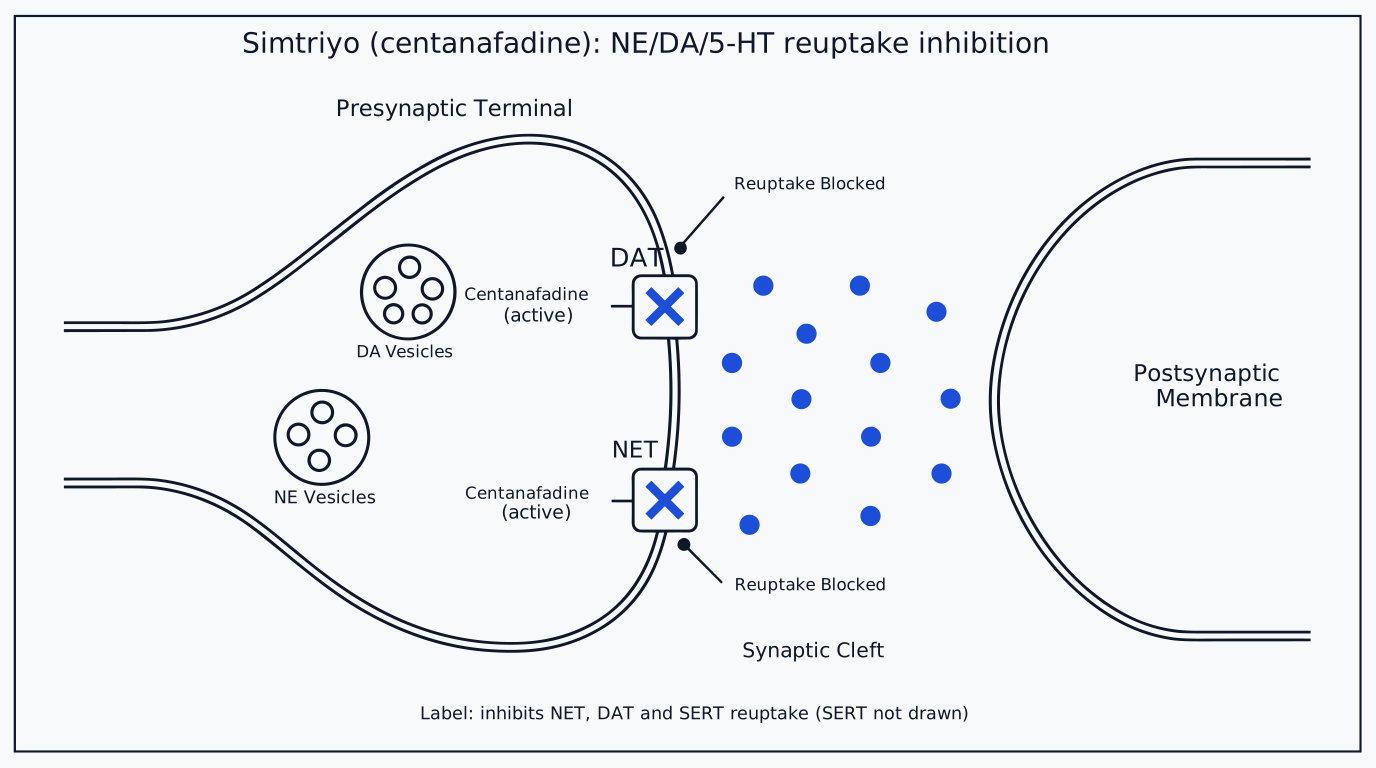
Centanafadine blocks the reuptake of three brain messengers — norepinephrine, dopamine and serotonin — so more of each stays available between nerve cells. Simtriyo does not contain methylphenidate.
Per labeling, centanafadine has inhibitory activity at norepinephrine, dopamine and serotonin reuptake transporters and is a central nervous system stimulant; its mechanism of action in ADHD is unclear, but efficacy could be mediated through norepinephrine-dopamine-serotonin reuptake inhibition. Centanafadine is highly protein bound (fraction unbound <0.01). Serotonin syndrome is possible with other serotonergic drugs.
Formulations and duration
Extended-release capsules taken once in the morning, with or without food. Swallow whole, or open and sprinkle the entire contents over 1 tablespoon (15 mL) of applesauce or yogurt, or into 1 tablespoon of orange juice; take immediately, followed by water. Do not cut, crush or chew.
| STRENGTHS | 140 mg, 210 mg, 280 mg extended-release capsules |
|---|---|
| APPROVED AGES | Adults, and children 6 years and older weighing at least 20 kg |
| DOSING | Once daily in the morning; missed dose may be taken up to 4 hours late |
| CONTROLLED STATUS | Schedule III controlled substance (CIII); DEA interim final rule effective Oct 30, 2026 |
| AVAILABILITY | Now marketable (since Oct 30, 2026); check pharmacy availability |
The 210 mg capsule contains FD&C Yellow No. 5 (tartrazine), which can cause allergic-type reactions, more often in people with aspirin hypersensitivity.
Appearance
Simtriyo capsules (FDA-approved label; bottles of 30). Pharmacy stock not yet confirmed:
- 140 mg — light orange opaque cap / white opaque body, “C140” on cap and “Otsuka” on body (NDC 59148-302-13)
- 210 mg — yellow opaque cap / white opaque body, “C210” / “Otsuka” (NDC 59148-303-13)
- 280 mg — powder blue opaque cap / white opaque body, “C280” / “Otsuka” (NDC 59148-304-13)
Store at room temperature. The label revised 10/2026 marks Simtriyo CIII.
Official package photos and pill identifiers:
Generic manufacturers
There is no generic or authorized generic centanafadine.
| Product | Notes |
|---|---|
| Simtriyo (Otsuka) | NDA 218145, approved Jul 24, 2026; approval effective Oct 30, 2026 (DEA Schedule III rule) |
| Generic or authorized generic centanafadine | None |
Not yet listed in the Orange Book (October 2026 data files); the approval letter states it will be listed on the effective approval date.
Common side effects
Boxed warnings — suicidal ideation and behaviors in pediatric patients 6 years and older, and abuse, misuse and addiction: higher rates of suicidal ideation and behavior occurred in Simtriyo-treated children aged 6–12 than with placebo in a 6-week study; Simtriyo also has potential for abuse and misuse like other CNS stimulants, so risk is assessed before and during treatment.
In trials, the most common side effects were rash and decreased appetite in children 6–12; decreased appetite, nausea, rash, headache and stomach pain in teens; and headache, decreased appetite, trouble sleeping, nausea, dry mouth and diarrhea in adults.
| EFFECT | FREQUENCY | NOTES |
|---|---|---|
| Rash | Common (9% vs 0% placebo, ages 6–12) | A common reason for stopping; report any rash |
| Decreased appetite | Common (15% vs 2%, ages 13–17) | Weight and growth are monitored |
| Nausea | Common (10% vs 3%, ages 13–17) | |
| Headache, trouble sleeping, dry mouth, diarrhea | Common in adults | |
| Higher heart rate or blood pressure | Monitored | Checked before starting, after dose increases and periodically |
| Suicidal thoughts (boxed warning, children) | Uncommon but serious | Watch closely in the first months |
Most common adverse reactions (≥5% and greater than placebo): ages 6–12 — rash, decreased appetite; ages 13–17 — decreased appetite, nausea, rash, headache, abdominal pain; adults — headache, decreased appetite, insomnia, nausea, dry mouth, diarrhea. Discontinuations (≥1%): rash, decreased appetite, nausea, somnolence. Warnings: suicidal ideation and behaviors in pediatric patients (boxed); abuse, misuse and addiction (boxed); serious cardiac disease; blood pressure and heart rate increases; psychiatric reactions (psychosis, mania); hypersensitivity including anaphylaxis and angioedema; long-term growth suppression; peripheral vasculopathy including Raynaud’s; serotonin syndrome; tics/Tourette’s; tartrazine (210 mg). Contraindications: hypersensitivity, MAOIs within 14 days, pheochromocytoma.
Dosing considerations
Adults start at 210 mg once each morning and may go up to 280 mg. Teens 13–17 take 280 mg once daily. Children 6–12 take a dose based on weight.
Label 2.2 (rev. 07/2026): ages 6–12 weighing at least 20 kg are dosed by weight (Table 1): 140 mg for 20 to less than 35 kg, 210 mg for 35 to 50 kg, 280 mg for more than 50 kg, once daily. Per label section 14 (Study 1), the only dosage approved for ages 6–12 is the weight-based dose equivalent to 280 mg; the Table 1 doses (including 210 mg at 35–50 kg) are that 280 mg-equivalent regimen. Ages 13–17 weighing at least 20 kg: 280 mg once daily. The label also states: “The effectiveness of SIMTRIYO 140 mg once daily in patients aged 13 to 17 years and the weight-based equivalent dosage in patients aged 6 to 12 years was not established” and “SIMTRIYO 210 mg once daily and weight-based equivalent dosages have not been studied in pediatric patients aged 6 to 17 years and are not recommended.” These statements refer to the lower dose levels (a fixed 140 mg or 210 mg dose in teens and their weight-based equivalents in younger children), not to the 210 mg capsule listed in Table 1 for 35–50 kg. CYP1A2: centanafadine is a moderate CYP1A2 inhibitor — monitor and consider lowering the dose of CYP1A2 substrates. Alcohol: avoid at the same time as, and for at least 2 hours after, a dose. With other CNS stimulants, monitor cardiovascular effects. Hepatic: not recommended in severe impairment; no adjustment for mild or moderate. MAOI: wait at least 14 days after stopping an MAOI.
| Age / weight | Recommended dose |
|---|---|
| 6–12 years, 20 to <35 kg | 140 mg once daily (weight-based equivalent of 280 mg) |
| 6–12 years, 35–50 kg | 210 mg once daily (weight-based equivalent of 280 mg) |
| 6–12 years, >50 kg | 280 mg once daily |
| 13–17 years (at least 20 kg) | 280 mg once daily |
| Adults | Start 210 mg once daily; may increase to 280 mg (maximum) |
For children 6–12, the three weight-based doses in the table are one dose level adjusted for body weight (the equivalent of the 280 mg dose). The label says lower dose levels were either not shown to work (the 140 mg level) or not studied in children and teens and not recommended (the 210 mg level).
Pregnancy and breastfeeding
Tell your clinician if you are pregnant, plan to become pregnant, or are breastfeeding. There is not enough information from pregnant women to know whether Simtriyo raises the risk of birth defects, miscarriage, or other problems. In animal studies, some effects on the mother and developing baby were seen.
It is not known whether centanafadine passes into breast milk. If you breastfeed, talk with your clinician about the best way to feed your baby.
A national pregnancy registry collects information about ADHD medicines used during pregnancy. You or your clinician can enroll by calling 1-866-961-2388.
Pregnancy (label 8.1): clinical-development data in pregnant women are insufficient to evaluate a drug-associated risk of major birth defects, miscarriage, or other adverse maternal or fetal outcomes. Animal data: in rats, lower maternal and fetal body weight at exposures below human exposure at the MRHD (280 mg) and more fetal skeletal variations at about 4 times that exposure; no embryo-fetal effects in rabbits at any dose; a slight increase in early pup deaths in a rat pre- and postnatal study at exposures below human exposure. Registry: National Pregnancy Registry for ADHD Medications (as named in the label), 1-866-961-2388.
Lactation (label 8.2): no data on centanafadine or its metabolite in human or animal milk, effects on the breastfed infant, or milk production. Weigh the benefits of breastfeeding against the mother’s clinical need for Simtriyo and any potential effects on the child.
Outside the label: LactMed (NCBI Bookshelf, “Centanafadine,” revised Aug 2026; NBK624329) says no clinical information is available; because centanafadine is over 99% protein bound, milk amounts are likely low, and needing it is not a reason to stop breastfeeding, but another drug may be preferred while nursing a newborn or preterm infant. This is LactMed’s summary of published data, not FDA label content.
Availability and shortages
NOW MARKETABLE · CHECK PHARMACY AVAILABILITY The DEA placed centanafadine in Schedule III by an interim final rule published and effective October 30, 2026 (91 FR 68470), so Simtriyo can now be marketed. DailyMed lists a marketing start date of October 24, 2026. No Otsuka launch announcement was found and pharmacy stocking was not confirmed as of November 4, 2026, so check with your pharmacy before filling a prescription.
Otsuka’s Simtriyo GO Savings Program: patients with commercial insurance that covers Simtriyo may pay as little as $20. Commercially insured patients whose plan does not cover Simtriyo may pay as little as $20 for up to four 30-day fills per lifetime, then as little as $115 per 30-day supply. Up to 13 uses per calendar year. Patients whose prescription is covered in whole or in part by a government healthcare program are not eligible. The manufacturer can change these terms (simtriyo.com, accessed Nov 4, 2026).
Sources checked Nov 4, 2026: DEA interim final rule, 91 FR 68470 (FR Doc. 2026-22208; Docket No. DEA-1743), published and effective Oct 30, 2026, comments due Nov 30, 2026 (federalregister.gov); Prescribing Information revised 10/2026, labeled CIII (Otsuka); DailyMed SPL version 1, published Oct 26, 2026, marketing start date Oct 24, 2026 (DailyMed). No Otsuka launch press release was found; pharmacy stocking is unconfirmed. Not in the Orange Book when last checked (Oct 20, 2026). FDA and ASHP shortage lists not checked for Simtriyo (no entries for centanafadine when checked Oct 20, 2026).
How Simtriyo compares to nonstimulant options (and stimulants)
Rows summarize each product’s FDA labeling; they are not head-to-head comparisons. Unlike stimulants, atomoxetine, viloxazine, guanfacine and clonidine are not controlled substances and are taken every day for continuous coverage, with benefit judged over weeks of titration rather than hours after a dose.
| Medication | Class / action (label) | Dosing and time course | Controlled status / boxed warning | Key safety and practical notes |
|---|---|---|---|---|
| Simtriyo (centanafadine ER capsule) | Norepinephrine-dopamine-serotonin reuptake inhibitor; labeled a CNS stimulant | Once daily in the morning; fixed weight-/age-based doses; trials 6 weeks | Schedule III (CIII) · Boxed warnings: pediatric suicidality; abuse/misuse | Approved Jul 24, 2026; DEA Schedule III since Oct 30, 2026; now marketable (check pharmacy availability). Moderate CYP1A2 inhibitor. Ages 6+ and ≥20 kg. |
| Atomoxetine (Strattera; generics; Atoncy solution) | Selective norepinephrine reuptake inhibitor | Once daily or split twice daily; titrate after ≥3 days; acute trials up to 18 weeks | Not controlled · Boxed warning: suicidal thoughts (ages 6+) | CYP2D6 poor metabolizers/strong 2D6 inhibitors: 4-week titration interval; label states start, target and maximum unchanged. Liver injury warning. Brand discontinued; AB generics. |
| Qelbree (viloxazine ER capsule) | Selective norepinephrine reuptake inhibitor (also 5-HT2C partial agonist) | Once daily; weekly titration; steady state in 2 days; trials 6–8 weeks | Not controlled · Boxed warning: suicidal thoughts (all ages) | Strong CYP1A2 inhibitor: contraindicated with sensitive/narrow-range CYP1A2 substrates. Sprinkle allowed. Brand only. |
| Intuniv (guanfacine ER tablet) | Central α2A-adrenergic agonist | Once daily (AM or PM); +1 mg/week max; trials up to 15 weeks | Not controlled · No boxed warning | Rebound hypertension if stopped abruptly (taper ≤1 mg every 3–7 days). CYP3A4 dose adjustments. Ages 6–17 studied. AB generics. |
| Clonidine ER tablets (Kapvay discontinued) | Centrally acting α2-adrenergic agonist | Twice daily (equal or larger bedtime dose); +0.1 mg/week; max 0.4 mg/day | Not controlled · No boxed warning | Rebound hypertension if stopped abruptly (taper ≤0.1 mg every 3–7 days). Ages 6–17. Kapvay brand discontinued; AB1 generics. |
| Onyda XR (clonidine ER oral suspension) | Centrally acting α2-adrenergic agonist | Once daily at bedtime; +0.1 mg/week; max 0.4 mg | Not controlled · No boxed warning | Rebound hypertension if stopped abruptly (taper ≤0.1 mg every 3–7 days). Liquid 0.1 mg/mL; not mg-for-mg with other clonidine. Ages 6+. |
| Stimulants for contrast (e.g. Concerta, Vyvanse) | Methylphenidate or amphetamine: block (and for amphetamines, release) dopamine and norepinephrine | Effects begin within hours of each dose and wear off the same day (timing depends on formulation; see each label) | Schedule II · Boxed warning: abuse, misuse and addiction | Coverage is tied to dosing time each day, unlike the continuous steady-state coverage of atomoxetine, viloxazine and the alpha-2 agonists. |
Other nonstimulant and newer-mechanism pages: Strattera (atomoxetine), Atoncy (atomoxetine solution), Qelbree, Intuniv, Kapvay (clonidine ER), Onyda XR. Stimulant overviews: methylphenidate (Ritalin) and amphetamine (Adderall) family pages.
Clinical evidence from published studies
These findings come from published research, not from the FDA label. The FDA label is the official source for approved uses, doses and warnings. Results from studies may not apply to you. Uses marked off-label are not FDA-approved. Talk with your prescriber before making any change.
Items summarize peer-reviewed publications, checked against the PubMed abstract (or full text where stated); figures are reproduced only where the source states them. The FDA label governs approved indications and dosing. Off-label items are not FDA-approved uses. Industry funding or sponsor affiliation is noted where the PubMed record shows it; absence of a note does not mean no industry involvement.
Studies of this medicine (7 studies)
-
Simtriyo (centanafadine), adolescents 13–17
In 459 adolescents aged 13–17, the higher centanafadine dose (328.8 mg) reduced ADHD symptoms more than placebo, with separation from week 1. The lower dose (164.4 mg) did not meet the main goal. Side effects were more common at the higher dose (50% vs 24% on placebo), most often decreased appetite, nausea, headache and rash.
Phase 3 RCT: 459 randomized (164.4 mg n=155; 328.8 mg n=155; placebo n=149); 371 (80.8%) completed. Week 6 ADHD-RS-5: 328.8 mg −18.50 vs −14.15 (p=.0006); 164.4 mg did not meet the primary endpoint. TEAEs 31.4% / 50.3% / 23.8%.
Funding / affiliation: Otsuka-affiliated authors per PubMed record.
Ward CL, Childress AC, Jin N, et al. (2026). Centanafadine for Attention-Deficit/Hyperactivity Disorder in Adolescents: A Randomized Clinical Trial. J Am Acad Child Adolesc Psychiatry 65(6):805-817. DOI · PubMed 40619095
-
Simtriyo (centanafadine), children and adolescents
A secondary analysis of the two pediatric trials (children 6–12 and teens 13–17) reported improvement in inattention and hyperactivity from week 1 at the higher dose. The lower dose did not meet the trials’ main goal, and these secondary results were not adjusted for multiple testing, so they should be read as supportive only.
Secondary analysis of NCT05428033 (6–12 y) and NCT05257265 (13–17 y), high dose vs placebo: Conners 3 inattention separation from week 1; clinically meaningful within-patient change 55% (children) and 65% (adolescents) higher chance for inattention; 48% and 46% for hyperactivity/impulsivity. Low dose excluded (did not meet primary endpoint); p-values not multiplicity-controlled. Primary children’s-trial publication not found in PubMed at time of review.
Funding / affiliation: Otsuka-affiliated authors per PubMed record.
Ward CL, Oberdhan D, Jin N, et al. (2026). Clinically Meaningful Within-Patient Change in Core Attention-Deficit/Hyperactivity Disorder Symptoms in Children and Adolescents Treated With Centanafadine: Results From Two Phase 3 Randomized Clinical Trials. J Atten Disord 10870547261483444. DOI · PubMed 42779129
-
Centanafadine across ages (children, teens, adults)
A 2026 systematic review of four placebo-controlled trials (1,845 people) found the higher centanafadine dose improved ADHD symptoms in children and teens, while the lower pediatric dose did not clearly help. Both adult doses helped. The authors noted there are no head-to-head trials against other ADHD medicines and little independently funded research.
Narrative systematic review (no pooling), 4 RCTs / 3 publications, n=1,845 randomized. Children: high dose ADHD-RS-5 −16.3 vs −10.8 (p<0.001); low dose MD −2.7 (95% CI −6.0 to 0.5; p=0.10). Adolescents: 328.8 mg −18.5 vs −14.2 (p=0.0006; d −0.40); 164.4 mg p=0.3016. Adults: LSMD −2.74 to −4.42 (p≤0.039). TEAEs 25–39% children, 23.8–50.3% adolescents, 17.6–31.8% adults. Secondary source; the children’s trial (NCT05428033) primary paper was not found in PubMed — the children’s figures match FDA label Table 6 (−16.3 vs −10.8; difference −5.6).
Gul D, Khan S, Baral K, et al. (2026). Dose-dependent efficacy and safety of centanafadine in patients with attention-deficit/hyperactivity disorder: A systematic review of the latest evidence. PCN Rep 5(4):e70428. DOI · PubMed 42877260
-
Centanafadine in adults (sustained-release tablets, not Simtriyo)
Two 6-week adult trials (446 and 430 adults) found centanafadine reduced ADHD symptoms more than placebo, but the effects were small (effect sizes 0.24 to 0.40). These trials used a different centanafadine formulation (sustained-release tablets, 200 or 400 mg/day), not Simtriyo.
Two phase 3 RCTs. Study 1: 200 mg n=149, 400 mg n=149, placebo n=148; study 2: n=145/143/142. AISRS LSMD at day 42: −3.16 (P=0.019) and −2.74 (P=0.039); −4.01 (P=0.002) and −4.47 (P=0.001). ES −0.28/−0.24 and −0.37/−0.40. TEAEs increased slightly with dose.
Funding / affiliation: Otsuka-affiliated authors per PubMed record.
Adler LA, Adams J, Madera-McDonough J, et al. (2022). Efficacy, Safety, and Tolerability of Centanafadine Sustained-Release Tablets in Adults With Attention-Deficit/Hyperactivity Disorder: Results of 2 Phase 3, Randomized, Double-blind, Multicenter, Placebo-Controlled Trials. J Clin Psychopharmacol 42(5):429-439. DOI · PubMed 35652746
-
Centanafadine in adults: early (phase 2) studies, sustained-release tablets, not Simtriyo
Two small early studies in adults used an older sustained-release tablet form of centanafadine. In the controlled crossover study (85 adults), symptoms improved more on centanafadine than on placebo, with a difference seen by week 1. Doses up to 400 mg a day were generally well tolerated; at higher doses more people stopped because of side effects.
Phase 2a: single-blind, flexible dose, 41 men, ADHD-RS-IV fell 21.41 (SD 10.74) over 4 weeks (no placebo). Phase 2b: randomized double-blind placebo-controlled crossover, 85 adults, 400–800 mg/d; LS mean −16.5 vs −8.4 (P<0.001), effect size 0.66, separation from week 1. 13 of 120 stopped for TEAEs, only 1 at ≤400 mg; no serious TEAEs. Formulation differs from Simtriyo ER capsules.
Funding / affiliation: Neurovance/Otsuka involvement disclosed in the PubMed record.
Wigal SB, Wigal T, Hobart M, et al. (2020). Safety and Efficacy of Centanafadine Sustained-Release in Adults With Attention-Deficit Hyperactivity Disorder: Results of Phase 2 Studies. Neuropsychiatr Dis Treat 16:1411-1426. DOI · PubMed 32606695
-
Centanafadine vs placebo (pooled trials)
A 2026 meta-analysis of five placebo-controlled trials (1,968 people) found centanafadine reduced ADHD symptoms more than placebo, with a small-to-moderate effect. Side effects were somewhat more common than on placebo, but the difference was not statistically clear. The paper calls centanafadine a nonstimulant; the FDA label classifies it as a CNS stimulant.
Random-effects MA (REML, Hartung-Knapp). Symptoms: 5 RCTs, n=1,968, Hedges g −0.37 (95% CI −0.68 to −0.05; p=0.032). CGI-S: 4 RCTs, n=1,683, MD −0.26 (−0.31 to −0.21). Any AE: 6 RCTs, n=2,287, RR 1.29 (0.97–1.71). Pools adult SR-tablet and pediatric ER-capsule trials. Note: authors describe it as a nonstimulant; FDA labeling (2026) states it is a CNS stimulant.
Muneer MA, Naveed M, Amjad M, et al. (2026). Efficacy and Safety of Centanafadine in Attention-Deficit/Hyperactivity Disorder: A Systematic Review and Meta-Analysis of Randomized Controlled Trials. Psychopharmacol Bull 56(3):47-65. DOI · PubMed 42267239
-
Centanafadine long-term in adults (sustained-release formulation, not Simtriyo)
In a 52-week open-label adult study (662 enrolled) using the earlier sustained-release formulation, 12% stopped because of side effects. About half completed the year.
52-week open-label, CTN SR 400 mg: 662 enrolled, 653 dosed, 345 completed. ≥1 TEAE 61.4%; insomnia 8.0%, nausea 7.7%. 80 (12.3%) discontinued for TEAEs. Uncontrolled.
Funding / affiliation: Otsuka-affiliated authors per PubMed record.
Mattingly GW, Turkoglu O, Chang D, et al. (2025). 52-Week Open-Label Safety and Tolerability Study of Centanafadine Sustained Release in Adults With Attention-Deficit/Hyperactivity Disorder. J Clin Psychopharmacol 45(5):454-462. DOI · PubMed 40600581
How ADHD medicines compare (4 studies)
-
Centanafadine vs Vyvanse, Strattera and Qelbree in adults (short term, indirect)
No trial has compared centanafadine directly with other ADHD medicines. This manufacturer-funded statistical comparison of separate 6-week adult trials suggested centanafadine had fewer of several common side effects than lisdexamfetamine (Vyvanse), atomoxetine (Strattera) or viloxazine (Qelbree). It also had a smaller effect on symptoms than lisdexamfetamine and no clear difference from atomoxetine or viloxazine. Indirect comparisons like this are much weaker than head-to-head trials.
Anchored MAIC: patient-level data from NCT03605680/NCT03605836 (SR tablets) vs published aggregate data. vs LDX: lower risk of decreased appetite (RD 23.42 pp), dry mouth (19.27), insomnia (15.35) and others, but 6.58-point smaller symptom reduction (ADHD-RS used as proxy for AISRS). vs ATX: lower nausea (18.64), dry mouth (17.44), fatigue (9.21); efficacy NS. vs viloxazine ER: lower fatigue (11.07), insomnia (10.67), nausea (7.57); efficacy NS.
Funding / affiliation: Otsuka employee author; Analysis Group paid by Otsuka (per PubMed record).
Schein J, Cloutier M, Gauthier-Loiselle M, et al. (2024). Assessment of centanafadine in adults with attention-deficit/hyperactivity disorder: A matching-adjusted indirect comparison vs lisdexamfetamine dimesylate, atomoxetine hydrochloride, and viloxazine extended-release. J Manag Care Spec Pharm 30(6):528-540. DOI · PubMed 38824626
-
Centanafadine vs Vyvanse, methylphenidate and Strattera in adults (up to 52 weeks, indirect)
A manufacturer-funded indirect comparison of separate long-term (up to 52 weeks) adult studies suggested centanafadine had lower rates of several side effects than lisdexamfetamine, methylphenidate or atomoxetine. Symptom improvement was smaller than with lisdexamfetamine and not clearly different from methylphenidate or atomoxetine. This is not a head-to-head trial.
MAIC: patient-level data from the 52-week open-label centanafadine SR study (NCT03605849) vs published aggregate data (LDX NCT00337285, MPH NCT00326300, ATX NCT00190736). Efficacy: 6.15-point smaller reduction vs LDX (p<0.05); vs MPH 1.75 points (p=0.13); vs ATX 1.60 (p=0.21). Largest AE differences e.g. nausea 26.18 pp and dry mouth 25.07 vs ATX; decreased appetite 20.25 vs MPH.
Funding / affiliation: Otsuka employee author; Analysis Group authors (per PubMed record).
Schein J, Cloutier M, Gauthier-Loiselle M, et al. (2024). A matching-adjusted indirect comparison of centanafadine versus lisdexamfetamine, methylphenidate and atomoxetine in adults with attention-deficit/hyperactivity disorder: long-term safety and efficacy. J Comp Eff Res 13(9):e240089. DOI · PubMed 39132746
-
Centanafadine vs Concerta in adults (indirect)
A manufacturer-funded indirect comparison suggested centanafadine had fewer side effects such as dry mouth and trouble falling asleep than Concerta, but a smaller effect on symptoms. When the analysis was rerun with extreme values capped, the difference in symptom effect was no longer significant.
MAIC vs methylphenidate HCl ER (Concerta) trial. Lower risk: dry mouth (RD −11.95 pp), initial insomnia (−11.10), decreased appetite (−8.05), anxiety (−5.39), palpitations (−5.25), jittery (−4.73). AISRS reduction 4.16 points smaller; no significant efficacy difference in the sensitivity analysis.
Funding / affiliation: Otsuka employee author (per PubMed record).
Schein J, Cloutier M, Gauthier-Loiselle M, et al. (2024). Assessment of centanafadine in adults with ADHD: a matching adjusted indirect comparison versus methylphenidate hydrochloride extended release (Concerta). Curr Med Res Opin 40(8):1397-1406. DOI · PubMed 38958732
-
Centanafadine vs Foquest (methylphenidate ER) in adults (indirect)
A manufacturer-funded indirect comparison with a Canadian long-acting methylphenidate (Foquest) found no significant difference in symptom improvement at week 4 and less insomnia with centanafadine. This is not a head-to-head trial.
Anchored MAIC: centanafadine SR trials (NCT03605680, NCT03605836) vs Foquest trial NCT02139124. Insomnia RD −9.46 pp, initial insomnia −4.68; no significant difference in AISRS/ADHD-RS-5 change at week 4.
Funding / affiliation: Otsuka employee author (per PubMed record).
Schein J, Catillon M, Xu C, et al. (2025). A Matching-Adjusted Indirect Comparison (MAIC) of Centanafadine versus Methylphenidate Hydrochloride in Adults with Attention-Deficit/Hyperactivity Disorder (ADHD): Short-Term Safety and Efficacy Outcomes: Comparaison indirecte ajustée par appariement (MAIC) entre centanafadine et le chlorhydrate de méthylphénidate chez les adultes atteints d'un trouble déficitaire de l'attention avec ou sans hyperactivité (TDAH) : Résultats en matière d'innocuité et d'efficacité à court terme. Can J Psychiatry 70(8):629-638. DOI · PubMed 40452389
Heart and blood pressure (1 study)
-
Centanafadine and the heart’s QT interval
In a study of 30 healthy adults given a higher-than-usual dose of the older sustained-release form (800 mg a day), centanafadine did not meaningfully affect the QT interval on the ECG, a measure of heart rhythm safety. This study was not designed to look at blood pressure or pulse effects seen in ADHD trials.
Thorough QT crossover (placebo- and moxifloxacin-controlled), 30 healthy adults; centanafadine SR 800 mg total daily dose (supratherapeutic). C-QTc slopes NS; no ΔΔQTcF ≥10 ms; predicted ΔΔQTcF at geometric mean Cmax −2.72 ms (moxifloxacin 11.75). Sponsor-employed authors.
Funding / affiliation: Otsuka employee authors (per PubMed record).
Turkoglu OS, Wang X, Repella-Gordon J, et al. (2025). A Randomized Thorough QT Trial Using Concentration-QT Analysis to Evaluate the Effects of Centanafadine on Cardiac Repolarization. Clin Pharmacol Drug Dev 14(8):621-630. DOI · PubMed 40424304
Frequently asked questions
Is Simtriyo FDA-approved?
Yes. The FDA approved it on July 24, 2026 for ADHD in adults and in children 6 and older weighing at least 20 kg. Under federal law the approval took effect when the DEA published its scheduling rule, on October 30, 2026.
Can I get Simtriyo now?
It can now be marketed: the DEA rule placing it in Schedule III took effect on October 30, 2026, and DailyMed lists a marketing start date of October 24, 2026. Pharmacy stocking had not been confirmed as of November 4, 2026, so check pharmacy availability. Otsuka’s Simtriyo GO Savings Program may lower the cost for commercially insured patients (see Availability and shortages).
Is Simtriyo a stimulant?
Its label classifies it as a CNS stimulant and a norepinephrine-dopamine-serotonin reuptake inhibitor, with a boxed warning for abuse, misuse and addiction. It does not contain methylphenidate or amphetamine.
Is there a generic version of Simtriyo?
No. There is no generic or authorized generic centanafadine.
Is Simtriyo a controlled substance?
Yes. The DEA placed centanafadine in Schedule III (CIII) by an interim final rule published and effective October 30, 2026 (91 FR 68470); public comments are due November 30, 2026. The label revised 10/2026 marks Simtriyo CIII.
What are the boxed warnings?
Higher rates of suicidal thoughts and behavior occurred in children 6–12 taking Simtriyo than placebo, and like other CNS stimulants it can be abused or misused.
What dose is used?
Adults start at 210 mg each morning and may increase to 280 mg. Teens 13–17 take 280 mg. Children 6–12 take 140 mg (20 to under 35 kg), 210 mg (35–50 kg) or 280 mg (over 50 kg); each is the weight-adjusted equivalent of the 280 mg dose.
Can the capsule be opened?
Yes. The contents can be sprinkled on a tablespoon of applesauce or yogurt, or into a tablespoon of orange juice, and taken right away followed by water. Do not chew.
What should be avoided with Simtriyo?
MAOIs (within 14 days), alcohol at the time of a dose and for at least 2 hours after, and caution with medicines broken down by CYP1A2 or with other stimulants. Review all medicines with your prescriber.
How long does Simtriyo take to work?
The label does not give an onset time. In the clinical trials, benefit was measured after 6 weeks of daily treatment.
Does Simtriyo work all day?
Simtriyo is taken once each morning at about the same time (label section 2.3). The label does not describe when effects start or stop during the day; blood levels reach steady state by day 2 and peak about 5 hours after each dose (label section 12.3), and efficacy was measured after 6 weeks of daily treatment (label section 14).
Can Simtriyo be taken with food?
Yes. Take it in the morning with or without food (label section 2.3). A high-fat meal raised the peak level by about 29% and delayed it by 1.5 hours but did not change total exposure (label section 12.3).
Simtriyo vs Qelbree — what’s the difference?
Both are once-daily capsules that can be opened and sprinkled. Simtriyo (centanafadine) blocks reuptake of norepinephrine, dopamine and serotonin and is labeled as a CNS stimulant, with boxed warnings for suicidal thoughts in children and for abuse and misuse; it was approved in July 2026 and placed in DEA Schedule III on October 30, 2026. Qelbree (viloxazine) is a non-controlled selective norepinephrine reuptake inhibitor with a boxed warning about suicidal thoughts. See the Qelbree page and the comparison table above.
What should I do if I miss a dose of Simtriyo?
Take the missed dose as soon as you remember, but no later than 4 hours after your usual dosing time, and do not take more than one dose in the same day (label section 2.5).
What are the most common side effects of Simtriyo?
In children 6 to 12, the Medication Guide lists rash and decreased appetite. In teens 13 to 17, it lists decreased appetite, headache, nausea, stomach pain and rash. In adults, it lists headache, nausea, decreased appetite, dry mouth, trouble sleeping and diarrhea (label section 6.1). These are not all the possible side effects; call your prescriber for advice about side effects that bother you.
Can I take Simtriyo while pregnant or breastfeeding?
Tell your clinician if you are pregnant or planning a pregnancy. The label says there is not enough information from pregnant women to know the risk, and some effects were seen in animal studies. It is not known whether centanafadine passes into breast milk. A pregnancy registry for ADHD medicines can be reached at 1-866-961-2388.
Prescribing guidelines
Guidelines generally place stimulants first for most school-age children, adolescents and adults when medication is indicated, with atomoxetine, extended-release guanfacine and extended-release clonidine as evidence-based alternatives or (for the alpha-2 agonists) add-on options. Viloxazine and centanafadine were approved after the 2019 AAP guideline, so it does not address them.
Resources
Sources
- Otsuka Pharmaceutical Co., Ltd. Simtriyo (centanafadine) extended-release capsules, for oral use, CIII. Prescribing Information, revised 10/2026, accessed Nov 4, 2026. Otsuka.
- Otsuka Pharmaceutical Co., Ltd. Simtriyo (centanafadine) extended-release capsules, controlled substance schedule pending. Prescribing Information (original approved label, superseded), revised 07/2026. Drugs@FDA (accessed Oct 2026).
- U.S. Food and Drug Administration. NDA 218145 approval letter, Simtriyo (centanafadine) extended-release capsules, July 24, 2026. FDA.
- U.S. Food and Drug Administration. Novel Drug Approvals for 2026 (No. 29, Simtriyo, Jul 24, 2026), accessed Oct 20, 2026. FDA.
- Office of Information and Regulatory Affairs. EO 12866 Regulatory Review: Schedules of Controlled Substances: Placement of Centanafadine in Schedule III (RIN 1117-ZA11; interim final rule; received Oct 14, 2026; review concluded Oct 22, 2026, consistent with change; not yet published), accessed Oct 28, 2026. reginfo.gov.
- Drug Enforcement Administration. Schedules of Controlled Substances: Placement of Centanafadine in Schedule III. Interim final rule; request for comments. 91 FR 68470 (FR Doc. 2026-22208; Docket No. DEA-1743); published and effective Oct 30, 2026; comments due Nov 30, 2026. federalregister.gov.
- Otsuka America Pharmaceutical, Inc. Simtriyo GO Savings Program, terms and conditions, accessed Nov 4, 2026. simtriyo.com.
- U.S. National Library of Medicine. DailyMed: SIMTRIYO (centanafadine) capsule, extended release, Otsuka America Pharmaceutical, Inc.; SPL version 1, published Oct 26, 2026 (marketing start date Oct 24, 2026), accessed Nov 4, 2026. DailyMed.
- U.S. Food and Drug Administration. Approved Drug Products with Therapeutic Equivalence Evaluations (Orange Book), data files dated October 2026. FDA.
- U.S. Food and Drug Administration. Drug Shortages database, accessed Oct 20, 2026 (no current-shortage entries for atomoxetine, viloxazine, guanfacine, clonidine or centanafadine; guanfacine ER tablets appear only on the discontinuation list). FDA.
- American Society of Health-System Pharmacists. Current Drug Shortage Bulletins list, accessed Oct 20, 2026 (no atomoxetine, viloxazine, guanfacine, clonidine or centanafadine entries). ASHP.
- Wolraich ML, Hagan JF Jr, Allan C, et al.; American Academy of Pediatrics Subcommittee on Children and Adolescents with ADHD. Clinical Practice Guideline for the Diagnosis, Evaluation, and Treatment of Attention-Deficit/Hyperactivity Disorder in Children and Adolescents. Pediatrics. 2019;144(4):e20192528. AAP.
- Centers for Disease Control and Prevention. Clinical Care of ADHD in Children (summary of the AAP guideline; updated Oct 21, 2026). CDC (accessed 2026).
- Drugs and Lactation Database (LactMed). Centanafadine. National Institute of Child Health and Human Development; revised Aug 2026. NCBI Bookshelf NBK624329.